INTRODUCTION
Traditionally, physical examinations have been performed in-person and employed several techniques to assess physical function including objective measurements of joint and limb range of motion (ROM).1–5Virtual healthcare visits have steadily grown in popularity and functionality, and can readily include physical examinations where range of motion is measured. Virtual healthcare may be the preferred option due to living in a remote or rural area with less access to healthcare, or it may be selected out of convenience by the patient despite their physical location.6–9 Regardless of the reason for choosing virtual healthcare, knowing that the aspects of the physical examination that include objective measurements are accurate and reliable is vital to both clinician and patient.
Previous research evaluating upper extremity joint and limb motions for flexion and extension of the shoulder, elbow, and wrist reported good to excellent inter-rater and intra-rater reliability when comparing in-person and virtual measures.10 The comparison technique used a simple image capture of each motion and was subsequently measured with a goniometer. The motions listed are described as being uniplanar (in the sagittal plane) without any rotational component; however, many motions in the body required for activities of daily living and beyond include rotation, especially when assessing the glenohumeral joint and forearm.
Measuring shoulder rotation presents a challenge in a virtual setting because the screen is two-dimensional, and the motion occurs in three-dimensions. Measuring internal rotation (IR) using the hand-behind-back (HBB) method is popular because this motion mimics several activities of daily living. Various techniques for measuring IR using the HBB method have been reported as having fair to excellent reliability (intraclass correlation coefficient (ICC range: 0.58-0.92) .11–13 These techniques have ranged from linear measurements between anatomical landmarks to the obtainment of joint angles at terminal motion. The non-joint angle-based studies suggested using either ratios involving vertebral landmarks and trunk length, or clothing and/or body landmarks to quantify IR ROM.11,12 While reported as being reliable, these linear measurements are dependent upon accurate palpation to identify the landmarks needed for recording motion. Conversely, Sraj et al. proposed a HBB method using a goniometer which is likely more conducive to measuring IR ROM virtually.13 While Sraj et al. did not identify an expected measurement for normal IR, their measurements ranged from 50° to 125° with a mean of 95°.13
Forearm pronation and supination, also performed in the transverse plane, are important to one’s activities of daily living. Forearm pronation and supination is often measured with the patient’s elbow flexed to 90° and held closely against the body. The patient grips an implement, such as a pencil or small dowel rod, and rotates into pronation or supination.14 One arm of the goniometer aligns with the implement to provide a point of reference for the rotational measurement. This method has been reported as having excellent reliability (ICC ≥0.75).15,16
As the functional need for rotation of the shoulder and forearm is essential, it is important to determine if rotation can be captured consistently both in-person and virtually. Therefore, the purpose of this study was to evaluate the reliability (inter-rater and intra-rater test/re-test) of goniometric measurements of shoulder internal rotation and forearm pronation/supination obtained in-person and virtually. It was hypothesized that test/retest inter-rater and intra-rater reliability for both in-person and virtual measurements would reach an acceptable level of reliability defined as an intraclass correlation coefficient ≥0.60.
METHODS
Subjects
A publicly recruited sample of subjects using word of mouth were invited to participate in this study. Inclusion criteria included: age between 18-60 years; can actively internally rotate the shoulder and place the hand behind the back; actively flex the elbow joint and move the forearm into pronation and supination from a starting position of neutral (0°). Subjects were excluded if age was <18 years and >60 years of age, could not move the shoulder, elbow, and wrist as noted in the inclusion criteria, had a Disabilities of the Arm, Shoulder, and Hand (DASH)17 disability score ≥40%,18 or had neurological compromise that would prevent joint/limb motion from occurring.
Procedures
This study was approved by the Institutional Review Board. After reading and signing the informed consent packet, demographic information including age, sex, height, weight, and arm dominance were obtained. Following completion of the demographic obtainment, subjects completed the DASH.17
The right arm of each subject was utilized for all measurements. Each subject was tested in a standing position facing away from the examiners for shoulder IR and facing towards the examiners for forearm pronation/supination. This was necessary for both the in-person and virtual assessments to clearly visualize the anatomical landmarks for goniometer placement (Table 1). Following similar methodology from a previous study,10 prior to performing the in-person goniometric measurements for each joint, an image was captured of the end range of each position using a mobile device with a camera (iPad Air 2, Apple, Inc, Cupertino, CA). This still shot image represented an image that could be captured via screenshot on a virtual platform during a telemedicine visit.
After the images were captured, subjects returned to a rest position prior to performing the motions again for the in-person measurements. Testing positions for the images and goniometric measurements are described below. After the virtual images were captured, serial in-person measurements were obtained by each of three clinician research team members (two certified athletic trainers and one occupational therapist all with a minimum of 10 years of clinical experience). Subjects were asked to actively move the arm into the testing position (shoulder IR, forearm pronation, and forearm supination) and hold the position while each clinician took a turn measuring the specific joint angle. This process continued until all team members performed all measurements twice in the same session. To reduce the potential for recording bias by the clinician performing the measurements, the goniometer dial was covered with paper so the clinician obtaining the measurement was blinded to the measurement. A second clinician read and recorded the range of motion to the nearest degree mark. Approximately one week (7-10 days) after the in-person measurements were completed, each team member analyzed the images in duplicate using the same goniometric techniques. The same process for recording measurements was used for the virtual measures as was used in the in-person measures. The average of the two trials was calculated for both in-person and virtual sessions.
Internal Rotation
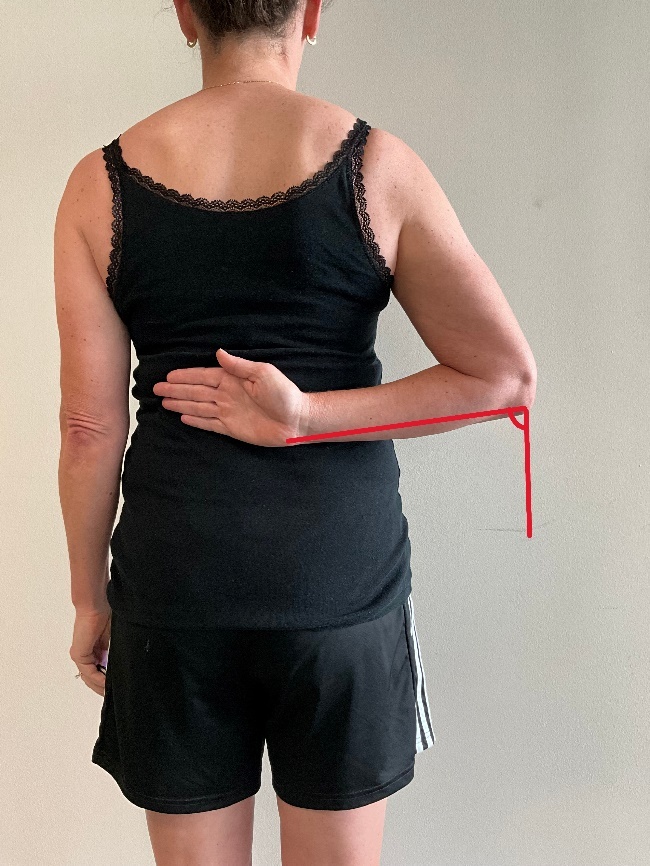
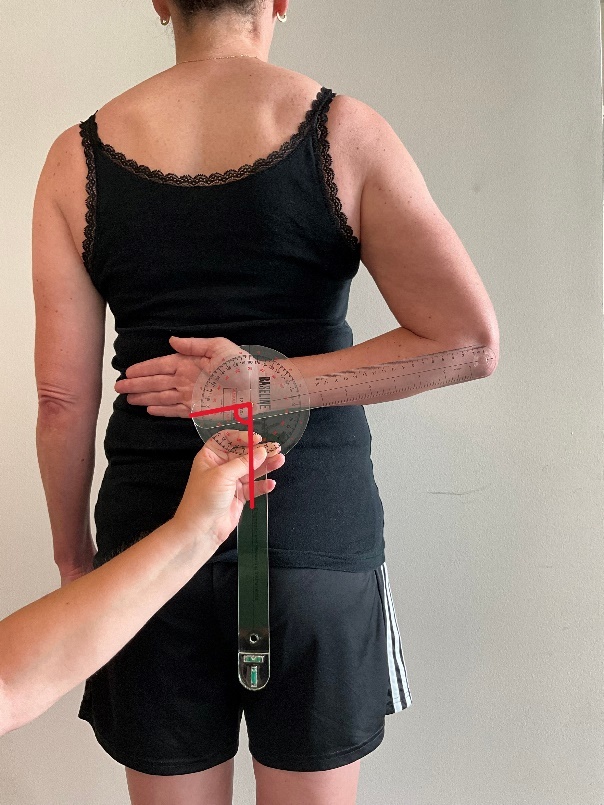
Shoulder IR was measured using the HBB angle (Figure 1) as described by Sraj et al.13 and is defined as the angle between the long axis of the forearm and the line of gravity, or vertical line perpendicular to the floor as observed through a bubble level on the stationary arm of the goniometer. The 0-angle is defined as the forearm being completely vertical (elbow extended) and pointing inferiorly (Figure 2). The testing position for shoulder IR measurement occurred as follows: the subject was asked to place their hand behind their back and reach up the back to the highest point without altering erect trunk position while keeping the wrist in a neutral position (no radial deviation or thumb extension). The axis of the goniometer was placed on the pisiform bone with the moveable arm along the ulna. The stationary arm with the bubble level was placed perpendicular to the floor.


Forearm Pronation and Supination
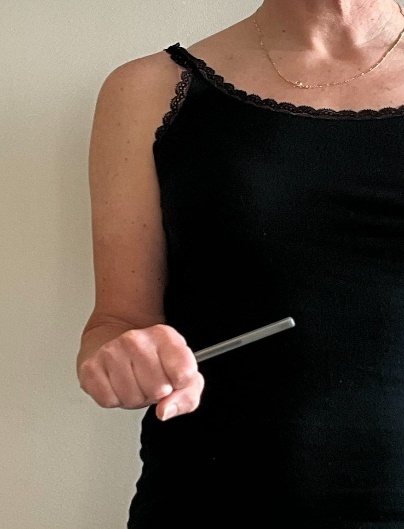
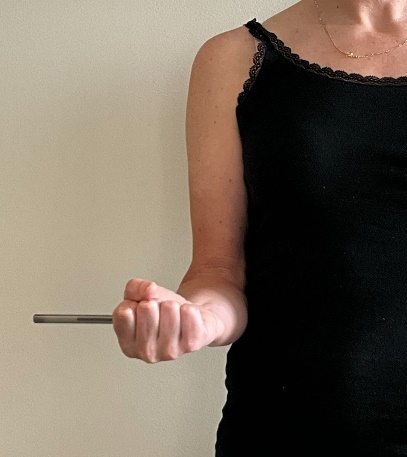
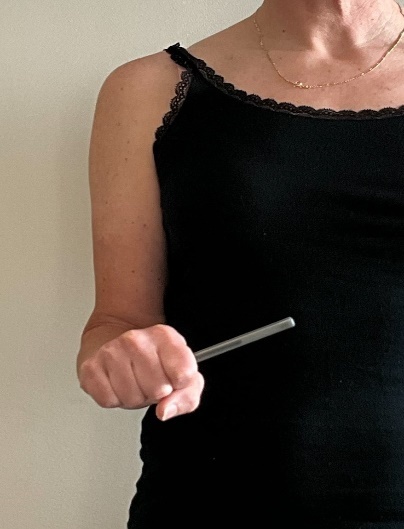
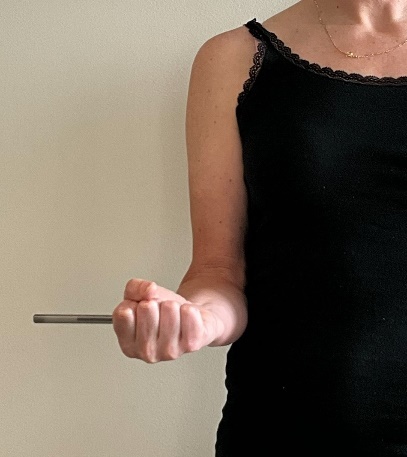
For pronation and supination, subjects were instructed to stand with their shoulder adducted to the body, with the elbow flexed to a 90° angle and were given a pencil to grip. For pronation, each subject was asked to rotate the volar side of the hand to the floor as far as possible (Figure 3). For supination, each subject was instructed to rotate the volar side of their hand towards the ceiling as far as possible (Figure 4). During these motions, subjects were cued to keep the humerus close to the torso and to maintain an upright posture. The axis of the goniometer was placed in the center of the 3rd proximal phalanx with the stable arm perpendicular to the floor and the moving arm parallel to the pencil.
Statistical Analysis
Summary statistics for demographic items were calculated and reported as means and standard deviations for continuous variables and frequencies with percentages for categorical variables. The distribution of data for each variable was assessed for normality using the Shapiro-Wilk test. Using a two-way random with absolute agreement design for inter-tester (2, k) and intra-tester (2,1) test/re-test reliability, intraclass correlation coefficients (ICC) were calculated for both in-person and virtual testing sessions. An ICC greater than 0.75 was interpreted as excellent, 0.74-0.60 was good, 0.59-0.40 was fair, and <0.40 was considered poor.19 Once the ICCs were determined, standard error of measurement (SEM), an estimate of how repeated measures of a person using the same device tend to be distributed around his or her “true” measurement, and minimal detectable change, the smallest change in a measurement that is greater than the random error associated with the measurement device itself, at the 90% (MDC90) and 95% (MDC95) confidence level were calculated. An ICC greater than 0.75 was interpreted as excellent, 0.74-0.60 was good, 0.59-0.40 was fair, and <0.40 was considered poor.19 Finally, a between session comparison of measurement values was conducted using paired t-tests or Wilcoxon sign rank tests (based on normality results) for the overall comparisons (in-person versus virtual) and one-way analyses of variance with Bonferroni correction for between examiner comparisons.
Using previously established criteria for sample size estimation, it was determined that 20 subjects would be needed to achieve a minimum intraclass correlation coefficient of 0.60 at an alpha level of 0.05 and beta level of 0.90.20
RESULTS
Twenty subjects (Age: 26.2±9.6years; height: 174.5±9.3centimeters; weight: 81.3±14.4kilograms; DASH: 4.8±5.9%; Sex: 50% female) participated in the study. The inter-rater reliability for all in-person and virtual measurements were classified as excellent (ICC≥0.94). SEM values for measuring all three motions ranged from 1.5-1.8° for in-person measurements and 0.8-1.1° for virtual measurements. In-person MDC values for measuring all three motions ranged from 3.4-4.1 (MDC90) and 4.0-4.8 (MDC95) while virtual MDC values ranged from 1.9-2.6 (MDC90) and 2.2-3.1 (MDC95). The intra-rater reliability for all in-person and virtual measurements for each examiner was classified as excellent (ICC≥0.91) (Table 2).
SEM values for measuring all three motions ranged from 1.1-2.4° for in-person measurements and 0.0-2.6° for virtual measurements. In-person MDC values for measuring all three motions ranged from 2.5-5.5 (MDC90) and 2.9-6.5 (MDC95) while virtual MDC values ranged from 0.0-6.1 (MDC90) and 0.0-7.2 (MDC95) (Table 3).
There was a statistically significant difference between in-person and virtual internal rotation (77.5±9.0° vs. 75.3±9.0°, p=0.001) when combining the measurements for all three examiners (Table 4).
The only statistical difference that existed between examiners occurred for the in-person measurement of pronation (Examiner 3 3.9° greater compared to Examiner 1, p=0.044) (Table 5).
DISCUSSION
This study identified that goniometric measurements performed in-person and virtually for shoulder IR and forearm pronation/supination can be performed with excellent reliability. While earlier studies have explored the reliability of measuring in-person range of motion with goniometers,21 they have not explicitly addressed the reliability of virtual measures for shoulder IR and forearm pronation/supination. The findings of the current study are supported by previous research where a virtual image was captured, and range of motion was measured with a goniometer both in-person and using a digital image.10,22 Spigelman et al.10 reported good to excellent reliability between clinicians when comparing in-person goniometry measures (ICC:0.61-0.96) to virtual goniometry measures (ICC:0.72-0.97) for flexion/extension of the shoulder, elbow, and wrist using four examiners with methodology similar to the current study. Blonna et al. reported excellent to good reliability between surgeons and physician assistants when comparing visual observation of elbow flexion/extension to goniometry but noted the highest ICC’s using a goniometer.22 While the above studies focused on sagittal plane measures, the current study measured transverse plane motion also revealing excellent reliability both in-person and virtually. This suggests that clinicians can consistently measure shoulder IR and forearm pronation/supination virtually using a goniometer.
This study attempted to address the rotational component of shoulder motion as studies describing how to objectively measure internal rotation during a virtual appointment are limited. The traditional method of measuring internal rotation requires scapular stabilization yet this is difficult for a patient to correctly perform autonomously. Finding a method of assessing internal rotation that could be performed both in-person and virtually was paramount. Yun et al.12 suggested using an indirect evaluation method that relied on one’s own body parts, specifically grasping onto a trouser belt, opposite elbow, and scapula which correlated with standard values of degrees of range of motion associated with underlying anatomical landmarks in those body regions. Results of their study demonstrated a wide range using that method and no goniometers were used. Mitsukane et al.11 also used a hand-behind-back method that could be used among people with different physiques. They showed moderate to good reliability; however, this method requires palpation of the C-7 vertebra and the posterior superior iliac spines to calculate the ratio used for measurement. This method was not considered in the current study due to the palpation component.
The method chosen to measure shoulder internal rotation in our study was the IR HBB movement. This method allowed for simple patient positioning both in-person and virtually and did not require the subjects to lay down or stabilize the scapula. Previous researchers have utilized this method to provide a numerical value to this shoulder position and reduce subjectivity seen in other methods.13 The authors chose to employ this method because having a joint angle to measure with a goniometer with an objective measurement reduces the subjectivity of looking at the vertebral level. Often, clinicians use Apley’s scratch test23 for IR or attempt to gauge the level of the spine that is reached by the thumb.11 This can be difficult to see virtually and would require the patient to have the back exposed. The technique described by Sraj et al.13 still requires the subject to place the hand behind the back but uses the pisiform bone in the hand as the axis to line up the goniometer and ulna as the moveable arm landmark. The stationary arm of the goniometer had a Jurgan ball hanging to line it up with the floor as a gravity line.13 Although the IR HBB angle was also used, the authors used a goniometer with a bubble level to replicate the gravity line and to ensure the stationary arm was perpendicular to the ground. Goniometers with bubble levels are readily accessible to clinicians. They do not require any alteration such as the addition of a Jurgan ball as Sraj et al.13 used to ensure that vertical was maintained. The range of motion determined via in-person measures (77.5±9.0°) and virtual measures (75.3±9.0°) was comparable to the range Sraj et al.13 demonstrated. An important finding in the current study is that although the inter- and intra-rater reliability for shoulder internal rotation was excellent, there was a statistically significant difference between the in-person measurements and the virtual measurements (p=0.001) when all measurements for a motion were considered. While the difference between our in-person measurements and virtual measures was statistically significantly different, it is not clinically relevant because it did not exceed minimal detectable change.
Strategies for measuring range of motion in forearm pronation and supination have been reported.15,16 Cimatti et al. compared using a pencil as a refence with the moving arm to planning the moving arm with the dorsal surface of the wrist near the ulna head and reposted excellent reliability with both techniques (pronation ICC ≥0.83, supination ICC ≥0.93).16 Santos et al. compared handheld pencil to multiple forearm measuring strategies: plumb-line goniometer method, bubble goniometer, and iPhone app in a healthy population. Their group noted excellent and consistent reliability (ICC≥0.75).15 These studies focused on finding the most reliable method form measuring forearm pronation and supination and determined pencil method was it. However, these methods were all performed in person. The current study results expand upon these initial findings by using the technique for a virtual evaluation and found excellent reliability utilizing this method.
LIMITATIONS
The findings of this study show that virtual range of motion measures taken with a goniometer from a still shot image had a high level of ICC’s (excellent) which suggests clinicians can utilize this method to quantify measurements during virtual assessments. However, there were limitations. First, the authors acknowledge that the scapula was not stabilized during shoulder internal rotation and the lack of accounting for scapular position in both in person and still shot measurements may result in compensatory motion influencing the objective measurements. However, for a more pragmatic approach to virtual assessment, the shoulder IR HBB method with a goniometer was selected due to the simplicity of the motion as performed by the subject. Additionally, it is difficult to instruct a subject to stabilize the scapula properly via a virtual appointment. Second, differences found in the results of this study while obtaining shoulder IR measurements could be due to difficulty aligning the goniometer on the proper anatomical structures required for the IR HBB angle. The goniometer was covered in paper to blind the examiners and although the axis of the goniometer specifically was not covered, the paper surrounding the axis made proper alignment on the pisiform difficult, especially for the virtual images. Removal of the paper may improve technique and alignment and more closely resemble what would occur in an actual virtual examination. Third, bulky clothing and sleeves could have hindered the subject’s ability to properly position the hand behind the back or obscure the clinician’s ability to tell if the subject was holding the arm next to the body during pronation/supination measures. However, subjects were requested to wear tight fitting or sleeveless clothing to mitigate this limitation. Fourth, still photos for all motions (shoulder IR, forearm pronation/supination) were taken prior to measuring with the goniometer. Subjects were asked to perform the same motion performed for the virtual image obtainment a second time for the in-person measures. It is acknowledged that identical position replication may not have occurred which may have contributed to some of the variations between in-person and virtual measurements. However, the difference between measurements only occurred for shoulder IR and were minimal (approximately 2°) and likely clinically insignificant.
CONCLUSION
Measuring transverse plane range of motion for shoulder IR and forearm pronation and supination both in-person and virtually had excellent test/re-test reliability, indicating that measurements performed in-person are reproducible during a virtual assessment. This technique is performed by acquiring screenshots during a virtual exam allowing for range of motion measurement. Goniometers can be used to measure ROM via the captured images much in the same way clinicians are trained to do during in-person evaluations and allow for an objective assessment and diagnosis of injuries involving the upper extremity via telehealth visits. While the current study findings are specific to athletic trainers and occupational therapists, it is unknown if these findings can be generalized to any clinical discipline that has been trained in the use of goniometric measurements.
Corresponding Author
Autumn Whitson
Department of Biological Sciences, Eastern Kentucky University, Richmond, 40475
Telephone: 859-622-8173
Email: autumn.whitson@eku.edu
Conflicts of Interest
The authors declare no conflicts of interest regarding this manuscript.
Acknowledgments
This work was supported by a Cross College or Interdisciplinary Collaboration project fund.