Background
Sports physiotherapists are health professionals who have specialised skills and competencies to work in sports, at elite and community levels. The role of the sports physiotherapist, as described through the International Sports and Exercise Physiotherapy Association (ISEPA), previously known as International Federation of Sports Physical Therapy (IFSPT), emphasizes that they are a recognized professional who demonstrates advanced competencies in working with athletes of all ages and abilities, ensuring a high standard of professional and ethical practice.1 Historically, the International Olympic Committee (IOC) has included sports physiotherapy in the scope of the IOC Medical Commission and as part of the Games Group since 1997, recognizing the importance of sports physiotherapists in the supervision of elite athletes and as an integral member of the multidisciplinary medical team.2 Further, in 2005 the IOC Games Medical Services Technical Manual specified that at Olympic events, services by experienced sports physiotherapists were essential to diagnose and treat musculoskeletal conditions and manage minor trauma.3 The important role sports physiotherapists play in managing medical emergencies in sport, especially if there is no doctor present, is also recognized by the IOC.4 The role of the physiotherapist on the field of play is well described in the IOC Manual of Emergency Sports Medicine, where it highlights the fact that physiotherapists should have skills to work in sports and on the field of play.5
Based on the recognition of the important role physiotherapists have in sports, it is evident that international sports physiotherapy competencies and standards are needed, and the defined skills and behaviors of sports physiotherapists should ensure the wellbeing of athletes of all levels and abilities.6 The Sports Physiotherapy Competencies and Standards were first developed as part of the Sports Physiotherapy for All Project, through a European Union Leonardo Da Vinci grant awarded to IFSPT together with a team of physiotherapists working in sports, researchers, and educators.1 The research team utilized an international consensus Delphi study in 2003, to identify and develop the 11 final competencies using the Master’s Competency Model which included various interlinked roles.7 Each competency included a description, the context of practice of the sports physiotherapist, the behaviors to be demonstrated and standards to be achieved, including knowledge and clinical reasoning. More specifically, each competency also included standards utilized as part of physiotherapy practice with subheadings of A. Foundational Knowledge, B. Critique and Synthesis, C. Information Collection, D. Information Processing, E. Action/Intervention, F. Evaluation and Modification, and G. Specific National Standards. Published in 2005, the 11 competencies were adopted at the 2004 IFSPT General Meeting and were made available internationally8 (Table 1).
The Sports Physiotherapy Competencies and Standards (referred to as “the Competencies”) 2005 were incorporated within the Sports Physiotherapy community internationally, as a framework for education and training in career pathways for physiotherapists working in sports. For instance, several Master of Sports Physiotherapy programs and other courses utilized this framework to inform career pathways of a sports physiotherapist that meet international expectations. Additionally, a system for international recognition as a Sports Physiotherapist was developed, whereby individuals from an ISEPA Member Organization could apply for and be awarded the title of Registered International Sports Physiotherapist (RISP). This registration provided physiotherapists with international recognition of their skills and expertise as ports physiotherapists, while enabling global recognition both for traveling physiotherapists and athletes.9
As the sports landscape is constantly evolving, the Competencies needed to be contemporary and relevant in today’s sporting environment, and an update was recommended.10 In 2023, a consortium that included the ISEPA and four European Universities (Jamk University of Applied Sciences, Finland, Vrije Universiteit Brussel, Belgium, University of Thessaly, Greece and University of Tartu, Estonia) began the work to update the Competencies. After receiving an Erasmus+ funding of 400,000 Euros from the European Commission, the consortium conducted the SportsComp project (Higher Education to Improve Competency in Sports Physiotherapy),11,12 which was a cooperative partnership project implemented across a 3-year period from 2023. The general objective of the SportsComp project was to increase the quality of Sports Physiotherapy education and the profession through the Sports Physiotherapy competency improvement.
The SportsComp Project (Higher Education to Improve Competency in Sports Physiotherapy)
The SportsComp project (Higher Education to Improve Competency in Sports Physiotherapy) was implemented from 1 September, 2023 to 31 August, 2026 and consisting of five Work Packages (WP). WP 1 oversaw the management, coordination and quality assurance of the project, and governance reporting responsibilities over the three years. WP 2 led the research studies to update the sports physiotherapy competencies and standards. WP 3 led the development of three eLearning courses using updated competencies based on the European Qualifications Framework (EQF) level 7,13 which is at a Masters educational level. WP 4 led the implementation of the eLearning courses, their evaluation and development of a tutor guide for ongoing use of these courses. WP 5 oversaw the dissemination of information about the project, and publication of the outcomes throughout the three years.12
Updating the International Sports Physiotherapy Competencies and Standards
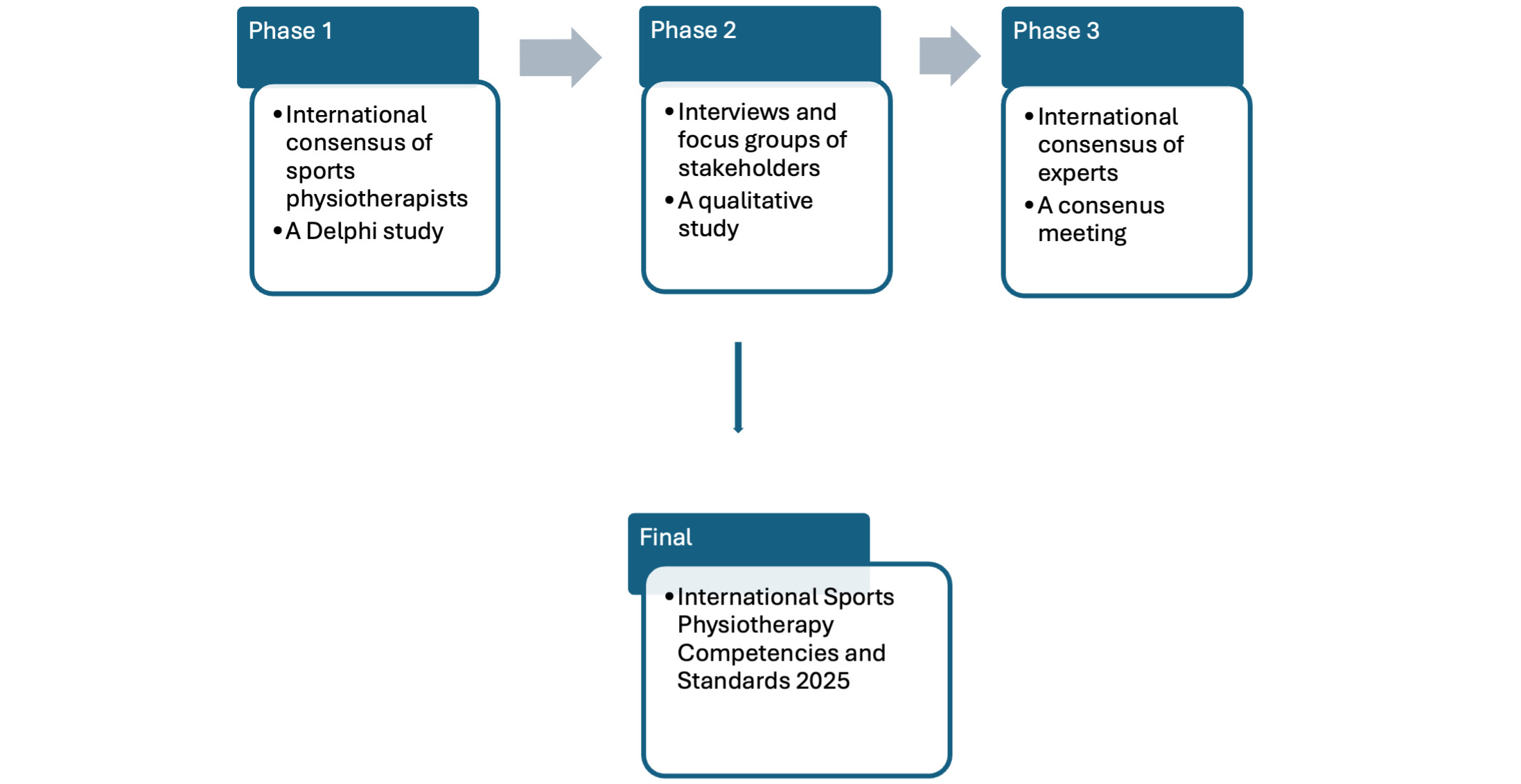
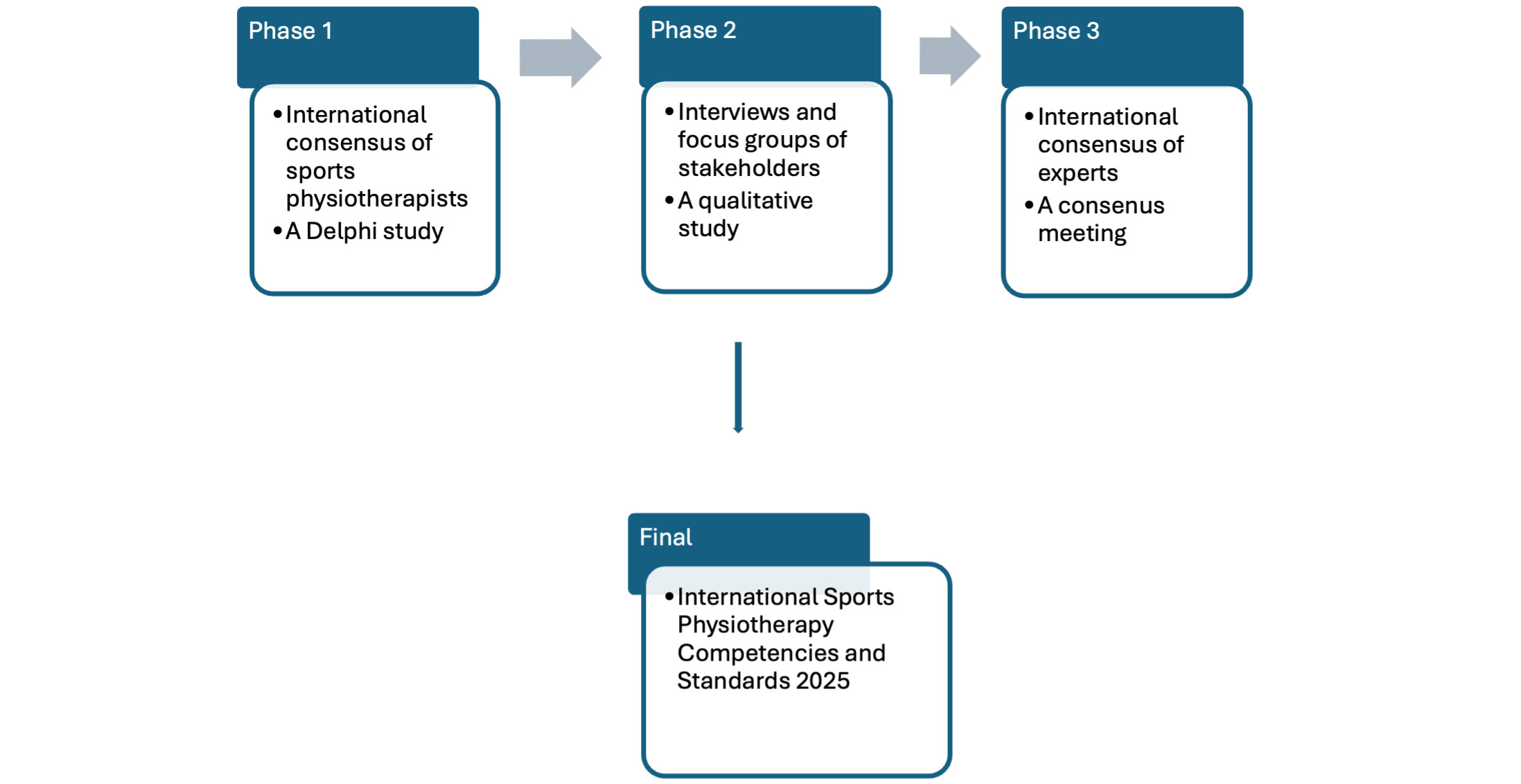
The aim of WP 2 was to update the Competencies and standards of sports physiotherapists internationally and consisted of three phases (Figure 1)14: Phase 1 focused on which of the current competencies and standards were still relevant and included a Delphi study of three rounds with 143 sports physiotherapists from 38 countries participating.15 Phase 2 involved a qualitative study with individual interviews and focus groups with diverse stakeholder groups to explore their perspectives and any additional competencies or new standards. Twenty-six participants from multiple countries took part in this Phase, which included three international focus groups, one with athletes, one with athlete support personnel, and one with managers of sporting organizations, and eight semi-structured interviews with leaders of international sporting organizations and medical commissions, all conducted virtually. Phase 3 consisted of an in-person consensus meeting of 12 expert sports physiotherapists, researchers and academics from multiple countries, where the information from Phases 1 and 2 was incorporated to define the final set of the Competencies.
Findings
The findings from Phase 1, the Delphi study, confirmed the importance of interdisciplinary collaboration, athlete-centred approaches, evidence-based practice, comprehensive assessments and continuous learning, which were also in the 2005 Competencies.15 Outcomes from Phase 2, the qualitative study of focus groups and semi-structured interviews, identified the importance of sports physiotherapists diagnosing injuries and being able to conduct clinical examinations, especially if there are no doctors present, and the importance of their understanding of the return-to-play process and collaborating with multidisciplinary teams. Soft skills were also deemed essential, such as effective communication, cultural competence, and personal qualities including empathy, adaptability, and leadership. Finally, the Phase 3 consensus meeting that occurred in Brussels, Belgium, reviewed the outcomes from Phases 1 and 2 to ensure the final profile of the Competencies was comprehensive and contemporary, and aligned with global standards of sports physiotherapy. The final Competencies and Standards were defined, new themes emerged, and minor modifications to Competencies 1-10 and significant changes to Competency 11 occurred.
The New International Sports Physiotherapy Competencies and Standards 2025
The final updated Competencies remained 11 in number (Table 2), with minor changes to the names, descriptions, behaviors and standards.
The detailed list of the International Sports Physiotherapy Competencies and Standards 2025 is included in Supplementary Material 1.
Key Changes Included in the Updated Competencies
Competency 1: Injury prevention. Key themes identified in Competency 1 included interdisciplinary collaboration, athlete-centred approaches, evidence-based injury prevention programmes, comprehensive assessments and incorporating health promotion in athlete care. The description of the competency remained the same with minor edits in the behaviors and standards.
Competency 2: Acute intervention. Key themes identified included the importance of quick decision-making processes in emergency situations and on the field of play. Additional themes included the need for physiotherapists to recognize their own professional limits, and in acute care settings, it was important for sports physiotherapists to maintain confidentiality and protect the athlete’s personal information. The description of the competency remained the same with minor edits in the behaviors and standards.
Competency 3: Rehabilitation. Key themes once again emphasized the need for sports physiotherapists to incorporate athlete-centred care and evidence-based practice as part of the rehabilitation. It also emphasized that sports physiotherapists need to ensure interdisciplinary collaboration and continuous education as part of their professional development. The description of the competency remained the same with minor edits in the behaviors and standards.
Competency 4: Performance enhancement. Key themes emphasized the sports physiotherapist’s role in the importance of ensuring individualized training programs for athletes, recognizing their own professional limits and the need for interdisciplinary collaboration when necessary. The description of the competency remained the same with minor edits in the behaviors and standards.
Competency 5: Promotion of a safe active lifestyle. For this competency, an explanation was added to define who is considered an athlete and to emphasize the role of the sports physiotherapist in promoting physical activity for public health. The role of sports physiotherapists in advising individuals on how to minimize inactivity and sedentary behaviors was also identified. There were minor edits in the description of the competency.
Competency 6: Lifelong learning and practice. One major change in Competency 6 was to add lifelong learning and practice to the title, to ensure physiotherapists continued to update their knowledge and practice skills throughout their careers.
Competency 7: Professionalism and management. Several changes were required for this competency. While the description remained the same, the behaviors and standards were adjusted to reflect that a basic level of management and reporting skills is sufficient for most sports physiotherapists, rather than the ability to develop and deliver business plans in their entirety.
Competency 8: Research. For this competency, the word involvement was removed from the title to allow more flexibility. Sports physiotherapists are expected to engage with research (in some manner) depending on the context of their work. They are not necessarily expected to undertake research, as was the perception in some cases. Some examples of how this competency may be met include any of the following: designing and/or conducting research, participating in a research study, contributing to a journal club, interpreting and applying research findings, or translating research findings into evidence-based practice. The description of the competency remained the same with minor edits in the behaviours and standards.
Competency 9: Dissemination of best practice. There were no major changes for this competency.
Competency 10: Extending practice through innovation. The description was changed to incorporate the emergence and growing use of digital health technologies.
Competency 11: Ethical, legal and cultural practice. Significant changes were required for this competency, reflected firstly in the name change from “Promotion of Fair Play and Anti-Doping Practices”. The description of the competency was also changed to “Sports physiotherapists participate in and promote professional, ethical, and legal sporting practices. They are committed to fair play and their duty of care to the athlete, while respecting all cultures”. Several behaviors and standards needed to change to incorporate the themes of diversity, inclusion, cultural capability, and ethical and legal considerations that were identified during the process of updating the competencies. The behaviors and standards for ensuring Fair Play and anti-doping practices were maintained within Competency 11.
Development and Piloting of eLearning Courses
As part of WP 3, three eLearning courses were developed at an EQF7 Master Level, and these were based on several of the updated competencies. Each course encompassed a student workload of 5 European Credit Transfer and Accumulation System (ECTS) credits. Course 1 was titled “Inclusion and Diversity in Sports”, and was mainly based on the updated Competency 11, while Course 2 titled “Decision-Making in injury prevention and return to sports” was based on Competencies 1, 3 and 4, and Course 3 titled “From Research to Innovation in Sports Physiotherapy Practice” was based mainly on competencies 3, 4, 8, and 10. Courses 1 and 3 were piloted from September to December 2025 with positive feedback from both participants and tutors. A tutor guide was developed to support the delivery of these courses. The eLearning courses are available through the ISEPA and the consortium partners after the completion of the SportsComp Project in 2026.
Discussion
The International Sports Physiotherapy Competencies and Standards 2025 were developed using robust methodologies, incorporating perspectives from experienced sports physiotherapists, athletes, athlete support personnel, sports organization managers and leaders and from expert sports physiotherapy researchers and educators. These final Competencies are contemporary and relevant in the context of the sports physiotherapist’s practice today, with the knowledge and behaviours to be demonstrated and standards to be achieved outlined clearly. Sports Physiotherapy career pathways internationally can incorporate these Competencies through the development of Master degrees by universities and other educational institutions, or through a framework of other short courses developed at a Master’s level.
By ensuring physiotherapists working in sport have advanced international competencies and standards, they can provide better care for the wellbeing of athletes of all levels and abilities. As sports physiotherapists of the future they need to be recognised as a "professional who demonstrates advanced competencies in the promotion of safe physical activity participation, provision of advice, and adaptation of rehabilitation and training interventions for the purposes of preventing injury, restoring optimal function, and contributing to the enhancement of sports performance in athletes of all ages and abilities, while ensuring a high standard of professional and ethical practice".1
Acknowledgements
The authors would like to thank the European Commission (Erasmus+) for the financial support.
Funding
The SportsComp project (project reference 2023-1-FI01-KA220-HED-000155843) is funded by the European Union.
Views and opinions expressed are, however, those of the author(s) only and do not necessarily reflect those of the European Union or the European Education and Culture Executive Agency (EACEA). Neither the European Union nor EACEA can be held responsible for them.