INTRODUCTION
Breaking is a dancesport with a strong cultural background that has developed into a recognized competitive discipline.1,2 It is a dynamic and physically demanding dance style that originated in the 1970s as a core element of hip-hop culture.2–4 Its physiological and athletic profile is multifaceted, with b-girls and b-boys (also known as breakers or breakdancers) demonstrating diverse styles, strengths, and training approaches.4–7 Breakers worldwide dedicate countless hours to creating their own signature styles by building on the core elements of breaking.2 These elements include toprock (upright steps performed while standing), go-downs (moves that take a breaker from standing to the floor), footwork (intricate patterns on the ground using hands and feet, often with some limbs lifted), freezes (striking still poses), power moves (high-energy spins and acrobatic moves), and transitions (linking movements that connect different levels and techniques).8 Every breaker develops a personal vocabulary of these core elements, combining them in ways that reflect their own style and create unique combinations.9
Breaking’s inclusion in the Youth Olympic Games in 2018 in Buenos Aires as well as in the Olympic program for the first time at the 2024 Paris Games marked milestones in the international recognition of breaking as a competitive discipline.1,10–12 This development has opened new avenues for institutional support and for the integration of the dance style into national elite sport support systems.1,4,10,11 In Germany, for example, breaking had previously existed largely outside the structures of organized high-performance sport. Despite its new Olympic status, the discipline remains underrepresented in the scientific literature.3,6 While existing research has primarily focused on injury prevalence,13–21 studies examining key performance indicators and/or physiological determinants remain limited.3,6 Consequently, it is unclear which established performance testing methods from training science and elite sports are applicable to breaking, and which of these can be sustainably implemented within its highly decentralized and individualised organizational framework. Moreover, the lack of evidence-based physical performance tools presents a barrier to systematic evaluation and development of the athletes’ performance within breaking. Based on these considerations, this exploratory study examined anthropometric and neuromuscular characteristics across three performance levels in German breakers to assess the feasibility of a field-based testing battery and explore whether commonly used athletic field tests show differences across performance levels.
The objectives were to evaluate the feasibility, relevance, and performance testing utility of this battery in the context of breaking and across the participating cohorts of breakers. The study addressed the following research questions:
(i) Feasibility of implementation: Can the test battery, which was developed in collaboration with breaking coaches, be applied in a standardized manner across different regions with appropriate support from trained and qualified staff, while ensuring practical applicability in terms of testing duration, equipment requirements, and organisational effort?
(ii) Preliminary discriminative validity: Can the selected performance testing battery differentiate between performance levels (national squad members and non-squad breakers, athletes of similar age) and between elite and developmental athletes (athletes of different age), whereas the classification of performance levels was provided by the German Dancesport Federation and, thus, might differ to other standards?
METHODS
Participants
Participants were recruited through collaboration with the German Dancesport Federation and affiliated breaking training centers. Elite and developmental athletes were invited to participate through the national squad system of the federation, while recreational breakers were recruited via local breaking communities and training groups at the participating testing sites. To participate in the study, athletes had to be actively engaged in breaking training and able to complete the full testing battery. Athletes were excluded if they reported acute injury, pain, illness, or any medical condition that could limit maximal performance during testing. Participants who were unable to complete individual tests due to discomfort or technical difficulties were excluded from the respective analysis. The participating b-girls (n=21) and b-boys (n=53) were categorized as elite, developmental, or recreational athletes based on the squad system of the German Dancesport Federation. The classification criteria were derived from the federation’s official talent identification and performance evaluation structure and are summarized in Table 1.
An a priori power analysis was not conducted as the number of elite and developmental athletes is limited by federation regulations, which define a fixed maximum number of squad positions. In the present study, all available elite athletes from the national squad were included. Recreational athletes represented an open category without predefined limits. Therefore, the sample size was primarily determined by the existing athlete population. Given the restricted nature of this population (i.e., national squad athletes), large samples are uncommon. Instead, small sample sizes are justified by the information value approach,22 which suggests that relevant insights can be obtained from limited participant numbers. Consequently, the study should be interpreted as an exploratory investigation within the available elite athlete population.
All athletes were informed about the nature and potential risks of the procedures prior to providing written informed consent. For underage athletes, consent was additionally obtained from their guardians. The study was conducted in accordance with the Declaration of Helsinki. Ethical approval was obtained from the ethics committee of the Humboldt-University Berlin (HU-KSBF-EK_2023_0022).
Study Design
This study implemented a standardized field-based test battery with breakers across three performance levels to examine its feasibility, relevance, and performance testing utility. The study employed an exploratory observational cross-sectional design. All measurements were obtained during standardized field-based testing sessions conducted at decentralized breaking training venues across Germany. For each participant, all anthropometric and neuromuscular assessments were performed within a single testing session lasting approximately 90 to 120 minutes. Standardized warm-up procedures and rest intervals between tests were implemented to ensure consistent testing conditions. Testing was integrated into either regular training environments or centralized training camps and was scheduled in coordination with the national head coach, representatives of the federation, and local coaches. Data collection occurred between October 2023 and November 2024 and therefore spanned multiple phases of the national and international competition calendar. To minimize potential fatigue effects related to competitions, testing sessions were scheduled during regular training periods. Analyses focused on between-subject comparisons across performance levels rather than repeated within-subject measurements.
Development of Test Battery
Based on the physical and technical demands of breaking, the following key domains were identified as central components for the development of a test battery:
(i) Strength and power: Executing explosive movements such as power moves, spins, and flips, as well as performing freezes, requires substantial muscular strength and power. Upper body strength and stability - particularly in the shoulders, arms, and core - are essential for supporting bodyweight during static and dynamic elements such as freezes and air power moves. Lower-body power is equally important for power moves, footwork, jumps, and flips.3,12,14
(ii) Flexibility: A high degree of flexibility is necessary to execute the wide range of dynamic movements, contortions, and acrobatic elements characteristic of breaking.3,12,14
(iii) Agility and coordination: Rapid, complex footwork combined with seamless transitions between power moves and freezes requires well-developed neuromuscular coordination and agility.3,12
(iv) Balance and postural control: Elements with static components, such as freezes (e.g., one-hand freeze with moving legs) and spins (e.g., spinning on one hand), demand considerable balance and postural control.3,6,12
With the aim of addressing these four domains, the tests (Table 2) were selected in consultation with the German Dancesport Federation, based on their presumed relevance to the athletic demands of breaking and included assessments of sprinting, jumping, balance, and agility. The construction of the test battery aimed to balance sport-specific relevance with practical feasibility in decentralized training environments. Therefore, widely used field-based performance tests were prioritized, as they allow standardized implementation with portable equipment across different locations. Cardiovascular testing was not included, as the focus of the present study was on neuromuscular and mobility-related performance characteristics rather than metabolic profiling. In addition, several testing sessions were conducted in smaller dance studios where spatial constraints limited the feasibility of implementing running-based field tests (e.g., Yo-Yo Intermittent Recovery Test), and where access to alternative endurance testing equipment (e.g., treadmills or ergometers) was not available. All selected tests are well-established and validated field tests in both scientific literature and applied sports practice.23–25 They are mobile, cost-effective, easy to administer, and familiar to coaches and support staff within competitive sports environments. The tests are routinely used across different populations, including youth athletes, elite-level competitors, and recreationally active individuals.23–25 They are considered relatively safe, with a very low incidence of injury reported in both practice and research contexts. In addition, the use of widely established tests enables benchmarking against reference values from other sports. Furthermore, anthropometric measures, including standing and seated height (cm) as well as body mass (kg), were obtained to describe baseline characteristics and to account for their potential relevance to performance.
Testing Procedures
This test battery was administered to breakers across the three described performance levels at five decentralized training locations in Germany. Prior to testing, participants received standardized instructions and demonstrations for all assessments. Where appropriate, participants performed submaximal practice trials for familiarization before maximal trials were recorded. The number of recorded trials varied depending on the test protocol. For explosive strength assessments such as the CMJ, DJ30, and IMTP, up to five maximal trials were permitted. For grip strength, three trials per side were recorded. For the seated medicine ball push and Jefferson Curl, three trials were performed. For unilateral mobility and balance tests (Knee-to-Wall and Y-Balance), three trials per side were recorded. Pull-ups and the core strength test were performed once, as these assessments require near-maximal exertion and additional attempts rarely result in improved performance.
A standardized rest interval of approximately 60 to 90 seconds was provided between trials to minimize fatigue. For tests involving multiple trials, the best valid attempt was used for further analysis. Trials were considered invalid if predefined technical criteria were not fulfilled (e.g., loss of hand contact in the CMJ arm position, stepping errors in the agility test, or failure to maintain body position in the core strength test). For the DJ30, ground contact times exceeding 200 ms were not treated as invalid trials, as they were considered indicative of slow stretch-shortening cycle performance. Invalid trials were repeated after the standardized rest interval.
To enhance measurement consistency across the five testing sites, all testing staff received standardized instructions prior to data collection. Testing procedures were supervised and coordinated by a qualified sport scientist from the Olympic Training Centre Berlin. Identical equipment and standardized testing protocols were used across all locations. While formal inter-rater reliability analyses were not performed due to the field-based nature of the study, the use of well-established test procedures with documented reliability in previous literature supports the methodological robustness of the measurements.23–25
Statistical Analysis
All statistical analyses were performed using R version 4.5.1 (R Core Team, 2025) in RStudio version 2025.05.1 Build 513. The threshold for statistical significance was set at p < 0.05 for all primary analyses. Prior to hypothesis testing, the dataset was visually screened for normality using Q-Q plots and histograms and formally assessed using the Shapiro-Wilk test. As several variables violated the assumption of normality, non-parametric methods were consistently applied throughout the analysis to ensure robustness and avoid Type I errors due to distributional violations. To examine group differences across the three performance levels (elite, developmental, and recreational), Kruskal-Wallis rank sum tests were conducted for each continuous variable. DJ30 ground contact time was analysed as a continuous variable in all statistical procedures, while the ≤ 200 ms threshold was used solely for interpretative purposes and not for statistical categorization. Where the omnibus test indicated significance (p < 0.05), post-hoc pairwise Wilcoxon rank-sum tests were applied using Bonferroni-adjusted alpha levels to control for multiple comparisons. The strength of pairwise effects was quantified using rank-biserial effect sizes (r), calculated from the Wilcoxon U-statistic. Effect sizes were interpreted as small (r ≈ 0.10), medium (r ≈ 0.30), and large (r ≥ 0.50), following conventional benchmarks.26 Sex differences were assessed separately using Wilcoxon rank-sum tests (two-tailed). Rank-biserial effect sizes (r) were also reported for sex-based comparisons to indicate the magnitude of differences. Given the exploratory nature of the study and the relatively small subgroup sizes, particularly within the elite cohort, multivariate regression or classification models were not applied in order to avoid overfitting and unstable parameter estimates.
RESULTS
A total of 74 breakers (71.6% male), with a mean age of 21.2 ± 6.2 years (range: 12–38) and 9.3 ± 5.0 years (range: 1–22) of breaking experience, were successfully tested at five different breaking training venues across Germany. All necessary test equipment was transported from one venue to another by car, and data collection was successfully carried out by local coaches and staff members under the supervision and instruction of a qualified sport scientist.
The analysis revealed statistically significant differences between the three performance levels (elite, developmental, recreational) across several anthropometric, mobility, and neuromuscular performance variables (Supplementary Table 4). Sex-based differences favored males in strength and power measures, whereas females demonstrated greater mobility (Supplementary Figure 2). Further details, including insights in the sex-based differences as well as correlation analyses of key neuromuscular performance variables, are provided in the supplementary material (Supplementary Figure 3).
Anthropometrics
Age showed a significant group effect (χ² (2) = 10.60, p = 0.005), with elite athletes being significantly older than both developmental (p = 0.008, r = 0.56) and recreational athletes (p = 0.041, r = 0.51). As expected, elite athletes reported greater breaking experience (χ² (2) = 9.06, p = 0.011) than developmental (p = 0.006, r = 0.51) and recreational participants (p = 0.005, r = 0.59) (Table 3). To further quantify relative training exposure, the ratio of breaking experience to age was calculated. Although exploratory post-hoc comparisons suggested a higher experience-to-age ratio in elite athletes compared with recreational breakers, the overall Kruskal-Wallis test did not indicate a significant group effect (χ² (2) = 4.82, p = 0.090); therefore, this pattern should be interpreted cautiously, with no significant difference observed between elite and developmental (p = 0.160, r = 0.26) or between developmental and recreational athletes (p = 0.356, r = 0.12). No group differences were observed in body mass (χ² (2) = 0.71, p = 0.702). Body height showed a small overall group effect (χ² (2) = 6.46, p = 0.040); however, post-hoc comparisons were not significant after correction. Seated height differed significantly between groups (χ² (2) = 6.76, p = 0.034), with elite breakers being shorter than recreational athletes (p = 0.014, r = 0.42). No significant group differences were found for leg length (χ² (2) = 3.45, p = 0.178) or arm length (χ² (2) = 2.49, p = 0.288).
Mobility
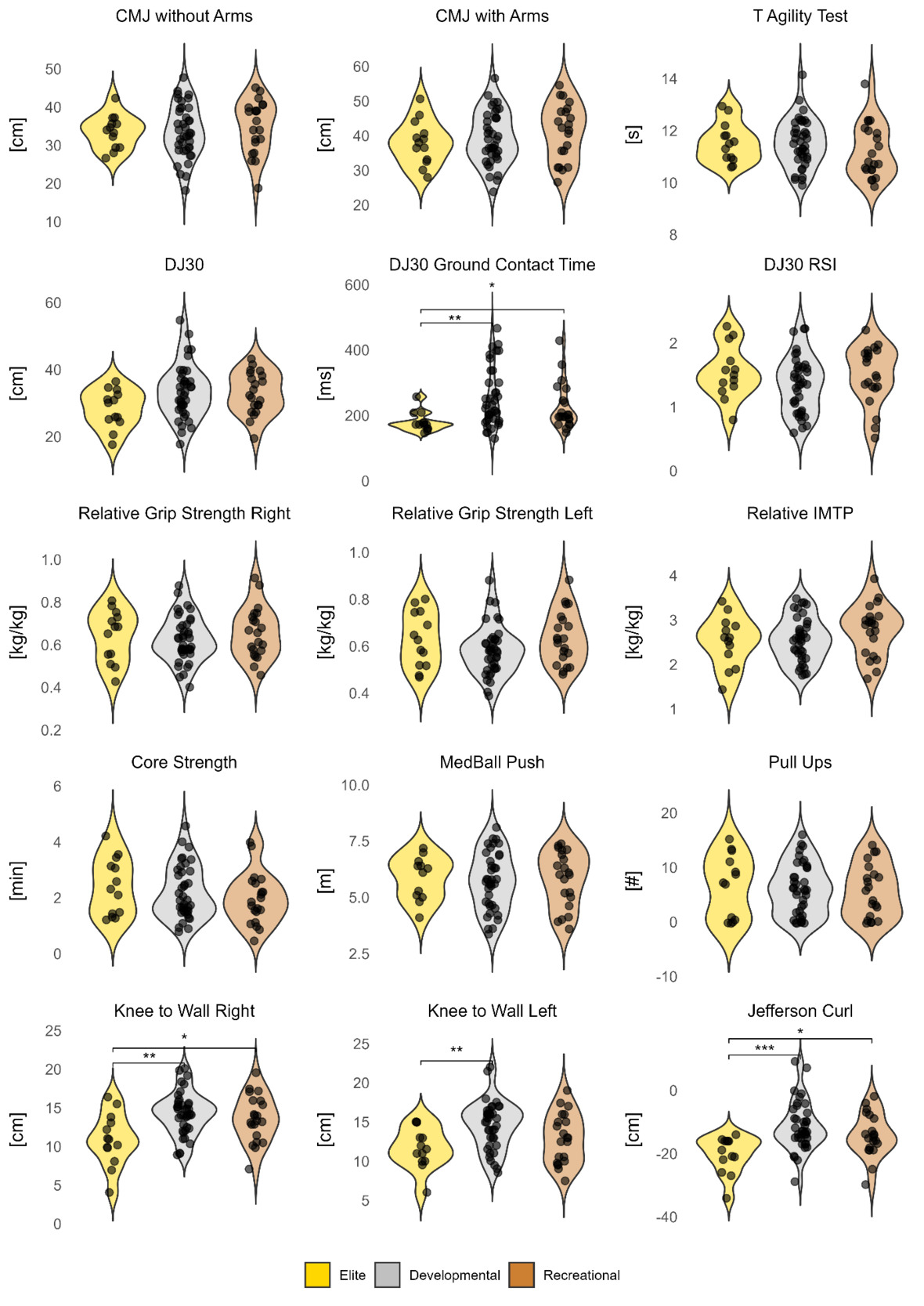
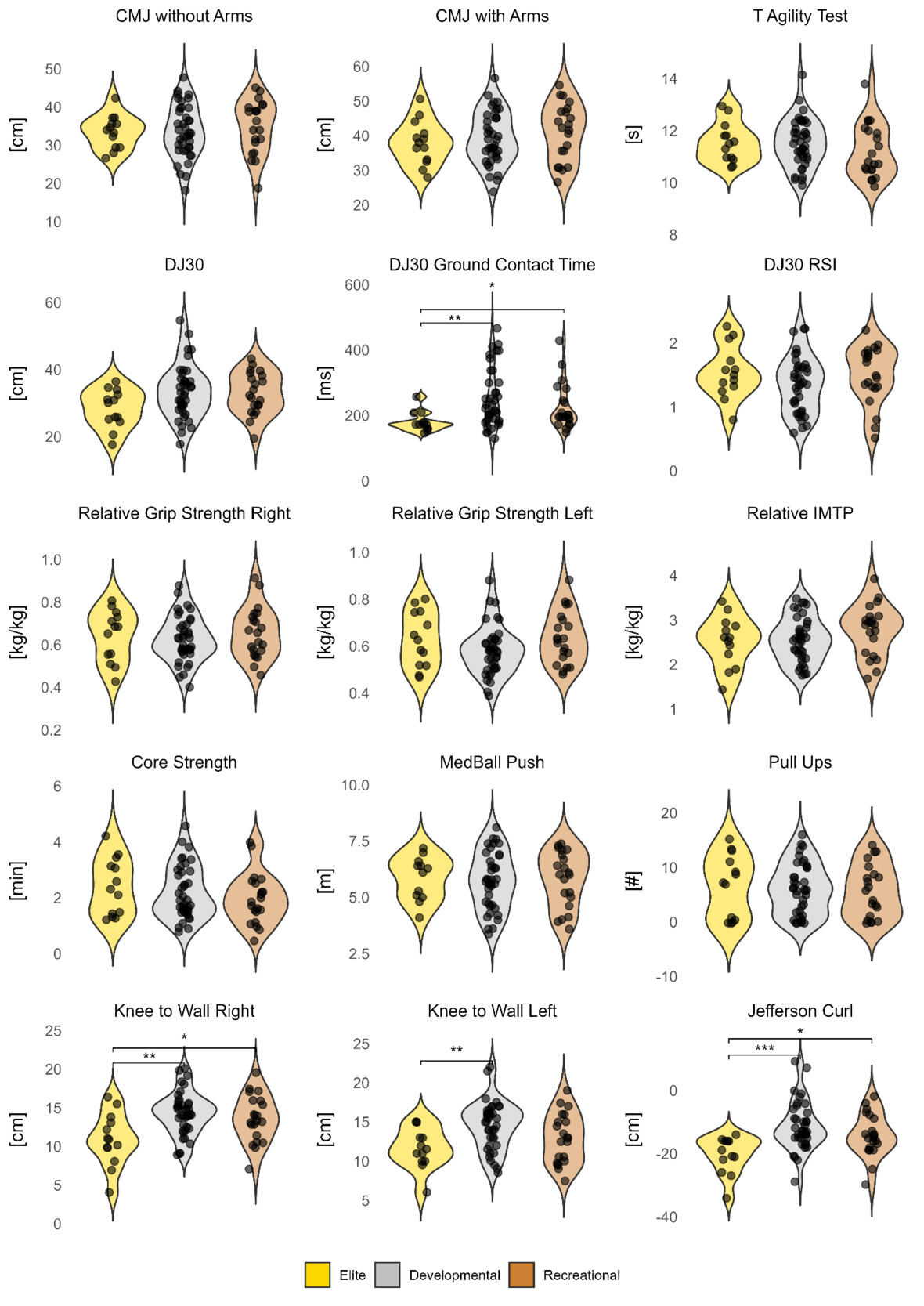
Mobility assessments revealed the Jefferson Curl as the most sensitive indicator of group differences (χ² (2) = 14.84, p < 0.001), where elite athletes outperformed both developmental (p < 0.001, r = 0.53) and recreational (p = 0.012, r = 0.44) peers. The Knee-to-Wall test on both the left (χ² (2) = 9.01, p = 0.011) and right (χ² (2) = 8.98, p = 0.011) legs also yielded significant group effects. Elite athletes showed greater ankle mobility than developmental athletes (left: p = 0.004, r = 0.40; right: p = 0.003, r = 0.41) and better right-sided mobility than recreational athletes (p = 0.031, r = 0.37).
Dynamic Balance (YBT)
No statistically significant differences were observed in any of the YBT parameters. This included YBT Lower Extremity Composite Score Left (χ² (2) = 1.15, p = 0.563), YBT Lower Extremity Composite Score Right (χ² (2) = 1.62, p = 0.444), as well as YBT Upper Extremity Composite Score Left (χ² (2) = 0.93, p = 0.628) and Right (χ² (2) = 0.93, p = 0.628). Directional components of the YBT, such as anterior, posteromedial, and posterolateral reach for the lower extremities, as well as medial, inferolateral, and superolateral reach for the upper extremities, did not differ significantly between groups on either side.
Neuromuscular Performance Variables
Of all assessed performance variables, only DJ30 ground contact time differed significantly between groups (χ² (2) = 10.56, p = 0.005), with elite breakers exhibiting shorter contact times than both developmental (p = 0.002, r = 0.43) and recreational athletes (p = 0.019, r = 0.40), reflecting superior reactive strength. In addition, a large proportion of athletes in the developmental and recreational groups produced ground contact times exceeding 200 ms, indicating slower stretch-shortening cycle behavior. These values were retained in the statistical analysis because ground contact time was analyzed as a continuous variable. In contrast, DJ30 jump height showed no statistically significant differences between performance levels (χ² (2) = 2.66, p = 0.264). DJ30 RSI also did not differ between groups (χ² (2) = 2.61, p = 0.271), indicating comparable reactive strength indices across all groups. Similarly, no significant group differences emerged for CMJ jump height performed with (χ² (2) = 1.41, p = 0.495) or without (χ² (2) = 1.83, p = 0.400) arm swing. Grip strength of the left hand did not differ significantly between groups (χ² (2) = 3.64, p = 0.162), nor did grip strength of the right hand (χ² (2) = 0.93, p = 0.629). Relative grip strength metrics also showed no significant group differences for either the left (χ² (2) = 3.44, p = 0.179) or the right side (χ² (2) = 0.48, p = 0.786). Furthermore, neither absolute IMTP force (χ² (2) = 1.96, p = 0.376) nor relative IMTP (χ² (2) = 2.16, p = 0.340) differed significantly between groups. The core strength test likewise yielded no significant group effect (χ² (2) = 1.57, p = 0.456). The seated medicine ball push also showed no significant group differences (χ² (2) = 0.17, p = 0.920) and pull-up performance was comparable across performance levels (χ² (2) = 2.69, p = 0.260). Finally, no significant difference was observed for T-Agility performance (χ² (2) = 0.88, p = 0.644).
DISCUSSION
The present study represents one of the first systematic attempts to assess physical performance in breaking through a standardized field-based performance testing battery. Although the present testing battery was implemented within the practical environment of national breaking training activities, in conjunction with training events organized by the national breaking performance program, the testing sessions themselves were specifically designed and coordinated for research purposes, using standardized protocols and equipment across all sites. This approach allowed the integration of research-oriented data collection within the applied training context of the national federation.
Conducted across decentralized training locations and involving breakers from elite, developmental, and recreational performance levels, the study sought to evaluate the feasibility, discriminative validity, and practical applicability in performance testing of commonly used sport motor tests within the context of breaking. The findings provide several important insights into the physical profiles of breakers, the applicability of established test formats, and the broader implications for athlete development in this still developing dancesport.
Regarding the first research question on the feasibility of implementation, the standardized implementation of the performance testing battery across five decentralized sites was successfully achieved, demonstrating the practicality of coordinated testing despite breaking’s currently decentralized organizational structure. Close collaboration with the national federation and the trained staff from the Olympic Training Centre Berlin was essential but successful for ensuring consistent data collection procedures. It was possible to complete the testing battery within a single standardized testing session lasting approximately 1.5 to 2 hours using portable equipment and standardized protocols, which facilitated its application across different locations. This suggests that field-based performance testing, if well-structured and coach-supported, can be effectively embedded into the breaking ecosystem, even in the absence of centralized training hubs. Future applications may further optimise testing logistics by streamlining station transitions and simplifying equipment setup.
From a practical perspective, the testing battery was designed to rely on portable equipment that can be transported between training locations. This allows the battery to be implemented in typical training environments such as dance studios or small gym spaces. Practitioners working in environments with fewer resources may consider simplified adaptations of the battery, prioritizing tests that require minimal equipment (e.g., CMJ using jump mats or smartphone-based apps, grip strength, mobility tests, or bodyweight strength assessments), or focusing on those tests that demonstrated the greatest ability to differentiate between performance levels across the three cohorts. Such adaptations may help integrate physical performance testing into breaking training contexts beyond national federation structures.
In terms of the second research question, the performance testing battery showed partial ability to differentiate between performance levels. Elite athletes in the present sample were significantly older (25.9 vs. 19.6 vs. 21.2 years) and more experienced (13.2 vs. 8.5 vs. 9.3 years) than their developmental and recreational counterparts, highlighting the central role of accumulated practice in performance development. Although the overall group effect for the experience-to-age ratio did not reach statistical significance, exploratory post-hoc comparisons suggested that elite athletes tended to have accumulated a greater proportion of lifelong training exposure (0.50 vs. 0.42 vs. 0.40). These findings align with previous research on professional breakers in national squads of other nations. Arundale et al.3 reported that elite athletes were older (27.4 vs. 18.7 years) and more experienced (12.5 vs. 10.0 years) than developing athletes, while Lindner et al.7 likewise found that elite breakers were older (27.9 vs. 26.3 years) and more experienced (12.9 vs. 11.5 years). However, weekly breaking training volumes show inconsistent patterns. Arundale et al.3 observed that elite athletes invested fewer hours per week in breaking training than developing athletes (15.5 vs. 28.5 hours), whereas Lindner et al.7 reported nearly identical weekly training times across groups (12.8 vs. 12.5 hours).
Interestingly, anthropometric variables such as body height, leg length, and arm length did not significantly differ between groups, underscoring the morphological diversity inherent in breaking and the non-prescriptive nature of its physical demands.1,2 The only significant difference was seated height, with elite breakers being shorter than recreational athletes. These findings suggest that while breaking does not appear to impose strict anthropometric constraints, certain body proportions may nevertheless offer biomechanical advantages for specific movement patterns. Thus, anthropometry may influence the efficiency of particular techniques without representing a strict prerequisite for participation or success. Prior research by Ruscello et al.6 reports that breakers in the Italian national squad tend to be shorter than athletes from other dance styles, which may benefit moves involving level changes, such as go-downs, as well as moves requiring body rotation and dynamic balance, such as flares (similar to the pommel horse). Comparable patterns are seen in gymnastics, where smaller athletes are often advantaged in body rotational skills,27,28 and lower stature has been linked to higher performance rankings.29
Mobility tests yielded some of the clearest group-level distinctions. The Jefferson Curl emerged as a particularly sensitive indicator, with elite breakers demonstrating significantly greater flexibility than both developmental and recreational peers. Similarly, the Knee-to-Wall tests revealed greater ankle mobility in elite athletes, particularly when compared to developmental breakers. Interestingly, Lindner et al.7 reported that elite breakers emphasized mobility training, while developing breakers focused more on endurance - potentially explaining the superior flexibility in elite athletes. These findings align with the movement-specific demands of breaking, where a high degree of joint and muscular flexibility is essential for performing acrobatic elements, transitions, and footwork.12 As such, mobility appears to be a critical differentiator of performance level and may represent a trainable and diagnostically valuable attribute in breaking. Future research should incorporate additional mobility tests, focusing on the shoulder for freezes and power moves, and on the hip for both power moves and footwork.
In contrast to mobility, most neuromuscular performance metrics, such as CMJ, IMTP or core strength, did not significantly differentiate between performance levels. Only DJ30 ground contact time distinguished elite athletes, who exhibited shorter contact times than both comparison groups, reflecting superior reactive strength and neuromuscular efficiency. Interestingly, DJ30 RSI did not differ significantly between groups. In fact, the majority of breakers in both the developmental and recreational groups produced ground contact times exceeding 200 ms. While these trials were retained in the statistical analyses, contact times above this threshold indicate slower stretch-shortening cycle behavior and do not reflect fast stretch-shortening cycle performance. The stretch-shortening cycle is commonly classified as ‘fast’ when ground contact time is ≤ 250 ms.30 In practice, however, elite athletes often demonstrate substantially shorter contact times, frequently below 200 ms, particularly in tasks involving reactive strength.31 Accordingly, a considerable proportion of trials in the present sample may be more representative of slower stretch-shortening cycle actions, which should be considered when interpreting RSI outcomes. Against this background, and based on previous literature on reactive jump performance, a threshold of ≤ 200 ms was adopted as a practical indicator of highly efficient fast stretch-shortening cycle function.30,31 The shorter contact times observed in elite breakers may reflect necessary neuromuscular qualities relevant for rapid transitions and explosive movements in breaking. However, as contact times exceeding 250 ms were retained in this exploratory analysis for descriptive purposes, the resulting RSI values should be interpreted with caution. The lack of consistent group differences in other strength and power metrics may stem from the high variability in training backgrounds and individual styles within breaking. Unlike many sports, where athletes follow structured programs under professional supervision, most breakers are self-taught and train without coaches.5 Skill development often occurs through the community-based principle of ‘each-one-teach-one’, in which techniques and experiences are shared peer-to-peer.32 This approach fosters highly individual repertoire, as breakers aim to develop distinctive styles and create original moves.9
Therefore, these traditional tests, while validated in other sports contexts,23–25 may lack specificity for capturing the unique movement patterns and performance demands of breaking. Moreover, because breakers frequently improvise transitions during training, they continually rehearse novel movement patterns,5 which may further limit the transferability of conventional strength tests to breaking performance. According to Arundale and colleagues, breakers are unique in that they can be classified as both overhead athletes and reverse chain athletes,3 due to their frequent use of upper-extremity-supported, inverted, and spinal-extension-dominant movements.3 However, this dual demand profile was not strongly reflected in the present data. While upper-body strength and grip parameters (e.g., pull-ups, grip strength, seated medicine ball push) did not display notable inconsistencies or functional deficits, they also did not distinguish performance levels. More strikingly, the IMTP results revealed rather modest values across all groups, particularly when compared to benchmarks from other strength and power-based sports.33–37 This may suggest a lack of maximal posterior chain strength development, or it may reflect breaking’s prioritisation of fluid, dynamic motor control over high force production in constrained positions. The overhead component, while central to many moves (e.g., handstands, air power moves, air freezes), was not directly assessed by the test battery, which may explain the absence of upper-body performance asymmetries or compensation patterns typically observed in overhead sport populations.38–40 These findings highlight the need for further investigation into the neuromuscular profiles specific to breaking, as well as the development and validation of appropriate performance assessment tools. This should ideally include overhead stability tests for one-handed moves and freezes, assessments of dynamic trunk extension capacity under load, and open-chain strength tests for hip strength in power moves. While the DJ30 test demonstrates similarities to breaking movements, further adaptations could enhance its relevance, such as implementing a single-leg CMJ (e.g., triple jump variations) or developing modified assessments that reflect the demands of breaking-specific elements. In addition, short-term endurance tests may provide valuable insights into the anaerobic capacity of breakers, particularly in the lower extremities.
In breaking, many movements are highly automated and frequently repeated, suggesting that performers rely less on active coordination during execution and more on well-established motor routines.5,41 These routines, often developed through extensive repetition and procedural memory, can resemble ‘overlearned’ sequences, allowing for efficient and fluid performance with minimal conscious control.41 As such, the coordination demands during actual performance in a battle scenario may differ from those required in a training setting. It can be suggested that breakers rely on rhythm ability, adaptation ability, reaction ability and orientation ability for battle performance, whereas other coordinative abilities - such as differentiation ability, coupling ability, and balance ability - may be more important when learning new movement patterns in the training context.9 This may partially explain the lack of performance-level differentiation in coordination-related tests such as the YBT tasks or T-Agility test, which may not adequately reflect the specific demands of different breaking environments (battle vs. training). None of the YBT parameters yielded significant group differences, suggesting that standardized balance assessments may not capture the highly specific balance skills developed in breaking.42 Similarly, agility tests failed to distinguish between groups, although correlations with relative strength measures indicate that stronger athletes tend to perform better in this domain. These findings further highlight the need for more breaking-specific assessments to capture the functional capacities most relevant to breaking performance.
Limitations
The cross-sectional design of the study precludes causal inferences or statements about performance development over time. Additionally, subgroup sizes, particularly among elite female breakers, were relatively small, limiting statistical power for some comparisons. An a priori power analysis was not conducted, as the sample size was constrained by the structural limits of the national squad system, which defines a fixed number of elite and developmental squad positions. Consequently, the findings should be interpreted in light of the available population size within this specific performance structure. Furthermore, the analyses were based on unadjusted group comparisons. Because elite athletes were older and more experienced than the other groups and sex differences were present for several performance measures, some observed group differences may partly reflect these factors rather than performance level alone. Because testing was conducted across multiple decentralized training sites, some degree of measurement variability cannot be fully excluded despite the use of standardized protocols, identical equipment, and supervision by a qualified sport scientist.
Another limitation lies in the use of general sport motor tests, which, while validated and easy to administer, may not fully capture the specific performance characteristics of breaking. It should also be considered that some assessments used in the battery, such as vertical jump tests, include a technical component. Although familiarization trials were provided, breakers may not regularly perform these movements in their training routines. Consequently, performance outcomes may partly reflect movement familiarity in addition to underlying physical capacities. The absence of tests assessing reaction and adaptation abilities to breaking-specific situations, as well as the lack of direct competition outcomes or judging decisions, further limits the predictive interpretation of test results. Future studies should aim to link performance testing with competitive success and training progression.
Although correlations between several neuromuscular variables were explored using Spearman correlation analyses (Supplemental Figure 3), additional multivariate approaches (e.g., regression models including covariates or multivariate classification methods) may provide further insights into the relative contribution of specific physical characteristics to breaking performance. However, given the exploratory nature of the present study and the limited subgroup sizes, particularly within the elite cohort, such analyses were not pursued in order to avoid overfitting and unstable estimates. Finally, this analysis was limited to the German breaking community, which may not be representative of the top international elite athletes.
Future research may benefit from developing a breaking-specific performance testing framework integrating multiple performance domains. Such a framework could include (i) neuromuscular performance (e.g., reactive strength, upper-body force production), (ii) mobility and joint range of motion, and (iii) coordination and rhythm-related abilities relevant for transitions and footwork. Combining standardized physical tests with breaking-specific movement assessments and performance evaluations may provide a more comprehensive understanding of the determinants of breaking performance.
CONCLUSION
The current findings offer valuable starting points for integrating performance testing into breaking practice. Tests such as the Jefferson Curl, Knee-to-Wall and DJ30 ground contact time may serve as effective and practical monitoring tools for mobility and reactive strength, respectively. While these tests differentiated between performance levels, the predominantly cross-sectional design precludes conclusions on long-term performance development. Thus, although selected tests may serve as useful monitoring tools within athlete development pathways, longitudinal studies tracking athletes over time will be essential in evaluating the predictive validity of performance tests and informing evidence-based talent development strategies. Furthermore, the development and inclusion of breaking-specific assessments appear essential to establish the battery as a reliable performance criterion for long-term athlete development. Test procedures should be grounded in standardized, evidence-based assessments to ensure reliability and comparability of results. Given breaking’s freestyle orientation, testing protocols should further be complemented by creative implementations within individualized training settings, while acknowledging the inherent challenges of making creative performance aspects measurable. Importantly, the present study demonstrates that standardized physical performance testing can be implemented within the decentralized training structures typical of breaking, providing a foundation for future evidence-based athlete monitoring in this dancesport.
Corresponding author
Sophie Manuela Lindner
Am Sportpark Müngersdorf 6, 50933 Cologne
Germany
Email: sophiemanuelalindner@gmail.com
Phone: +49 (0)221 4982-2630
Fax: +49 (0)221 4982-2620
CONFLICTS OF INTEREST
Some authors received consultancy compensation related to the development of the test battery and data analysis within the funded project. The authors declare no other conflicts of interest.
FUNDING
This study was funded by the Federal Institute of Sport Science (BISp), with additional support from the German Dancesport Federation e.V. and the Institute of Dance and Movement Culture at the German Sport University.
ACKNOWLEDGEMENTS
We would like to sincerely thank all the athletes for their commitment, effort, and valuable time devoted to this project. Their participation made this study possible. We are equally grateful to the staff members for their support throughout the data collection process and for their assistance in coordinating the testing sessions. Their dedication and cooperation were essential to the successful completion of this work.