Introduction
The glenohumeral joint is the most commonly dislocated major joint in the body1 representing one of the leading upper body injuries in sports.2 These injuries typically occur during a traumatic event such as a fall or direct impact from an opponent,3 most often dislocating in the anterior direction in younger males who play contact sports.4 Without proper management, long term consequences can involve recurrent episodes of instability, residual apprehension, stiffness, pain, and osteoarthritis.5–7 Recurrent instability rates following non-operative management in this population have been reported to be greater than 70% following a first-time, or primary, dislocation event.8–11 Factors including younger age, bone loss, lower socioeconomic status, and higher activity level have been shown to contribute to a greater likelihood of recurrent instability.12–14 With high rates of recurrence following non-operative management in youth athletes, a shoulder stabilization procedure may be recommended to reduce risk of re-injury.15 Many athletes return to the same level of play following a shoulder stabilization procedure; however, upon return, these athletes continue to demonstrate attributes associated with high risk of shoulder injury such as young age and high activity levels.16
With nearly 75% of existing literature using time from surgery as the sole criterion for return to sports clearance, there is no criteria-based consensus on the best method for determining readiness for return to play (RTP) following a shoulder stabilization procedure.17 A typical timeline for RTP following shoulder stabilization is six months, but it is unknown whether this recovery duration is adequate for sufficient functional progress such that the athlete is prepared to return to the demands of their sport. Furthermore, current evidence suggests that the use of a criterion-based RTP criteria rather may modulate recurrence rates greater than time alone.18 Criterion-based evaluation of readiness for RTP includes screenings, such as the Closed Kinetic Chain Upper Extremity Stability Test (CKCUEST), which was developed to assess upper limb function and stability in a closed kinetic chain position.19 Dynamic tests like the CKCUEST can help identify post-operative deficits in strength, power, neuromuscular control, and proprioception.
Normative values for CKCUEST performance have been predominantly established in elite and collegiate athletes; however, no normative values exist for adolescents.20–24 Furthermore, it has been shown that arm length, sex, and weight may influence performance on the CKCUEST.25,26 To reduce the effect of anthropometrics on test performance, normalizing test position to arm length has been proposed, calculated as the distance from the spinous process of the 7th cervical vertebra (C7) to the tip of the middle finger, rather than completing the test at the standard 36-inch distance.26 This normalized CKCUEST has been assessed in small sample sizes of elite athletes,26 adult athletes,27,28 and youth athletes ages 7-10,29 but not in adolescent athletes who are at the greatest risk for shoulder dislocation.4 Therefore, this study aimed to compare performance and establish agreement between the standard versus arm-length-normalized testing positions in adolescent athletes. A secondary purpose was to establish adolescent and sport-specific reference values for practitioners to utilize when assessing shoulder function. It was hypothesized that performance on the arm-length-normalized position for the CKCUEST would be greater than performance on the standard testing position, and therefore, the agreement between the two methods would be moderate.
Methods
Participants
Healthy, adolescent athletes (ages 14-18 years) who reported participation in either contact or overhead upper-extremity sports were recruited from multiple community school, recreational, and travel teams across a single large metroplex. Teams were recruited via email and social media, and snowball sampling allowed for a diverse group of participants from a wide variety of geographical locations including both suburban and urban areas. Participants were excluded if they reported any musculoskeletal or neuromuscular condition or injury in the past six months that would limit their ability to perform the required assessments, and/or any previous history of shoulder surgery. Approval from a regional Institutional Review Board was obtained prior to initiating study procedures. Upon enrollment, informed consent/assent was obtained from all participants and parents, if applicable, prior to participation.
Procedures
Age and sport were captured in a survey of demographics and sport participation characteristics. Sport type was defined as the sport in which the participant was currently active and was categorized as either contact, defined as an athlete who plays a sport involving frequent contact with other players or objects, or overhead, defined as an athlete who plays a sport which requires repetitive upper extremity activity above shoulder height. If both conditions were met, for example, a quarterback or similar, then participants were removed from between-sport analysis. Body mass (kg) was collected for each participant and arm length (mm) was measured as the distance between the C7 spinous process and the tip of the middle finger.
The CKCUEST was completed as part of a larger series of upper extremity functional tests. Six additional tests involved measures of strength, stability, power, and endurance specifically for the shoulder and the CKCUEST was randomized in the test battery such that it may have been administered first, in the middle of the tests, or last. The test battery was completed in both field and laboratory-based settings as with adequate rest between outcome measures.
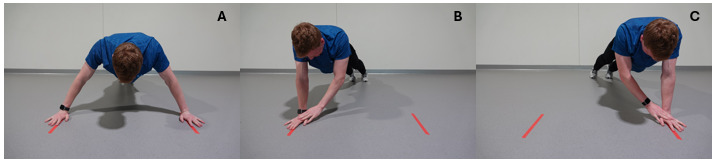
Standardized verbal instructions were provided for both conditions to “Begin in a pushup position with feet shoulder-width apart and hands placed on each piece of tape. Alternate taps to the top of the opposite hand as many times as possible within 15 seconds” (Figure 1).23,27,30 Each participant completed two trials of a standard distance (36 inches) condition19,21,23,30 followed by two trials of the arm-length-normalized distance, or the distance from C7 to the tip of the middle finger, condition.21,29 A rest period of 45 seconds was provided between each trial. A single, trained evaluator was responsible for timing and counting the number of touches per trial for each participant. A tap was not considered for scoring if the participant did not make contact with the top of their hand or if their support hand was not placed on the tape. The trial with the maximum number of taps for each condition were included for subsequent analysis.
__(a)_start_position__(b)_lef.png)
Statistical Analysis
Descriptive statistics (means and standard deviations) were computed for all continuous measures, including age, body mass, and CKCUEST performance for the two test conditions. Normality of continuous variables was assessed using Shapiro-Wilk tests and visual inspection of distributions. Given significant tests of normality, non-parametric approaches were used for inferential analyses. Differences in performance between the arm-length-normalized and standard distance conditions were evaluated using a Wilcoxon signed-rank test, with effect size (r) calculated to assess the magnitude of this difference and interpreted as small (0.10), moderate (0.30), or large (≥ 0.50).31 A two-way mixed-effects intraclass correlation coefficient model for absolute agreement (ICC [3,1]) with 95% confidence intervals was calculated to determine the level of agreement between the two conditions, as well as a Bland-Altman analysis. Additionally, within-condition trial-to-trial reliability was assessed using two-way mixed-effects ICCs for absolute agreement, and the standard error of measurement (SEM) and minimal detectable change at the 95% confidence level (MDC95) were calculated for each condition.
Lastly, Spearman rank correlations were used to assess associations of age, body mass, and arm length with CKCUEST performance for each condition. Correlation strengths were defined as weak (r ≤ 0.35), moderate (r = 0.36-0.67), or strong (r ≥ 0.68).32 To explore group differences, Mann–Whitney U tests were performed to compare contact versus overhead athletes. Group comparisons included CKCUEST performance as well as age, body mass, and arm length. Athletes who participated in both contact and overhead sports at the time of testing were excluded from between-group analysis. All statistical tests were evaluated in SPSS Statistics (IBM, version 24.0, Armonk, NY, USA) with a significance level (α) of 0.05.
Results
A total of 154 participants (77.9% male, 16.5±1.2 years, 75.8±18.0 kg) were tested and included for analysis (Table 1). All participants were actively involved in Lacrosse (31%) or football (23%) followed by baseball (18%), volleyball (12%), basketball (11%), water polo (3%) and tennis (1%). Of the female participants, 50% were volleyball players, 30% were lacrosse players, and 20% were basketball players.
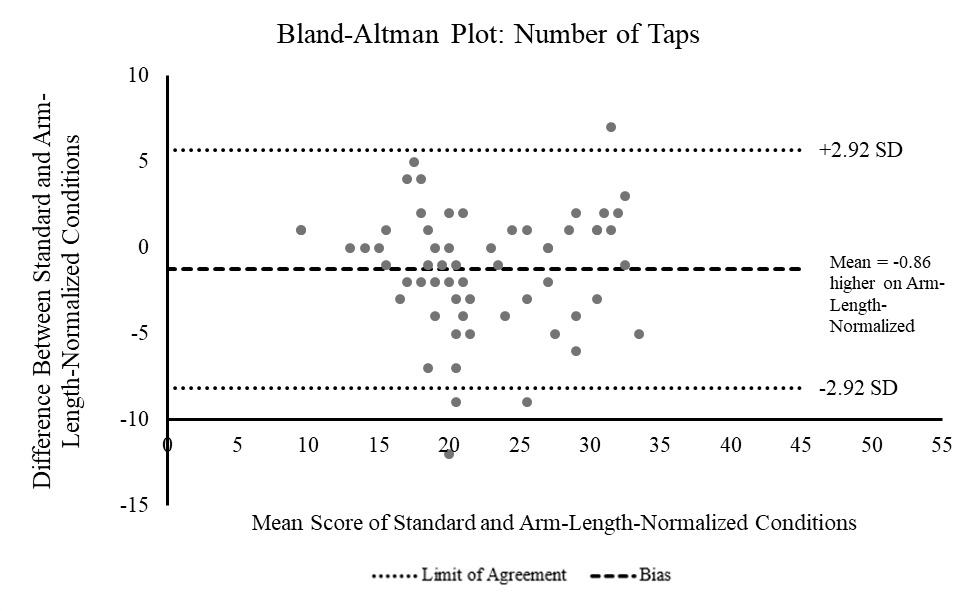
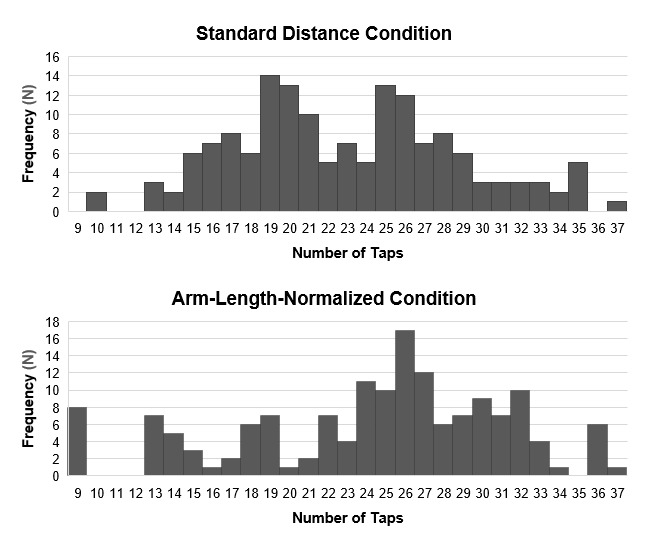
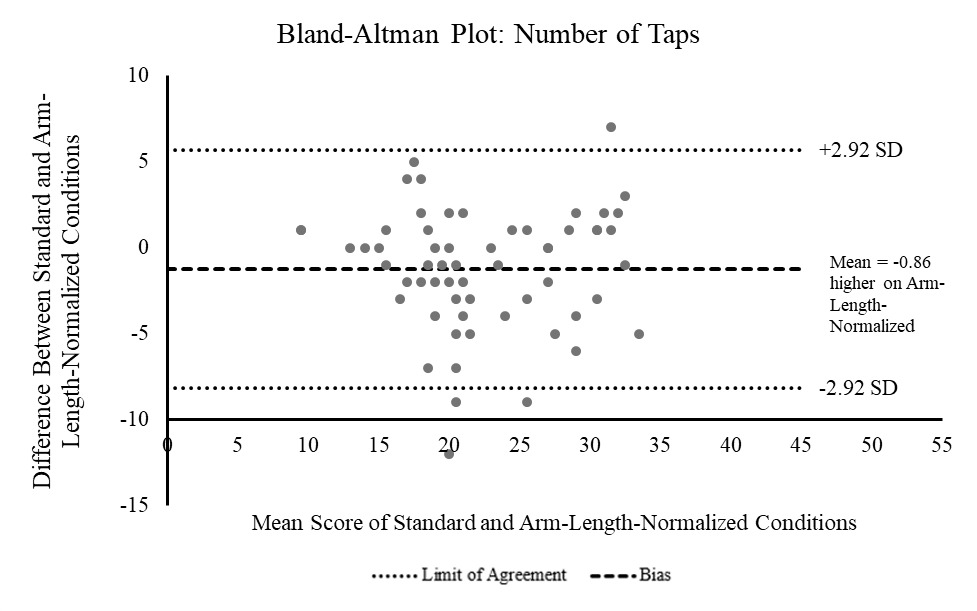
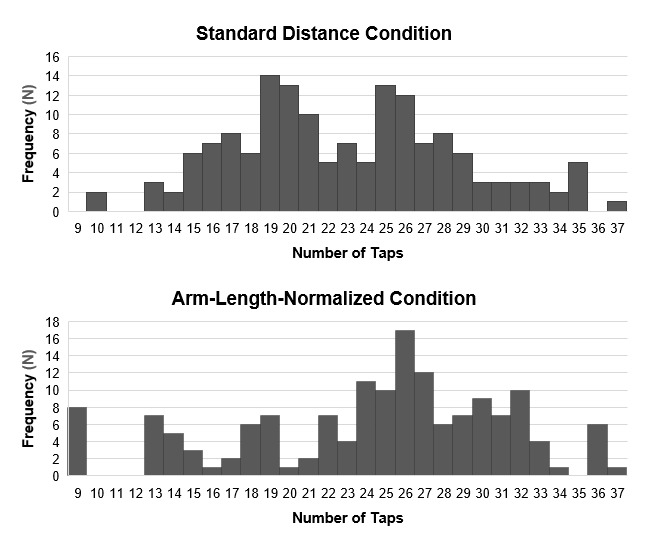
The number of maximum taps across the cohort were significantly greater during the arm-length-normalized condition (23.9±5.5 taps) compared to the standard distance condition (23.0±5.8 taps; p<0.001, r=0.29). Agreement between conditions was good (ICC=0.86, 95%CI=0.80-0.90). Bland-Altman analysis revealed a mean difference (bias) of -0.86 taps, indicating that, on average, the arm-length-normalized condition elicited slightly more taps than the standard distance condition (Figure 2). The average change between conditions was -0.86 ± 2.92 [-12.00-8.00], and 53.9% of participants performed better on the arm-length-normalized condition. The 95% limits of agreement ranged from -6.59 to 4.87, suggesting that for individual participants, differences between conditions may vary more widely than the small average bias would imply. Score distributions by condition are highlighted in Figure 3. Lastly, trial-to-trial reliability within each condition was excellent, with ICCs of 0.921 and 0.931 for the standard distance and arm-length-normalized conditions, respectively. The SEM and MDC95 were 1.60 and 4.43 taps for the standard distance condition and 1.46 and 4.03 taps for the arm-length-normalized condition, respectively.
Correlations with Participant Characteristics
For both conditions, age was not correlated to the number of taps (standard: p=0.486; normalized: p=0.686); however, body mass (r=0.17, p=0.033) and arm length (r=0.24, p=0.033) were both weakly correlated to the number of taps for the standard distance condition. Conversely, body mass (r=0.05, p=0.544) and arm length (r=0.08, p=0.317) were not correlated to the number of taps for the arm-length-normalized condition.
Group Comparison
For both CKCUEST conditions, contact athletes completed a greater number of taps (standard: 25.0±6.0 taps; normalized: 25.3±5.9 taps) than overhead athletes (standard: 20.2±4.2 taps; normalized: 21.9±4.5 taps, p<0.001, r=0.32-0.41), regardless of age (p=0.558), body mass (p=0.253), or arm length (p=0.560; Table 2).
Discussion
The purpose of this study was to compare the standard versus arm-length-normalized testing conditions for the CKCUEST in adolescent athletes. The hypothesis was partially confirmed as a greater number of taps were observed for the arm-length-normalized condition; however, agreement between the two conditions was better than anticipated. First, although performance between conditions significantly differed, the magnitude of this difference of approximately one tap was small and may not be clinically meaningful, particularly given the MDC of 4.43 and 4.03 taps for the standard distance and arm-length-normalized conditions, respectively. Second, supporting this assumption, agreement between the two testing conditions was good, as reflected in the strong correlation value. However, the Bland-Altman limits of agreement (-8.16 to 5.69 taps) exceeded the previously reported minimal detectable change. This indicates that, while the average difference between conditions was small, individual participants demonstrated a range of differences that could surpass what is typically considered true change. Therefore, although the two testing conditions show good group-level agreement, they may not be fully interchangeable for individual-level decision-making, particularly in contexts where detecting small but meaningful changes in performance is important.
Preliminary reference values established in this study further contribute to existing literature. Previous researchers have determined normative values for elite,26 adult,27,28 and youth (seven to ten years of age)29 populations. This study reported performance on the CKCUEST in a cohort of healthy, adolescent upper-extremity athletes, which provides clinically useful reference values to clinicians to aid in interpretation of test performance. Performance in the current study was found to be lower than previously reported thresholds in elite and collegiate athletes, which is not surprising. For example, prior work found that collegiate baseball players completed 30 taps,23 collegiate basketball players completed 27 taps,33 and collegiate football players completed 27 taps,34 on average, indicating greater overall performance compared to approximately 23 taps in this adolescent athlete population. The current findings are more consistent with research in adolescent athletes, which reported approximately 25 taps; however, their scores were determined as an average of three trials.20,27
Participant-specific factors were found to influence CKCUEST performance, including body mass, arm length, and sport type. As anticipated, test performance and arm length were not significantly correlated in the arm-length-normalized condition, suggesting reduced anthropometric bias and not necessarily greater upper extremity function. The results of this study agree with previous work establishing the effect of body mass and arm length on CKCUEST scores.25,26,35 Specifically, a taller athlete with a greater arm length may be able to perform better than a shorter athlete during the standard distance due to increased ability to reach and less body displacement occurring through each repetition. Previous work also includes alternative modifications for testing positions between male and female participants. Instead of normalization to arm length, in another study, females were instructed to complete testing from their knees, with arms placed a standard distance of 36 inches apart.27 However, there were no differences found in performance between the standard and modified on-knees CKCUEST conditions. This approach inherently alters the mechanical demands of the CKCUEST as well as limits comparisons in performance between males and females while the current study evaluated a modification that would allow for consistency between sexes.
The sub-analysis by sport type revealed that adolescents classified as contact players completed 25 taps. This was greater than the performance of adolescent overhead athletes who completed 22 taps, regardless of body mass and arm length, which differs from previously reported findings in older populations.23 One possible explanation for this finding is that training regimens and sport demands in adolescent athletes may strongly influence overall performance of closed kinetic chain testing. Contact athletes are frequently exposed to closed kinetic chain loading during weight room activities, blocking, and tackling, which may contribute to higher CKCUEST scores.36 In contrast, overhead athletes typically experience a greater amount of open kinetic chain demands during sport and training.37 Injuries in the overhead sport population tend to be more chronic in nature, with overuse-related pathology at the shoulder and elbow, while contact athletes demonstrate more acute, traumatic injuries involving instability.38,39 Given that the CKCUEST challenges shoulder stability, scapular control, and kinetic chain force transfer, its use may provide clinical insight into functional readiness when returning to different sport types. For example, performance by contact athletes may indicate overall restoration of stability and strength to tolerate high impact, closed kinetic chain demands of sport, whereas performance by overhead athletes may identify neuromuscular deficits contributing to overuse.
Clinically, these findings suggest that first, sport-specific reference values should be considered for assessment, and secondly, use of a test that reduces anthropometric bias may be more appropriate in adolescent athletes. The current study proposes that the arm length-normalized condition may be more suitable for assessment of upper extremity strength and function when determining functional capacity in this population. The good agreement between conditions suggests that both tests measure a similar construct; however, the standard distance condition demonstrates influence by participant-specific anthropometrics such as body mass and arm length. The CKCUEST may be useful in assessing shoulder stability and neuromuscular control in athletes recovering from shoulder instability, labral pathologies, or rotator cuff strains/tears, both operatively and non-operatively due to the necessary proximal stability at the shoulder joint.40 In clinical practice, the CKCUEST should be used in conjunction with other upper-extremity performance measures. These include isokinetic dynamometry to assess shoulder stabilizing muscle strength,41,42 the Seated Single Arm Shot Put to evaluate power required for sport-like activities,43,44 and the Posterior Shoulder Endurance Test to assess endurance and fatigability of muscle groups involved in activities of daily living, sport, and recreation.45 Using the CKCUEST as part of a multi-domain test battery allows for a comprehensive assessment of dynamic shoulder stability.
Limitations
There are several limitations of note in the current study. First, the uneven distribution of male and female participants may limit the generalizability of findings, particularly given previous research establishing sex-based differences in CKCUEST scores.25 Despite uneven distributions, the current study represents the adolescent patient population most at risk for shoulder dislocation.2,3 As such, findings may also not be generalizable to an older population. Second, the standard distance condition was consistently completed before the arm-length-normalized condition for each participant, allowing for potential learning effect during the arm-length-normalized testing condition. However, two trials were captured for each condition, and the best trial was taken, which may have mitigated a potential learning effect as participants had more than one opportunity to complete the first condition. Previous work suggests adequate rest between trials to combat fatigue-effects between conditions,46 which was provided. Further research may be warranted to include randomized order of test conditions prior to adoption of the arm-length-normalized condition in order to better understand a possible learning effect between conditions. Lastly, the greatest number of taps performed in two trials was selected for analysis, rather than averaging the performance of trials. Previous research has utilized an average of trials to determine performance recommendations in adolescent athletes.20,27 However, this study found excellent reliability with single measures in both conditions, suggesting averages of multiple trials are not necessary.
Conclusion
In a cohort of healthy adolescent athletes, performance on the arm-length-normalized condition of the CKCUEST was significantly although only slightly greater than the standard distance condition. While agreement between conditions was good, the influence of arm length and body mass on the standard condition performance suggests that the arm-length-normalized condition may be more suitable for assessment, as it reduces anthropometric bias in adolescent upper extremity athletes. Sport type was also shown to influence performance, highlighting the importance of sport-type specific functional measures and reference values for clinical assessment. Preliminary reference values established in this population can serve as a benchmark for clinicians when evaluating and interpreting closed kinetic chain upper extremity performance in athletes returning to play following a shoulder stabilization procedure.
Corresponding Author
Katie M Sloma, PT, DPT, CSCS
Movement Science Lab Frisco
Scottish Rite for Children
Frisco, TX 75034, USA
Telephone: 469-515-7157
Fax: 254-296-8154
Email: katie.sloma@tsrh.org
The authors report no potential conflicts of interest in the development and publication of this article.