INTRODUCTION
Soccer is the most widely played team sport worldwide, characterized by frequent high-intensity actions and rapid changes of direction.1 These explosive movements, particularly sprinting and high-speed running, impose substantial mechanical demands on the hamstring muscle group.2 Consequently, hamstring strain injuries (HSIs) are the most common muscle injury in soccer, accounting for up to 24% of all reported injuries, with an incidence reaching 1.9 per 1,000 hours of exposure.1
HSIs predominantly affect the long head of the biceps femoris and typically occur during the terminal swing phase of sprinting.3 Risk factors are commonly categorized as modifiable, such as muscle imbalances, fatigue, and reduced flexibility, or non-modifiable, including older age, previous injury, and short fascicle length.4,5 Although older age is a well-established non-modifiable risk factor for HSIs and injury incidence is generally lower in youth than adult players, hamstring injuries remain clinically relevant in adolescent soccer populations, where they can significantly disrupt participation, training continuity, and athletic development. A four-season study in an elite English soccer academy identified HSIs as the leading cause of time-loss and muscle-related injuries among players aged 15 to 18 years.6 Similarly, Valle et al. reported HSIs occurring as early as age 9, with avulsion-type injuries most prevalent between ages 12 and 16 and requiring the longest recovery durations.7 Recent meta-analytic data further confirm the thigh as the most frequently injured anatomical site in youth soccer players, with muscle and tendon injuries representing the majority of cases.8 These findings highlight the importance of early-stage prevention strategies for HSIs.8
Among the modifiable factors commonly discussed in relation to HSIs, hamstring flexibility has been recognized as a potentially relevant factor because of its influence on lower-limb mechanics and musculotendinous loading during high-speed actions. However, its role as an independent risk factor for HSI remains controversial.4 Although reduced hamstring flexibility has been associated with increased injury susceptibility in some studies, systematic evidence suggests that hamstring length is not consistently supported as a strong independent risk factor, whereas previous injury, age, and strength-related variables appear to show more consistent associations.5,9 Therefore, hamstring extensibility should be interpreted as a potentially relevant and modifiable physical characteristic, rather than as a confirmed causal determinant of HSI risk.
The relationship between hamstring flexibility and sports performance is also complex. Limited hamstring extensibility has been associated with selected performance-related variables in young soccer players, including sprinting, jumping, agility, and kicking velocity.10 Nevertheless, acute stretching interventions do not consistently enhance performance and may, depending on the technique, duration, and outcome assessed, induce transient reductions in force or power production. In this regard, Balle et al. reported that contract–relax stretching did not produce a greater shift in the hamstring length–tension relationship than static stretching and resulted in greater stretch-induced strength loss.11 These findings highlight the need to interpret acute flexibility interventions with caution, particularly when they are applied immediately before sport-specific actions.12
Several stretching techniques are frequently employed to enhance hamstring flexibility, including static stretching, dynamic stretching, and proprioceptive neuromuscular facilitation (PNF). Although these techniques can acutely increase range of motion (ROM), their effects on performance and injury-related outcomes appear to depend on the stretching modality, duration, population, and subsequent activity performed.12 PNF involves alternating muscle stretching with voluntary isometric contractions of either the agonist or antagonist muscle group. When the contraction is applied to the agonist muscle, the technique is referred to as contract–relax PNF (PNF-CR).13,14 Although autogenic inhibition mediated by Golgi tendon organ activity has traditionally been proposed as one possible mechanism, acute increases in ROM after PNF-CR may also reflect changes in stretch tolerance, sensory perception, passive resistance to stretch, and muscle–tendon mechanical properties.14–16
More recently, neuromuscular electrical stimulation (NMES) has been explored as an adjunct to PNF and other stretching techniques.17–21 NMES delivers transcutaneous trains of electrical pulses that depolarize motor and sensory axons beneath the electrodes, eliciting involuntary contractions in a largely nonselective, spatially fixed, temporally synchronous pattern and sending afferent volleys capable of influencing central excitability and stretch tolerance.22–25
When applied concurrently with stretching maneuvers, this additional motor and sensory input is hypothesized to increase joint range of motion (ROM) by enhancing the contractile phase, reducing perceived stretch discomfort, and, in some cases, modifying passive muscle–tendon properties.17,20,24–26 Recent randomized and crossover trials have reported modest ROM improvements following the addition of NMES to stretching protocols in healthy or athletic populations. For instance, combining NMES with PNF improved hamstring extensibility in adolescent basketball players, and pairing electrical stimulation with static calf stretching increased ankle dorsiflexion and altered passive torque parameters.17–21
However, few studies have addressed the potential placebo effect of NMES, and most available research has focused on adults. Notably, the only trial conducted in adolescent athletes exhibited important methodological shortcomings, such as the absence of placebo control, non-standardized testing procedures and possible insufficient NMES dosage.17 In this context, sensory-threshold NMES was selected as a placebo comparator because it reproduced the perceptual experience of stimulation and the use of the same apparatus without eliciting a visible muscle contraction or providing motor-level stimulation, thereby helping to better isolate the specific contribution of motor-threshold NMES.
This placebo-controlled randomized trial was designed to address previous methodological limitations and to compare the effects of contract–relax proprioceptive neuromuscular facilitation (PNF-CR) combined with motor-threshold NMES versus sensory-threshold NMES on hamstring flexibility in adolescent soccer players. A secondary objective was to assess the impact of the intervention on athletic performance, measured through a vertical jump test. It was hypothesized that the addition of motor-threshold NMES would result in greater acute improvements in hamstring flexibility compared with sensory-threshold stimulation, without negatively affecting jump performance.
METHODS
Study Design
This was a prospectively designed, two-arm, parallel-group, single-blind randomized controlled trial conducted in accordance with the CONSORT 2025 guidelines for non-pharmacological interventions. Ethical approval was obtained by a university institutional ethics committee (protocol code CEEI24/531), and the study was conducted in accordance with the Declaration of Helsinki. The trial was registered at ClinicalTrials.gov (NCT07075497; first submitted 11 July 2025; first posted 20 July 2025).
Participants
Fifty participants were recruited and assessed between 11 July and 23 July 2025. Recruitment was conducted through direct contact with coaches at a youth soccer club, whose players were invited to participate in the study. All interventions and outcome assessments were carried out at the club’s facilities. All participants were actively competing in regional youth soccer leagues organized by a regional soccer federation.
Inclusion criteria were: (1) soccer players actively training at least 2–3 times per week; and (2) aged between 11 and 18 years. Exclusion criteria were: (1) currently following a structured hamstring stretching program; (2) presence of acute low back pain; (3) history of HSI in the previous six months; or (4) spinal or abdominal surgery within the past six months.
The 11–18-year age range was selected to reflect the real-world adolescent competitive soccer population, where players may present different stages of musculoskeletal maturity but share similar sport-specific exposure to sprinting, kicking, and high-speed running demands.6,7 Eligibility was assessed by a trained physiotherapist through clinical interview and screening prior to participation.
Intervention
Written informed consent was obtained from all participants and their parents or legal guardians prior to enrolment. Participants were randomly assigned to one of two intervention groups. Before testing, all participants performed a standardized 10-minute warm-up on a stationary cycle ergometer to standardize muscle temperature and pre-testing activity levels.
All assessments were conducted at the same time of day for all participants, under standardized laboratory conditions, including room temperature and humidity controlled. Participants were instructed to refrain from ingesting caffeine or any substances that could influence neuromuscular performance for at least 24 hours prior to testing, and to avoid strenuous physical activity the day before.
PNF-CR Protocol
Motor-threshold NMES Condition
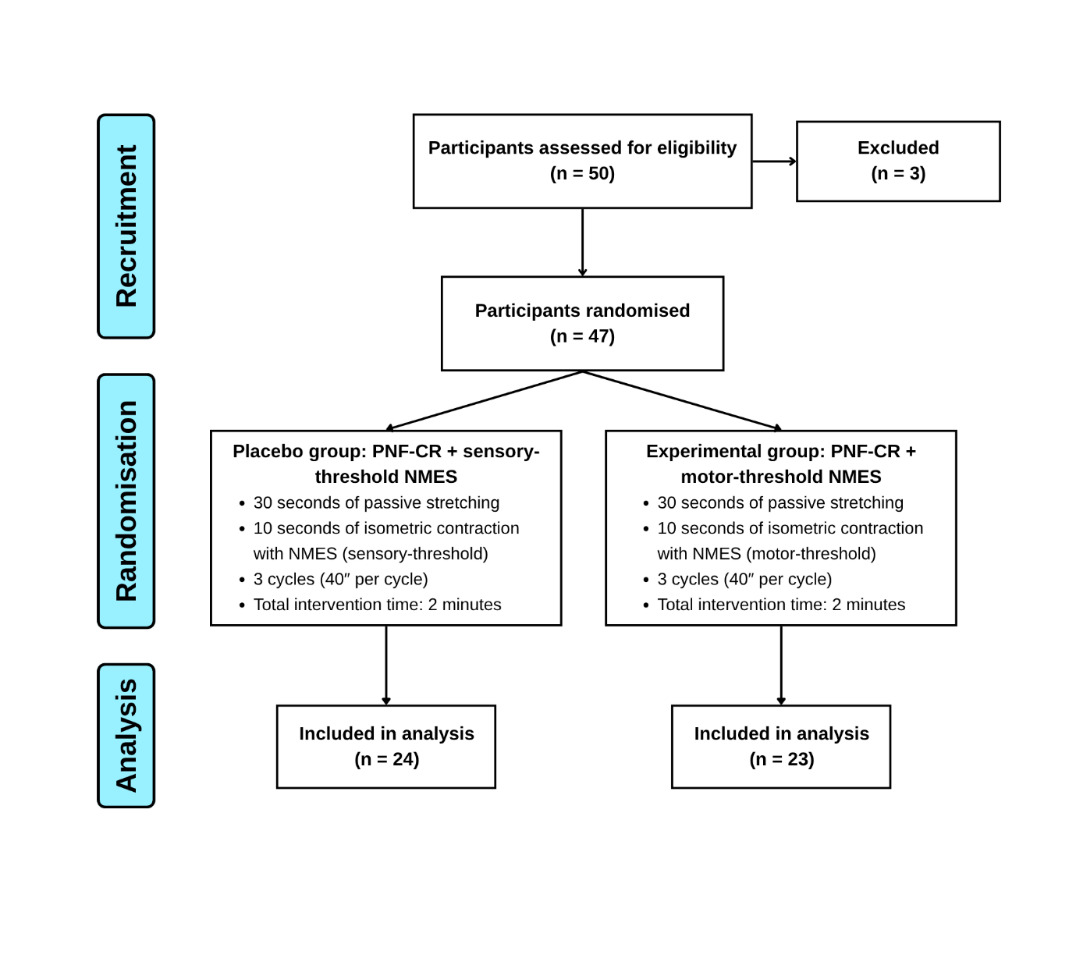
Participants in the experimental group completed a stretching protocol targeting the hamstring muscles, combined with NMES applied at an intensity above motor threshold, individually adjusted to elicit a strong but pain-free visible muscle contraction.
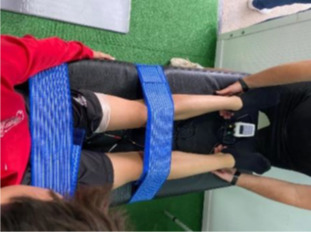
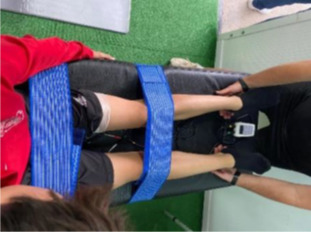
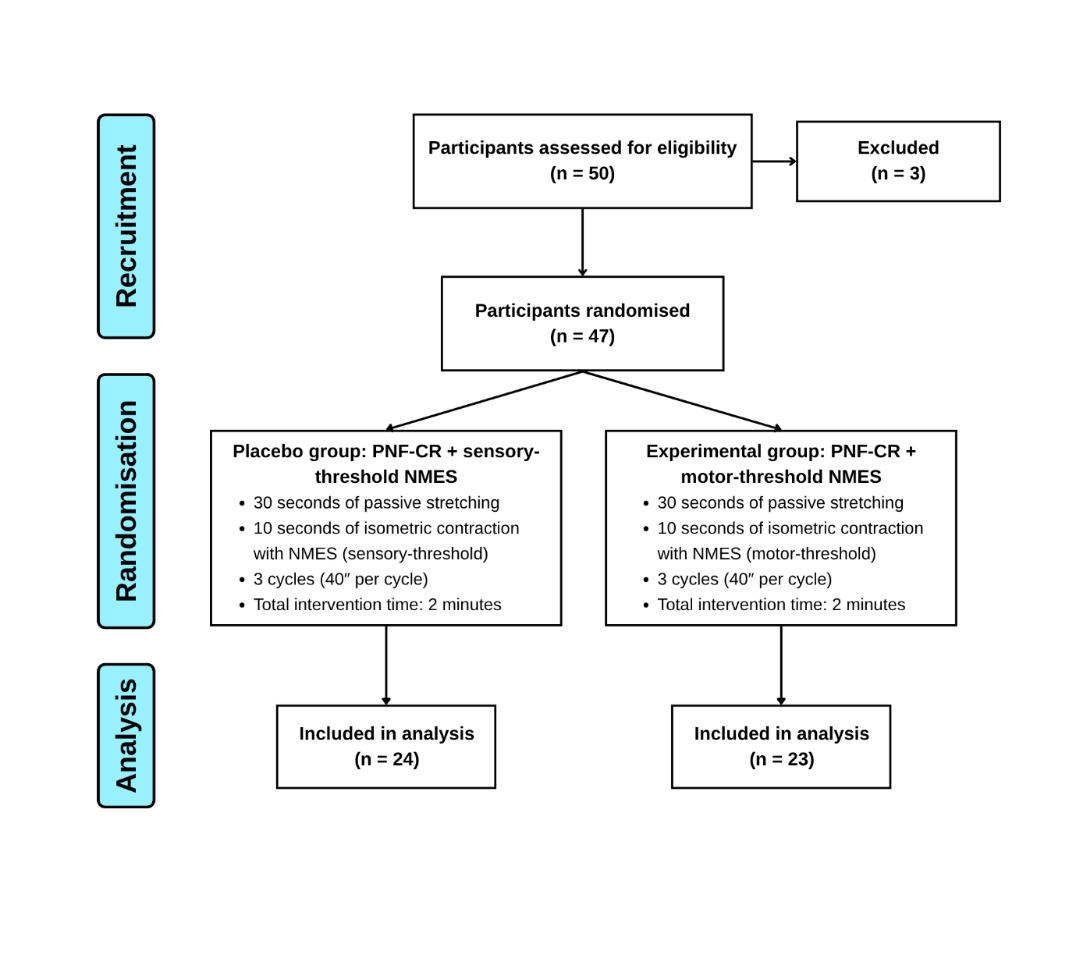
The protocol was performed bilaterally in a seated position on the table, with both knees fully extended and the pelvis visually maintained in a neutral or slightly anterior tilt position by the supervising researcher. Participants executed a 10-second maximal voluntary isometric contraction (MVIC) of the hamstrings by actively pressing their heels against the table. Immediately after the contraction phase, they performed a 30-second passive stretch by leaning the trunk forward from the hips, maintaining knee extension throughout. This contraction–relax cycle was repeated three times. The selected dose was based on previous PNF stretching protocols using 10-second isometric contractions and repeated 30-second stretching bouts and represented a moderate increase in stretching exposure compared with a previously published lower-dose protocol.17,27,28
NMES Parameters
NMES was delivered during the MVIC phase, using a symmetric, biphasic rectangular waveform at 50 Hz frequency and 250 microseconds pulse duration. Stimulation intensity was recorded in milliamperes (mA) separately for the right and left legs during the intervention.
Device and Electrode Placement
Electrical stimulation was administered using the same device in both groups, the TensMed S82 (Enraf-Nonius, Delft, The Netherlands). For each leg, two 5 × 9 cm self-adhesive electrodes (Herycor Rehabilitación y Medicina Deportiva S.L., Alicante, Spain) were positioned longitudinally along the hamstring muscle, in a proximal-to-distal orientation: one electrode was placed 1 cm distal to the gluteal fold, and the other 1 cm proximal to the tendinous insertion near the knee. The device model, electrode type, placement protocol, and overall procedure were identical for both groups, with the only difference being the nature of the stimulation (motor threshold vs sensory placebo).
Positioning and Stabilization
Pelvic position was visually monitored throughout the protocol by the same researcher to promote procedural consistency. To minimize compensatory knee flexion, two non-elastic straps were applied across the hips and knees. A second researcher placed their hands on the participants’ heels to ensure consistent timing and correct execution of the contraction and stretching phases.
Sensory-threshold NMES Condition
Participants in the placebo group followed the same PNF-CR protocol. However, during the MVIC phase, NMES intensity was maintained below motor threshold, producing only a sensory tingling sensation without visible muscle contraction. In this condition, current intensity was increased only until the participant reported the first minimal perceptible sensation and was not subsequently increased during the session to compensate for sensory accommodation. Stimulation was applied only during the 10-second contraction phase of each of the three cycles, resulting in a total sensory-threshold stimulation time of 30 seconds. This condition was designed as a credible sham comparator to control for the perceptual experience of receiving electrical stimulation while avoiding the motor-level contraction targeted by the experimental intervention.
Outcome Measures
Before outcome testing, height, body mass, and arm span were recorded. Height and arm span were measured in centimetres, body mass was measured in kilograms, and height–arm span difference was calculated as height minus arm span and expressed in centimetres. Three outcome measures were used to evaluate the effects of the intervention: hamstring flexibility, assessed by the Sit-and-Reach (SR) and Popliteal Angle (PA) tests, and jump performance, assessed by the Countermovement Jump (CMJ).
The SR and PA tests were selected as complementary clinical measures of hamstring extensibility rather than as direct predictors of HSI risk. The SR test provides a practical field-based assessment commonly used in youth and sport settings, with age- and sex-specific normative centiles available for European children and adolescents.29 The PA test provides a more angular-specific measure of hamstring extensibility, with established reference categories commonly used to classify hamstring flexibility as normal or limited.30 Given the uncertainty regarding hamstring length as an independent HSI risk factor, these outcomes were used to quantify acute flexibility changes following the intervention, not to infer changes in injury risk.5
Tests were administered in a fixed order (SR, PA, CMJ) to ensure methodological consistency and reproducibility. All pre- and post-intervention assessments were performed by the same trained evaluator, a physiotherapist with more than 20 years of professional experience. The same assessor also recorded all outcomes to minimize assessment bias and ensure standardization across participants.
Sit and Reach Test (SR)
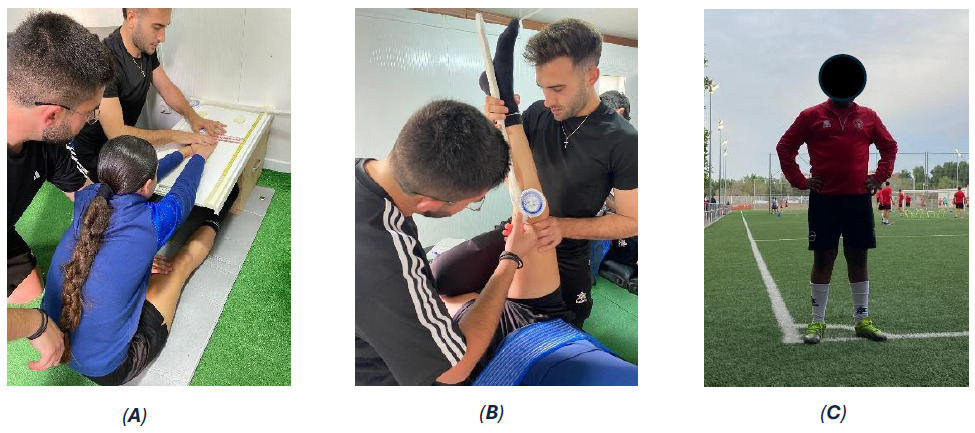
The SR test is a validated and widely used field-based measure of hamstring flexibility in youth, with excellent intra-rater reliability (ICC ≥ 0.90).31 A meta-analysis by Mayorga-Vega et al. reported moderate criterion-related validity (corrected rp = 0.46–0.67) when compared with angular reference measures such as the passive straight-leg raise.32 In the present study, participants sat on the floor with legs fully extended, feet flat against the SR box, and knees straight. They reached forward with one hand placed over the other along the measuring platform (Figure 2A). Three trials were completed, and the mean reach distance (cm) was recorded. Greater distances indicated higher hamstring extensibility.
Popliteal Angle Test (PA)
The PA test provides a quick and reproducible measure of hamstring extensibility. Among active young individuals, it shows near-perfect test–retest reliability (ICC = 0.97–0.99; CV < 1%), and strong criterion validity, as demonstrated by an inverse correlation with true hamstring length obtained from three-dimensional gait analysis (r ≈ –0.78).33,34 During testing, participants lay supine while a trained examiner passively extended the knee with the hip held at 90° flexion until a strong but non-painful stretch was perceived. Knee extension was measured using an inclinometer (Fabrication Enterprises Inc., White Plains, NY, USA) two seconds after end-range position was reached (Figure 2B). The procedure was repeated three times, and the mean angle (°) was recorded. A value of 0° represented full knee extension; higher angles indicated reduced hamstring flexibility.
Countermovement Jump (CMJ)
The CMJ is a standardized field test for assessing lower-limb explosive strength and overall athletic performance.35 It demonstrates excellent reliability in young athletic populations (ICC up to 0.98; CV < 3%) and strong factorial validity (r = 0.87) for explosive power.35 In this study, jump height was measured using the My Jump 2 smartphone application, which has shown near-perfect agreement with force platforms (ICC = 0.96; r = 0.995).36,37 Participants began from an upright stance (hands on hips, feet shoulder-width apart), remained still for 2 seconds, performed a rapid countermovement to approximately 90° knee flexion, and then executed a maximal vertical jump while maintaining full knee extension in flight. Landings were performed with both feet placed approximately shoulder-width apart and aligned side-by-side, avoiding a staggered foot position and excessive knee flexion (Figure 2C). Jump height was measured with the My Jump 2 on an iPhone 14 (1080p, 60 fps). Three trials were completed per participant; the mean height (cm) was recorded, with greater values reflecting better jump capacity.
_sit_and_reach_test__(b)_popliteal_angle_test__(c)_countermovement_ju.png)
Randomization and Blinding
Participants were randomly allocated to either the experimental or placebo group using a stratified randomization method. Stratification was based on PA, sex, and chronological age. The PA test was selected as it provides an angular-specific assessment of hamstring extensibility, minimizing the influence of unrelated variables such as spinal or hip mobility. Participants were categorized into three flexibility subgroups based on PA values: normal (≤15°), mild hamstring tightness (grade I: 16–34°), and moderate hamstring tightness (grade II: 35–44°), in accordance with established normative values.30
The randomization sequence was generated using dedicated computer software by a researcher not involved in outcome assessments or interventions. Allocation concealment was maintained until the moment of group assignment.
Due to the nature of the interventions, the researchers responsible for delivering them could not be blinded. However, to minimize assessment bias, all outcome measurements were conducted by an independent physiotherapist who was blinded to group allocation and had no involvement in the implementation of the intervention protocols.
Statistical Analysis
A sample size of 20 participants per group was required to detect a statistically significant between-group difference of 4.5° (SD = 5°), assuming 80% statistical power and an α level of 0.05. To account for potential dropouts and preserve statistical power, the sample was increased by 15%, resulting in a final total of 46 participants.
Statistical analyses were performed using IBM SPSS Statistics v.30.0.0.0 (Armonk, NY, USA) under an intention-to-treat approach. Descriptive statistics were calculated for all variables and expressed as mean ± standard deviation. A chi-square test was used to examine sex distribution across groups. The Shapiro–Wilk test was used to assess normality, and Levene’s test was used to assess homogeneity of variances. These assumptions were met for all variables (p > 0.05), except for age.
Independent samples t-tests were used to compare baseline height-to-arm-span differences, while the Mann–Whitney U test was applied to compare age between groups due to non-normal distribution.
To examine intra- and intergroup differences in SR, PA and CMJ before and after the intervention, a two-way repeated-measures ANOVA was conducted. The between-subjects factor was group (sensory-level NMES vs. motor-level NMES), and the within-subjects factor was time (pre- and post-intervention). Bonferroni post hoc tests were applied where appropriate. Statistical significance was set at p < 0.05.
Although no statistically significant differences were observed between groups in baseline CMJ values, a small numerical difference (1.8 cm) was present. To minimize potential bias and improve the accuracy of the intervention effect estimation, a univariate analysis of covariance (ANCOVA) was used for CMJ, with pre-intervention scores included as covariates.
An additional independent samples t-test was conducted to compare NMES intensity in milliamperes between groups, separately for the right and left legs. The experimental group received motor-threshold stimulation (high intensity without pain), while the placebo group received stimulation at sensory threshold to elicit a placebo effect.
Finally, to complement the inferential analyses described above, relative and absolute reliability were assessed for the SR, PA, and CMJ tests using the three repeated trials performed at pre- and post-intervention. Analyses were conducted separately for each test and time point. Relative reliability was evaluated using the intraclass correlation coefficient, ICC (3,1), with 95% confidence intervals. ICC values >0.90 were considered indicative of excellent reliability. Absolute reliability was assessed using the standard error of measurement (SEM) and the minimal detectable change at 95% confidence (MDC95), calculated as SEM × 1.96 × √2.
All statistical procedures adhered to standard assumptions and were interpreted accordingly.
RESULTS
Participant Flow
A total of 50 participants were recruited, of whom three were excluded based on exclusion criteria. The final sample comprised 47 youth soccer players (mean age: 13.2 ± 1.8 years), as illustrated in Figure 3. Baseline characteristics are summarized in Table 1.
Baseline Characteristics
Sex distribution was balanced between groups (p = 0.380). Stratified randomization was successful, as no statistically significant between-group differences were observed at baseline for any variable (p > 0.05), including the height-to-arm-span difference (p > 0.05), which is relevant because of its potential influence on SR test results. Sex distribution was as follows: placebo group, 16 males and 8 females; experimental group, 12 males and 11 females.
The full age distribution was as follows: 11 years, n = 10; 12 years, n = 8; 13 years, n = 12; 14 years, n = 4; 15 years, n = 9; 16 years, n = 2; 17 years, n = 0; and 18 years, n = 2. Based on baseline PA values, participants were classified as having normal hamstring flexibility (≤15°; n = 14), mild hamstring tightness (16–34°; n = 30), or moderate hamstring tightness (35–44°; n = 3), according to established normative categories.31
Flexibility Outcomes
There was no significant time × group interaction for SR (p = 0.942) or PA (p = 0.618). A significant main effect of time was observed for both SR and PA (both p < 0.001), whereas the main effect of group was not significant for either outcome (SR: p = 0.621; PA: p = 0.840). Bonferroni-adjusted pairwise comparisons showed significant pre–post improvements in both groups for SR (placebo: p < 0.001; experimental: p < 0.001) and PA (placebo: p = 0.018; experimental: p = 0.003). Mean changes, 95% CIs, and mixed ANOVA effects for flexibility outcomes are presented in Table 2.
Jump Performance Outcome
Regarding CMJ, no significant time × group interaction was observed (p = 0.793). In addition, neither the main effect of time (p = 0.498) nor the main effect of group (p = 0.793) was statistically significant.
NMES Intensity Verification
Mean NMES intensity in the experimental group reached 36.9 mA (right leg) and 36.5 mA (left leg), compared to 8.5 mA and 8.0 mA in the placebo group, respectively. These differences were statistically significant and confirm that the placebo protocol delivered substantially lower stimulation intensities, supporting the validity of the sensory-level condition used as a control.
Reliability of Outcome Measures
The reliability results are shown in Table 3. All tests demonstrated excellent relative reliability at both pre- and post-intervention, with ICC values ranging from 0.930 to 0.981. SEM values ranged from 1.026 to 2.061, while MDC95 values ranged from 2.845 to 5.712.
DISCUSSION
This randomized controlled trial examined the immediate effects of a PNF-CR stretching protocol combined with either motor-threshold or sensory-threshold NMES on hamstring flexibility and vertical jump performance in adolescent soccer players. The primary objective was to assess whether the addition of motor-level NMES would yield greater short-term improvements in hamstring flexibility compared to placebo-level stimulation. The secondary aim was to explore the acute effects of both interventions on vertical jump performance.
The results revealed that the addition of motor-threshold NMES to a PNF-CR stretching protocol did not produce significantly greater improvements in hamstring flexibility compared to sensory-level (placebo) stimulation. Both groups exhibited similar acute gains in flexibility following the intervention. Regarding vertical jump performance, no significant changes were observed within or between groups, indicating that neither protocol had an immediate effect on explosive lower-limb power.
The current trial was conducted in response to the limited number of studies investigating flexibility interventions in youth soccer players and was specifically designed to address several methodological limitations identified in a previous study by Sos-Tirado et al. in young basketball players.17 That earlier trial used shorter contraction and stretch durations, lacked non-elastic strap stabilization, and did not include a placebo control group. To overcome these limitations, the present study incorporated key methodological refinements, including longer stretch–contract cycles, standardized positioning with hip and knee straps to minimize compensatory movements, and the implementation of a placebo-controlled condition using sensory-level NMES to isolate the specific contribution of stimulation intensity. In addition, individual stimulation intensities were measured and recorded in both groups. The validity of the placebo condition was confirmed through statistically significant differences in stimulation intensity.
Both intervention groups showed statistically significant within-group improvements in hamstring flexibility, as measured by the SR and PA. However, these changes were modest in magnitude and should be interpreted as acute improvements in hamstring extensibility measures rather than definitive evidence of clinically meaningful individual changes. These findings are consistent with previous research demonstrating the effectiveness of PNF-CR protocols in acutely enhancing muscle extensibility.14,16,38–41 These acute improvements may be partly explained by mechanisms traditionally associated with PNF-CR, including autogenic inhibition, changes in stretch tolerance, sensory modulation, and alterations in passive resistance to stretch.14,15,42 However, the relative contribution of these mechanisms remains unclear, and the present findings should therefore be interpreted as short-term changes in clinical flexibility measures rather than evidence of structural adaptation. Given that the precise mechanisms underlying these acute improvements remain unclear, further research is needed to clarify the neurophysiological processes involved and to optimize stretching protocols in athletic populations.
Despite the clear within-group improvements, no significant between-group differences were observed in flexibility outcomes. This suggests that motor-threshold NMES did not provide additional benefit over sensory-level stimulation when superimposed on the PNF-CR protocol. Similar findings were reported in the 2024 basketball trial, where NMES also failed to outperform PNF-CR alone.17
In contrast, a recent randomized controlled trial conducted in healthy adults reported significant between-group differences favoring the addition of low-frequency NMES to PNF techniques, indicating that NMES may enhance the effectiveness of PNF stretching and lead to superior flexibility outcomes.43 Furthermore, Ortega Nieto et al. (2019) observed that improvements in hamstring flexibility following electromyostimulation can persist beyond the immediate post-intervention phase, resulting in meaningful and sustained increases in range of motion.44 These findings highlight the potential of NMES as a complementary tool in both clinical and athletic contexts.
The discrepancies between studies may be attributed to differences in participant characteristics, stimulation parameters, or the overall intensity and duration of the protocols. Moreover, the effectiveness of NMES may depend on factors such as familiarity with the stimulus, individual training status, or the cumulative effect of repeated applications.45,46 In this context, the comparable outcomes observed in the present study may reflect a potential placebo effect of sensory-level NMES or indicate a ceiling effect of the PNF-CR technique itself, which may already elicit near-maximal short-term flexibility gains.
Regarding athletic performance as assessed by the CMJ test, neither intervention produced significant changes in jump height. This indicates that none of the implemented protocols had a detrimental effect on vertical jump performance, a key variable linked to explosive power in the context of soccer. These findings are consistent with those of Sos-Tirado et al., who also reported no significant differences in CMJ height, as well as with other studies suggesting that stretching programs do not impair athletic performance and may even enhance it.14,15,17,47 Future research could expand upon these findings by exploring the long-term effects of such interventions on flexibility, performance outcomes, and injury prevention.
Limitations
This study presents some limitations that should be considered when interpreting the results. First, although randomization was stratified by sex, chronological age, and baseline hamstring flexibility, the inclusion of players aged 11–18 years may have introduced variability related to biological maturation, neuromuscular responsiveness, muscle stiffness, and flexibility characteristics. Because biological maturation was not directly assessed, maturation-related differences could not be formally examined in subgroup analyses. Similarly, although both male and female players were included and sex was considered in the randomization process, the sample size was not sufficient to examine sex-specific responses to the intervention.
Second, NMES intensity was individually adjusted according to participant tolerance to achieve the intended motor- or sensory-threshold condition. Although absolute current amplitude differed between groups and may have influenced treatment response, this should not be interpreted as variability in the predefined stimulation dose, as stimulation was operationally standardized according to a functional physiological criterion: a strong but pain-free visible contraction in the motor-threshold condition and a sensory tingling sensation without visible contraction in the sensory-threshold condition.
Third, sensory-threshold stimulation was used as a credible placebo comparator because it reproduced the perceptual experience of electrical stimulation and the use of the same device while avoiding the motor-level response targeted by the experimental NMES condition. However, this condition cannot be considered completely physiologically inert, as low-intensity sensory stimulation may provide afferent input capable of influencing stretch tolerance or neuromuscular responses. Therefore, the absence of a third group performing PNF-CR without NMES should be considered when interpreting the specific contribution of electrical stimulation. Accordingly, the present findings indicate that motor-threshold NMES did not provide additional benefit over a credible sensory-threshold comparator, but do not allow definitive conclusions about whether PNF-CR alone would have produced equivalent effects.
Finally, pelvic positioning and stabilization procedures were visually monitored but not objectively quantified. Nevertheless, the use of standardized positioning, non-elastic straps, the same supervising researcher, and the excellent intra-rater reliability observed for the SR, PA, and CMJ measurements at both pre- and post-intervention supports the consistency of the outcome assessment procedures. In addition, the intervention required participants to exert force against the table, which may have involved some coactivation of other hip extensor muscles, such as the gluteus maximus. Future studies should consider direct assessment of biological maturation, larger samples allowing sex-specific analyses, objective monitoring of pelvic positioning, and additional comparison groups to further clarify the isolated and long-term effects of PNF-CR and NMES on flexibility, performance, and injury-related outcomes.
Clinical Implications
Contract–relax PNF stretching provides a practical and time-efficient strategy to produce modest short-term increases in hamstring extensibility in adolescent soccer players without impairing vertical jump performance. Given the lack of additional benefit from motor-threshold NMES over the sensory-threshold comparator, practitioners should be cautious when assuming that adding motor-level stimulation to PNF-CR provides superior acute flexibility gains. However, because the study did not include a PNF-CR-only group, the findings should not be interpreted as direct evidence that PNF-CR alone is equivalent to PNF-CR combined with NMES. Rather, they suggest that, under the present acute protocol, the motor-level component of NMES did not confer additional benefit beyond a credible below-motor-threshold stimulation condition. From a practical perspective, both protocols appear suitable for pre-training contexts where modest short-term increases in hamstring extensibility are desired without compromising explosive performance.
CONCLUSIONS
The findings of this study indicate that the addition of motor-threshold NMES to a contract–relax PNF-CR stretching protocol does not produce superior short-term improvements in hamstring flexibility compared to the same protocol combined with sensory-level stimulation. These results suggest that motor-level NMES does not offer additional advantages for improving flexibility immediately after the intervention in adolescent soccer players. Additionally, the use of PNF-CR stretching combined with either motor- or sensory-threshold NMES did not impair vertical jump performance, indicating no detrimental effects on explosive strength.
Corresponding author
Juan J. Amer-Cuenca, PT, PhD
Department of Physiotherapy, School of Health Sciences
Universidad Cardenal Herrera-CEU
Alfara del Patriarca, Valencia, Spain
Email: juanjoamer@uchceu.es
Ethics approval and informed consent
The study was conducted according to the guidelines of the Declaration of Helsinki and approved by the Ethics Committee for Biomedical Research of the Universidad Cardenal Herrera (CEEI24/531) on 4 April 2025.
Funding Statement
This research was supported by grants from the University CEU-Cardenal Herrera (GIR25-41).
Disclosure statement
The authors have declared that no competing interests exist.
Data availability statement
The data that support the findings from this study are available from the authors upon reasonable request.
Trial Registration
ClinicalTrials.gov (NCT07075497; first submitted 11 July 2025; first posted 20 July 2025).