Introduction
Objective strength testing at the shoulder has been utilized to provide objective assessment of muscle function, guide rehabilitation practices, and even to inform return-to-play (RTP) decision making.1–3 Handheld dynamometry (HHD) at the shoulder, specifically for the internal and external rotators, has been recommended to be included as part of an assessment of RTP readiness,1,3 but variation in testing methods and limited examination in its application for the adolescent athlete limits interpretation of results. In contrast, lower extremity strength testing is more common and widely understood as gold standard, specifically at the quadriceps and hamstrings, is commonly performed using isokinetic dynamometry to determine readiness for return to play (RTP).4,5 However, isokinetic dynamometry is costly, and far less accessible than HHD, limiting its routine clinical use. As a result, HHD is a more widely utilized alternative for assessments of strength due to its portability and cost-effectiveness. While objective strength assessments have been investigated extensively in the lower extremity, little evidence exists regarding utility of these assessments in guiding rehabilitation or RTP practices following shoulder injuries in adolescent athletes.
While association of strength measures between HHD and isokinetic dynamometry in the lower extremity have been assessed across a range of ages and revealed moderate correlations between devices,6 few comparisons between testing methods at the shoulder have been made in adolescent athletes, despite the possible utility of strength measures in this population.7,8 This is largely due to the multitude of variations that exist in test position and examiner stabilization methods, limiting reproducibility.9,10 These variations further complicate any direct comparisons that can be made between clinicians, methods, patient groups, and devices.10–13 Further assessment is needed to identify which commonly utilized HHD testing positions for the internal and external rotators of the shoulder most accurately reflect gold standard isokinetic dynamometry values and can be reliably used to guide rehabilitation practices in adolescent athletes following a shoulder injury.
In addition to a lack of standardized testing methods, there are no published normative strength data that currently exist for adolescent athletes, making it difficult to interpret results or establish benchmarks. Identifying valid and reliable HHD positions with normative values for comparison will help clinicians standardize consistent testing positions, monitor progress over time, and make more informed decisions regarding rehabilitation and safe RTP.2 Therefore, the purpose of this study was to compare HHD strength values of shoulder internal rotators (IR) and external rotators (ER) to isokinetic values in healthy youth athletes. It was hypothesized that HHD values obtained in the prone position would demonstrate the strongest agreement with isokinetic strength measures for both shoulder internal and external rotators due to positional constraints that limit compensatory movement.
Methods
Participants
Healthy, youth athletes aged 14-18 years participating in contact or overhead upper extremity sports were recruited from local teams, clubs, and youth sports organizations to participate in this study. Participants were excluded if they reported any history of upper extremity musculoskeletal or neuromuscular conditions or experienced an injury in the past six months that would limit their ability to perform the required assessments. Approval from a regional Institutional Review Board was obtained prior to initiating study procedures. Upon enrollment, informed consent/assent was obtained prior to participation.
Procedures
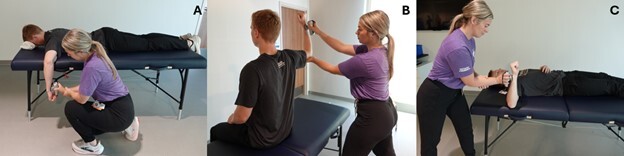
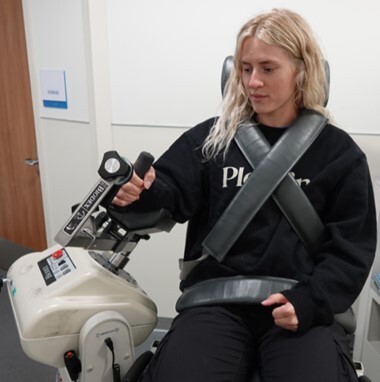
Age and arm dominance were obtained from a demographic survey and body mass (kg) was recorded for each participant. Arm dominance was defined as either the hand used for writing or the throwing arm, if differing from the writing hand.14 Strength testing on both the dominant and non-dominant limb was completed with the use of a HHD (Lafayette Instrument, Lafayette, IN) and a Biodex System 4 dynamometer (Biodex Medical Systems, Shirley, NY) as part of a series of upper extremity measures assessing strength, power, endurance, and stability. HHD testing was performed in three testing positions using a “make-test”, with the examiner holding the dynamometer stationary and the subject exerting maximal force against it.15 Positions included prone (90° shoulder abduction; neutral rotation), seated (90° shoulder abduction; 90° external rotation, and supine (90° shoulder abduction; neutral rotation) (Figure 1).2,13,16 The order of HHD test position was randomized, with two trials collected for each position recorded in pounds (lbs). Biodex testing was completed in a seated position (45° shoulder abduction in the scapular plane) at 60 degrees/second with a warmup period of two practice trials followed by a rest break of five seconds, and then three maximum effort trials with adequate rest breaks self-selected by participant provided between trials and conditions (Figure 2). Peak torque was captured in Newton-meters (Nm). For each testing condition, across both devices, the trial with the greatest strength measure was included for analysis.
_test_position_for_prone_handheld_dynamometry_(90_shoulder_abduction__neutral_rota.jpeg)
To allow comparison between HHD and Biodex strength measures, HHD force values recorded in pounds were converted to estimate joint torque (Nm). HHD values were first converted from pounds to Newtons (1 pound-force = 4.44822 N) and then multiplied by a standard forearm lever arm length to calculate torque. Lever arm length was defined as the distance from the elbow to the point of force application near the wrist and was estimated using sex-specific anthropometric values for adolescent athletes (0.29m for males, 0.25m for females).17,18 This approach yielded an estimate of isometric shoulder rotation torque from HHD testing, which was expressed in the same units (Nm) as the isokinetic Biodex measures.
Statistical Analysis
Descriptive statistics (means and standard deviations) were computed for all continuous measures, including age, body mass, and strength measures for each position and testing device. Given significant tests for normality, differences between strength measures from the Biodex versus each HHD condition, as well as differences between the individual HHD conditions, were evaluated using Wilcoxon signed-rank tests. Effect sizes (r) were calculated for all pairwise comparisons to quantify the magnitude of observed differences, and were interpreted as small (0.10), moderate (0.30), or large (≥ 0.50).19 To account for multiple comparisons, a Bonferroni correction was applied such that the significance threshold was adjusted to α = 0.05 / 6 comparisons = 0.008.
Intraclass correlation coefficients (ICCs) with 95% confidence intervals were computed to determine the level of agreement between Biodex strength measures and each HHD strength measure for both the ER’s and IR’s. Lastly, the standard error of measurement (SEM) was calculated to estimate absolute measurement error, and the minimal detectable change at the 95% confidence level (MDC95) was derived to represent the smallest change required to exceed measurement error and reflect a true change in strength. All statistical tests were evaluated in SPSS Statistics (IBM, version 24.0, Armonk, NY, USA).
Results
A total of 64 participants (37 male; 16.8±1.0 years, 177.0±9.3 cm, 73.0±17.1 kg), were tested bilaterally and included for analysis. Participant demographics as well as HHD and Biodex performance are presented in Table 1.
Paired comparisons between testing devices and positions are displayed in Table 2. When testing strength of the dominant arm IR, results from the seated HHD position were significantly less than Biodex testing (p < 0.001, r = 0.55), while no significant differences existed between the prone and supine positions and Biodex outcomes. However, strength of the non-dominant IR was significantly less than Biodex test results in seated (p < 0.001, r = 0.46) and significantly greater than Biodex in prone (p < 0.001, r = 0.53) positions. Additionally, between HHD methods of the IR’s, seated results were significantly less than both prone (DOM: p < 0.001, r = 0.68; NON: p < 0.001, r = 0.73) and supine (DOM: p < 0.001, r = 0.67; NON: p < 0.001, r = 0.67) position results.
For strength measures of the ER’s, HHD measures were significantly greater than Biodex measures in prone (DOM: p < 0.001, r = 0.87; NON: p < 0.001, r = 0.87) supine (DOM: p < 0.001, r = 0.87; NON: p < 0.001, r = 0.87), and seated (DOM: p < 0.001, r = 0.48; NON: p < 0.001, r = 0.54) positions. Between HHD methods of the ER’s, seated significantly differed from both prone (DOM: p < 0.001, r = 0.83; NON: p < 0.001, r = 0.83) and supine (DOM: p < 0.001, r = 0.86; NON: p < 0.001, r = 0.85) positions.
Agreement between Biodex and HHD positions ranged from moderate to large for strength of the IR’s but were consistently small for measures of strength for the ER’s (DOM: ICCs=0.28-0.43; NON: 0.29-0.38; Table 3). Specifically, for the IR’s, the strongest agreement with Biodex was found with the prone position (DOM: ICC=0.81, 95%CI=0.69-0.88; NON: ICC=0.84, 95%CI=0.65-0.92), followed by supine (DOM: ICC=0.76, 95%CI=0.63-0.85; NON: ICC=0.76, 95%CI=0.66-0.86) and seated (DOM: ICC=0.59, 95%CI=0.33-0.75; NON: ICC=0.59, 95%CI=0.39-0.73).
The MDCs computed for the IR’s in the prone, supine, and seated positions were 18.3 Nm, 20.5 Nm, and 26.6 Nm, respectively for the dominant arm and 16.7 Nm, 19.5 Nm, and 26.7 Nm, respectively for the non-dominant arm.
Discussion
The purpose of this study was to compare shoulder strength of the ER’s and IR’s measured across three commonly used HHD positions versus Biodex isokinetic testing in adolescent athletes. The hypothesis was partially confirmed as HHD testing in the prone position demonstrated the strongest agreement with Biodex strength measures. However, this agreement was only strong for strength of the IR’s. Strength measures of the ER’s consistently demonstrated weak agreement with Biodex measures across all positions. These findings underscore the continued challenges associated with accurately assessing ER using examiner-dependent measurement techniques and highlight the need for careful consideration when selecting assessment tools to monitor progress and inform RTP decisions in adolescent athletes.
Prior work comparing HHD with isokinetic dynamometry, primarily in adult populations, has reported mixed findings. While some studies report strong correlations between devices,2 others highlight important limitations related to variability20 which include test position, fixation techniques, and examiner stabilization strategy.16,21 Evidence regarding fixation techniques (e.g., using a strap or a belt to stabilize the dynamometer) remains inconsistent with some studies reporting worse reliability for fixed methods compared to non-fixed approaches,21,22 while others suggest that fixed dynamometry is more reliable at higher measures of strength in the upper extremity.23 Concurrent validity data are also mixed, with several studies reporting that strength measures of the ER’s and IR’s are comparable between HHD and isokinetic dynamometry,2,24 and others reporting poor agreement.25 Kramer et al. found strength measures of the IR’s to be similar and strength measures of the ER’s to differ across measurement devices, with measures of the ER’s noted to be higher with use of HHD compared to isokinetic dynamometry.26 The current findings are consistent with this work as the current study demonstrates that strength of the IR’s show stronger agreement with Biodex values than strength of the ER’s.26 The authors of the present study hypothesize that poor agreement with strength of the ER’s may be due in part to the smaller absolute torque values which may produce larger relative measurement error. Additionally, different length-tension relationships throughout the isokinetic arc of motion compared to a single angle isometric measure may further contribute to weaker associations observed between testing modalities.
Accurate assessment of strength of the ER’s is particularly important in adolescent athletes, as deficits in strength have been associated with increased shoulder injury risk. For example, adolescent athletes who have undergone a shoulder stabilization procedure, may experience rotator cuff weakness addressed throughout rehabilitation.27,28 Additionally, weakness of the ER’s is especially of concern in adolescent overhead athletes as strength deficits have been associated with several throwing related rotator cuff and labral pathologies.29 Preseason weakness of the ER’s and reduced rotator cuff strength has been linked to in-season injury30 and reduced strength of the ER’s and altered ER/IR strength ratios have been identified as modifiable risk factors for shoulder injury.31 With the utilization of HHD in assessment of strength of the ER’s, clinicians risk under- or overestimating an athlete’s readiness to progress in rehabilitation or to RTP. It has been shown that accuracy of HHD decreases at lower force levels,32,33 which is particularly relevant given the lower force production observed during assessment of the ER’s compared with the IR’s. Therefore, small changes in participant positioning, effort, or examiner-resistance may reflect a larger percentage of the measured strength value, leading to greater measurement error. Based on the weak agreement observed in the current study, the authors recommend using gold-standard isokinetic testing for assessment of strength of the ER’s in adolescent athletes, when available.
Arm dominance is another important consideration in upper extremity strength assessments, particularly in overhead athletes exposed to repetitive, unilateral loading (e.g., baseball, softball, volleyball, tennis).34,35 Previous work has identified significant strength differences between dominant and non-dominant upper extremity HHD measures,13 highlighting the importance of an assessment tool with consistent measurement properties across limbs. The current study found that reliability between HHD and Biodex strength measures was similar across dominant (ICC: 0.28-0.81) and non-dominant (ICC: 0.29-0.84) limbs, suggesting that measurement error was not limb dependent. This finding is clinically important as it suggests that observed side-to-side differences likely reflect true strength asymmetry rather than inconsistency in test administration, supporting the true interpretation of bilateral comparisons in adolescent athletes.
Although isokinetic dynamometry remains the gold standard due to its high reliability and validity, its cost, time and space requirements, and limited accessibility hinder routine clinical use. The current study provides valuable insight into the interpretation of more cost effective and available testing methods like HHD in relation to isokinetic dynamometers in adolescent athletes. To reflect typical clinical practice, non-fixed HHD methods were intentionally selected as many outpatient or school-based settings lack dedicated stabilization equipment. Although the positions chosen differ in terms of mechanical demands at the shoulder, each has been commonly cited in literature as a method for assessing ER and IR strength in adolescent athletes.36–39 Based on the findings in the current study, the use of HHD in prone and supine positions may be appropriate for assessment of strength of the IR’s in adolescent athletes. However, when accurate assessment of strength of the ER’s is necessary, as in RTP decision making, isokinetic dynamometry may be warranted rather than the positions and methods assessed in this study.
Limitations
There are a number of limitations to note in the current study. First, non-fixed HHD methods were intentionally utilized to reflect clinical practice across multiple environments; however, examiner dependent stabilization may have contributed to measurement variability. This limits comparisons with studies that have used a fixed stabilization method. Second, concentric isokinetic testing was performed at a single angular velocity of 60 degrees per second, which may not capture strength demands experienced during sport-specific tasks. While isokinetic dynamometry was completed in a neutral position (scapular plane, abducted to 45 degrees), HHD testing was completed in 90 degree (prone and supine) and overhead (seated) postures, altering the muscular length-tension demands at the shoulder. Additionally, testing was performed in a single session, and thus, test-retest reliability was not evaluated. Lastly, there is potential for a fatigue effect given that strength measures in all four conditions were captured in a single session. However, sufficient rest was provided between conditions, as well as between trials, and conditions were order-randomized to mitigate the potential influence of fatigue.
Conclusion
The results of this study indicate that strength measurements using HHD show acceptable agreement with Biodex measures when assessing the strength of the IR’s in adolescent athletes, particularly when assessed in prone or supine positions. However, HHD measurements of strength of the ER’s yielded inconsistent results and poor agreement with Biodex measures, regardless of testing position. Given the well-established association between ER strength deficits and shoulder injury risk in adolescent athletes, measurements of strength of the ER’s with HHD should be interpreted with caution when attempting to guide rehabilitation progression or RTP decision making. While isokinetic dynamometry remains the gold standard for capturing strength measures, moderate to strong agreement with HHD for IR suggests a viable alternative.
Corresponding Author
Katie M Sloma, PT, DPT, CSCS
Movement Science Lab Frisco
Scottish Rite for Children
Frisco, TX 75034, USA
Telephone: 469-515-7157
Fax: 254-296-8154
Email: katie.sloma@tsrh.org
Conflicts of Interest
The authors report no potential conflicts of interest in the development and publication of this article.