BACKGROUND
Clinically important outcome values (CIOVs) for patient reported outcome measures (PROMs) are frequently utilized by physiotherapists (PT’s) to evaluate treatment effectiveness, determine appropriate treatment goals, and improve communication with the patient regarding impact of treatment. These values, including the minimal clinically important difference (MCID) and patient acceptable symptom state (PASS), and maximal outcome improvement (MOI) allow for meaningful interpretation of change on PROMs and exist for several musculoskeletal pathologies, including femoroacetabular impingement syndrome (FAIS) and hip osteoarthritis.1,2 The International Hip Outcome Tool-12 (iHOT-12) is a validated PROM developed to assess function, sports participation, and social-well-being in young active individuals with hip pain.3 A short form of the iHOT-33, the iHOT-12 is proven to be reliable and responsive and is commonly utilized for individuals with symptomatic acetabular dysplasia (AD) in clinical practice and research. The iHOT-12 covers all four domains of the iHOT-33, symptoms and functional limitation, sports and recreational physical activities, job-related concerns, and social, emotional and lifestyle concerns, while reducing patient burden. While these values exist for other non-arthritic conditions of the hip, CIOVs have not been established for individuals with acetabular dysplasia undergoing physiotherapy (PT).
AD is characterized by insufficient coverage of the femoral head by the acetabulum resulting in pain, reduced quality of life, and early onset of osteoarthritis in adolescents and young adults.4–7 AD can range in severity from mild to severe undercoverage of the femoral head.8 In individuals with mild to moderate deformity, a trial of PT is often recommended to help improve strength of the lumbopelvic stabilizers, restore lumbopelvic and lower extremity neuromuscular control, and provide education on activity modifications.9 While PT can be effective to reduce pain and improve quality of life, individuals with severe AD or those with mild to moderate AD who fail to respond to PT may require surgical intervention to address underlying bony abnormalities, prevent joint degeneration, and improve quality of life.10,11 Currently, appropriate management of borderline AD is controversial, underscoring the need for reliable outcome measures and established thresholds for clinical improvement.12–15
To interpret the clinical significance of changes in iHOT-12 scores after a trial of PT, CIOVs, including the MCID, PASS, and MOI, need to be established. The MCID is defined as the smallest change in outcome that the patient is able to appreciate while the PASS change score is defined as the change in symptoms needed for a patient to find their current state satisfactory for daily life.16 The PASS absolute value is not a measure of improvement, but instead a threshold above which patients consider their symptoms to be satisfactory.17,18 Cheng et al.2 have reported the psychometric properties for the iHOT-12 in individuals with non-arthritic hip pain undergoing conservative management, however, this study included various non-arthritic hip pathologies, not specifically AD. Additionally, other previous studies have determined MCID and PASS values for the iHOT-12 in individuals undergoing a combined hip arthroscopy and periacetabular osteotomy for AD as well as individuals with borderline AD undergoing hip arthroscopy.19,20 To date, no study has evaluated the MCID and PASS values specifically for individuals with AD undergoing conservative management. Another metric utilized to quantify the degree of improvement following treatment is the MOI value. The MOI identifies the percentage of possible improvement a patient achieves based on their baseline score and the highest possible score of an outcome measure. The benefit of utilizing an MOI in clinical practice is it limits the ceiling effect associated with other psychometric values.21,22 MOI values have been defined for individuals undergoing both primary and revision hip arthroscopy, however, an MOI has not been defined for individuals with AD undergoing conservative management.22,23
The lack of established CIOVs for the iHOT-12 in individuals with AD undergoing conservative management poses a challenge for clinicians. The purpose of this study is to define the MCID, PASS change score, absolute PASS threshold, and MOI value for the iHOT-12 in individuals undergoing PT for AD. The authors hypothesized that the iHOT-12 will yield clinically meaningful CIOVs in this population, supporting its use in clinical practice.
METHODS
Setting and Participants
After obtaining institution review board approval (#23020175), a retrospective review of prospectively collected data between December 2023 and February 2025 at two centers specializing in hip preservation surgery was conducted. Individuals between the age of 10-35 who were referred to and completed 8-10 weeks of PT following an x-ray image-based diagnosis of AD were included in this study. Image criteria for diagnosis AD included lateral center edge angle < 25 degrees and Tonnis angle >14 degrees. As individuals presenting to hip preservations clinics come from a wide geographic area, they were permitted to go to PT provider of choice, and no attempt was made to control treatment interventions. Those with previous surgery to address AD or other structural hip abnormalities (ie. FAIS, slipped capital femoral epiphysis or Legg-Calve-Perthes), evidence of hip OA (Tonnis grade>1), evidence of hip subluxation on imaging, inability to read or understand English, or the presence of neurologic or other conditions that significantly impacts the individual’s ability to perform activities of daily living were excluded from the study. As individuals with AD frequently present with extra-articular hip pathology including but not limited to iliotibial band and iliopsoas tendonitis, those presenting with concomitant extra-articular hip pathology were not excluded from this current study.
Study Design
Upon initial examination, participants were asked to complete the iHOT-12. Following 8-10 weeks of PT, the participants were asked to complete the iHOT-12 as well as an anchor-based question regarding satisfaction. The iHOT-12 is scored using a visual analog scale range from 0-100 on a 100-mm line, with higher scores representing greater quality of life and functional ability.24 Previous research supports the use of the iHOT-12 in young, active individuals with hip-related problems given its reliability and validity.25,26 Participants were also asked to rate their current level of function during usual activities of daily living (0= inability to perform any of usual daily activities, 100 = level of function prior to hip injury). All data were collected electronically at 8–10-week physician follow-up or via email.
Statistical Analysis
The MCID and PASS thresholds were defined using the distribution-based and anchor-based methods, respectively. The MCID was determined by calculating one half the standard deviation of the iHOT-12 change score from pre- to post-treatment intervention.27 The PASS change score for the iHOT-12 was determined using an anchor-based method, the participants were asked the following yes or no question regarding satisfaction: “Are you satisfied with your current condition?” and the answer was coded as (0=no, 1=yes) with the difference in score from pre- to post-treatment intervention. The anchor-based method was also used to calculate the PASS absolute value score to identify those were satisfied with their current state following 8-10 weeks of PT as well as an MOI threshold. A receiver operator curve (ROC) analysis with Youden’s index was utilized and the AUC-ROC was calculated at a 95% confidence interval.28–30 The AUC of the ROC represents the accuracy of the instrument to distinguish between groups, with an AUC of 0.7 considered acceptable discriminative ability.31,32 The Youden’s index was utilized to maximize sensitivity and specificity of the threshold score along the ROC curve. An acceptable level of responsiveness has been defined as an AUC of >0.7 and a 95% CI that does not contain 0.5.32,33 All statistical analysis was performed using SPSS (version 29; IBM, Armonk NY).
RESULTS
Participants
Forty-five individuals (42 females, age 16.5 + 7.8 years) met the inclusion criteria and had outcome data available for analysis. Mean time to follow-up was 69 days. Participant demographics, including age and sex are presented in Table 1.
Psychometric Properties
Mean iHOT-12 scores at baseline and follow-up were 41.61 (16.0) and 49.00 (23.5), respectively. After 8-10 weeks of PT, 25 (55.6%) participants were in the “improved” group and 20 (44.4%) were in the “not improved” group. Of the 45 individuals, 32 participants (71.1%) responded “no” when asked about satisfaction with their current level of function, while only 13 participants (28.9%) responded “yes”.
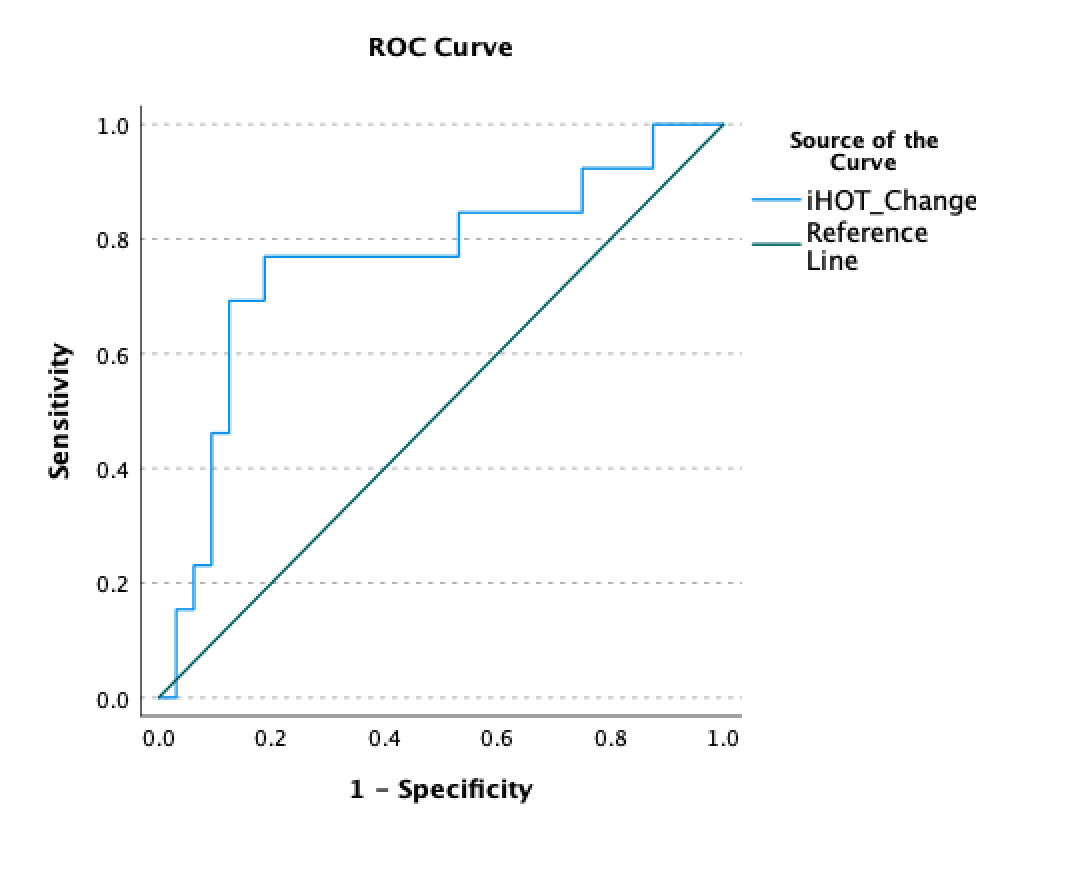
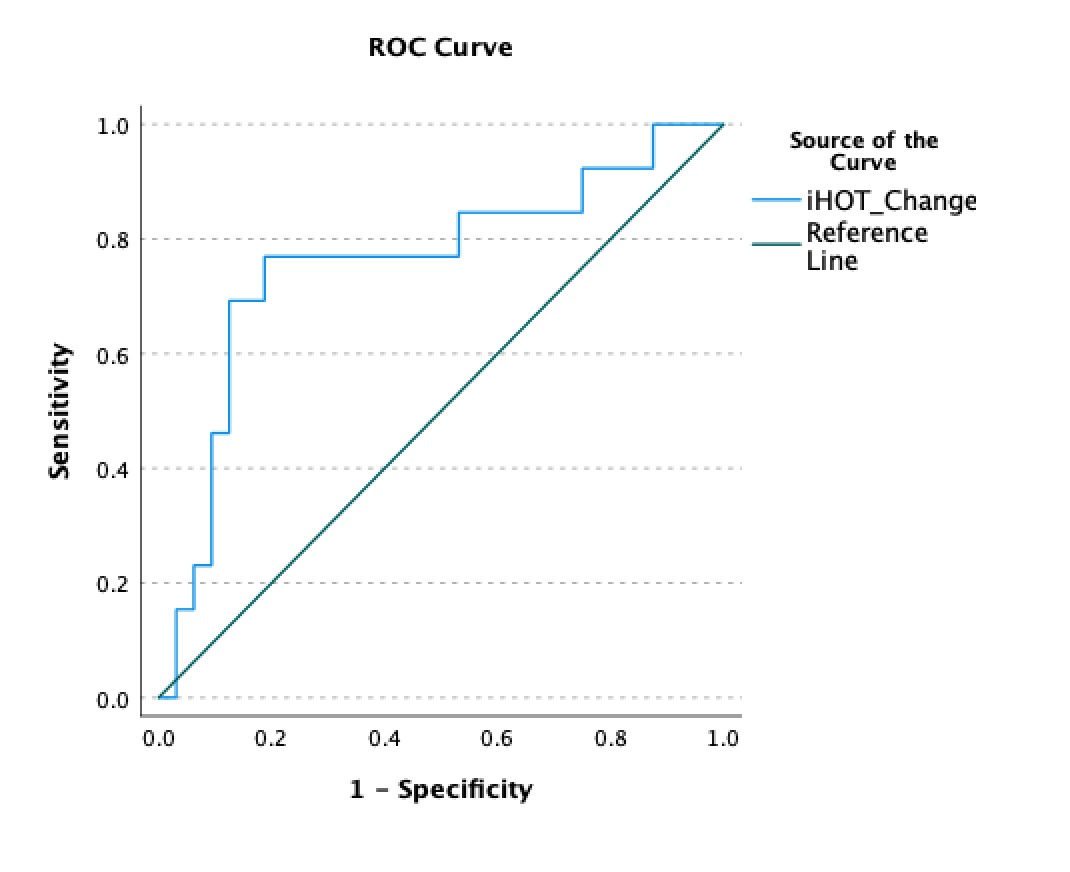
The MCID was 8.5 points. A PASS change score of was calculated for individuals who were satisfied with high sensitivity (.77) and specificity (.78) and an AUC = .76 (95% CI: .59-93) (Figure 1).
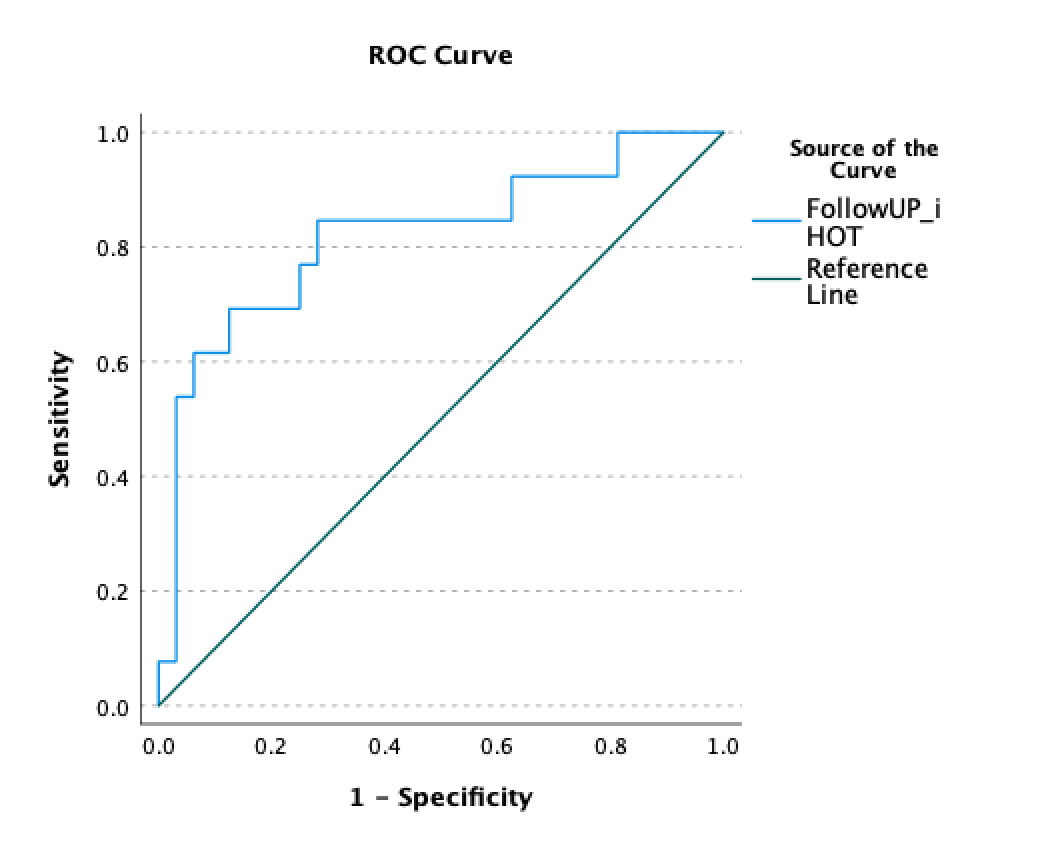
An absolute PASS iHOT-12 threshold score of 62 (sensitivity = .62, specificity = .87) identified those were satisfied (n=13, 29%) with their hip function after a trial of PT with an AUC = .82 (95% CI: .67-.97) (Figure 2).
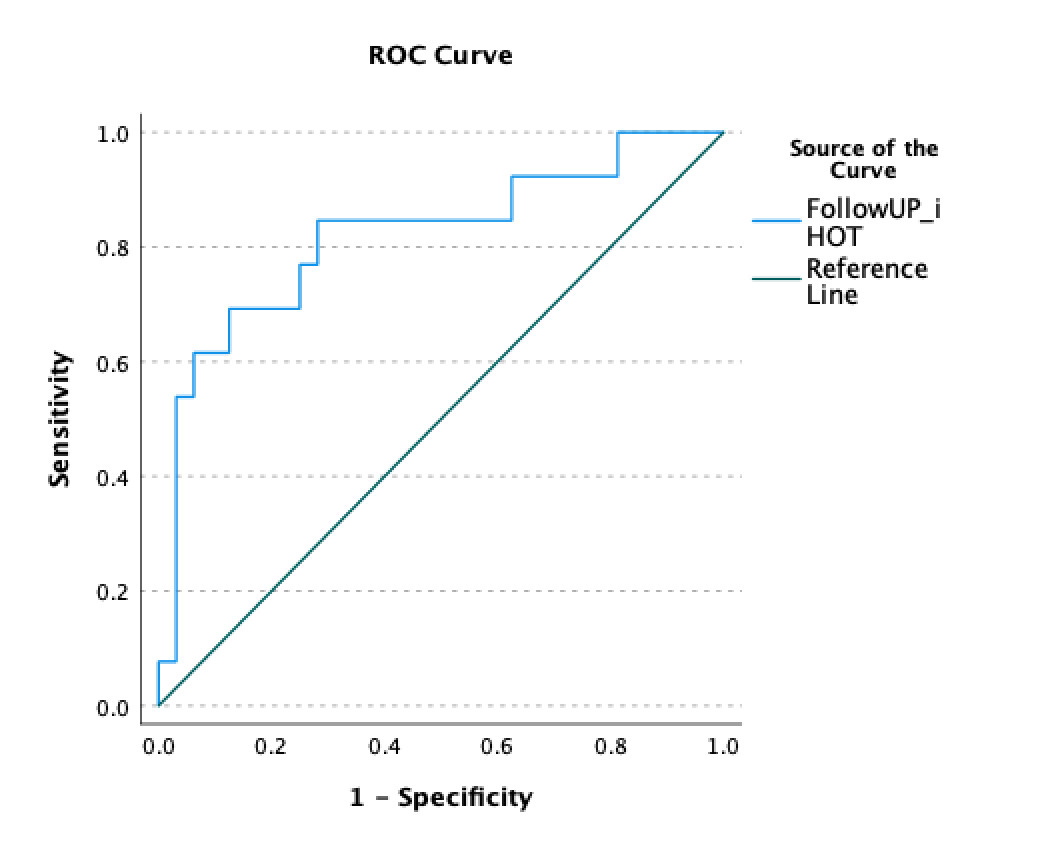
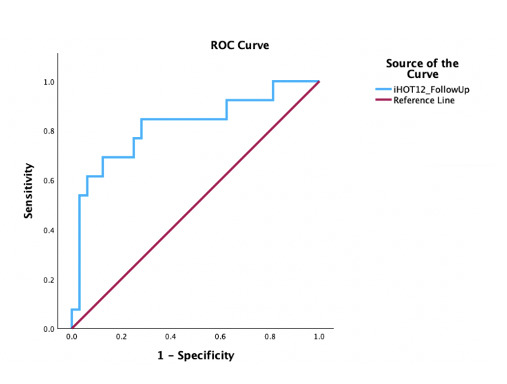
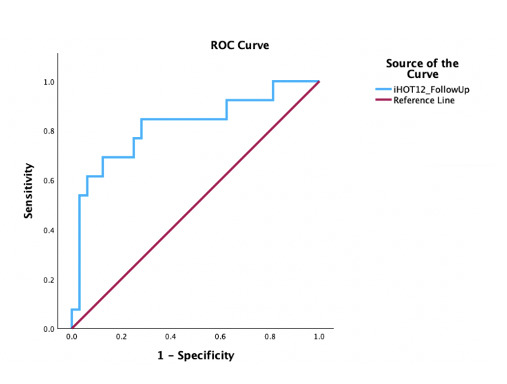
An MOI threshold of 22.9% was calculated for individuals who were satisfied with high sensitivity (.69) and specificity (.88) and an AUC = .78 (95% CI: .61-.95) (Figure 3).
Follow-up data indicated that 64.4% of participants achieved MCID, while only 37.8% achieved PASS change score.
DISCUSSION
The iHOT-12 is a commonly utilized PROM to assess health-related quality of life in individuals with AD. The primary purpose of this study was to define MCID, PASS change score, absolute PASS threshold, and MOI for individuals with AD undergoing PT. This study successfully defined the MCID, PASS change score, absolute PASS threshold, and MOI threshold for the iHOT-12 as 8.5, 15.2, 62, and 22.9% respectively. These threshold values can be applied to individuals with symptomatic AD undergoing an 8-10 week trial of PT. After a trial of PT, while over half of individuals met the MCID, less than half achieved PASS change score. This current study also found only 29% of individuals reported being satisfied with their current level of function following PT. This is the first study to define CIOVs undergoing conservative care for any non-arthritic hip pathology, including AD and FAIS.
CIOVs can be directly applied in clinical practice to enhance decision making and improve patient care. These values allow PTs to set individualized goals and adjust treatment plans as well as facilitate clear communication regarding the value of PT and the progress achieved during care. If an individual’s iHOT-12 score improves by more than the established MCID following 8-10 weeks of PT, this indicates a meaningful clinical benefit even if the individual did not reach the PASS change value. This is reflected in the current study as 64.4% of participants achieved MCID, while only 37.8% achieved PASS change value. A systematic review by Probst et al. reported 54% of individuals had a satisfactory response to non-operative treatment for non-arthritic hip related pain.34 The higher satisfaction rate compared the current study may be explained by a more diverse patient population, such as FAIS and other non-arthritic hip disorders, not just individuals with AD seeking care from a hip preservation specialist as was the case in the current study. AD is a bony abnormality of acetabulum resulting in insufficient coverage of the femoral head which cannot be modified by conservative measures, including PT.7,35 Instead, the focus of PT is to improve dynamic stability of the hip joint by improving strength of the hip musculature and lumbopelvic control, particularly during single leg activities. Given the ongoing presence of structural instability in the current study population, a conversation regarding realistic expectations should be had with these patients.
Unlike MCID and PASS change scores which utilize pre and post-treatment PROM scores, PASS and MOI thresholds provide cutoff values to determine whether a patients outcome reflects meaningful improvement or a satisfactory state following intervention.36 The current study identified an absolute PASS threshold of 62 on the iHOT-12, above which individuals considered their symptoms acceptable. While no studies have identified a PASS threshold for individuals with non-arthritic hip pain undergoing conservative management, Trotzky et al.37 identified a PASS threshold of 65 for the iHOT-12 in individuals who underwent a periacetabular osteotomy (PAO). These values are similar to those found in the current study and may indicate that acceptable symptom states may be consistent across both surgical and non-surgical interventions for AD. The current study also identified the MOI for the iHOT-12 as 22.9%, indicating the proportion of maximal possible improvement that is clinically meaningful. More recently, the MOI is being utilized as it is a patient centered benchmark that accounts for baseline score, limiting the ceiling effect.21 There are no studies identifying MOI thresholds for the iHOT-12 for individuals with any non-arthritic hip pathology.
This is the first study to define the MCID, PASS change score, absolute PASS threshold, and MOI threshold for the iHOT-12 in individuals with symptomatic AD undergoing 8-10 weeks of PT. Establishing these COIVs provides clinicians with meaningful benchmarks to interpret changes in health-related quality of life and patient satisfaction following a standard course of conservative management. Although a substantial proportion of patients achieved meaningful improvements, a smaller percentage reached a state of satisfaction with their current condition. These findings highlight the importance of setting realistic expectations for patients with AD and underscore the need for further research to optimize non-operative treatment strategies. Future studies should aim to validate these thresholds in broader populations, including a focus on individuals with AD in their second or third decade, explore the impact of longer rehabilitation periods, and investigate the long-term outcomes of conservative management for AD.
Limitations
There are several limitations to this current study. First, PT was not standardized during this study as the primary purpose was to determine CIOVs. While reducing practice variation is important to improve outcomes, variation in PT for the current study improves generalizability as many individuals with AD will not have access to a physiotherapist specializing in the treatment AD. Individuals presenting to hip preservations clinics are often from a wide geographic area and controlling PT treatment is extremely difficult. While the sample size is limited, the results demonstrated good-to-excellent discriminative validity, as evidenced by the AUC values with 95% confidence intervals exceeding 0.5. Although MCID and PASS values were defined, this study was unable to define a SCB value. The anchor-based method, while widely accepted, is based solely on the responses included in this study, which were determined by the study team. Therefore, the results of this study should only be applied to patients who undergo 8-10 weeks of PT with a diagnosis of AD. While 8-10 weeks is a commonly utilized trial time frame for these patients, these values may change with a rehabilitation period and future studies would be needed to define these values. Additionally, these results are not applicable to individuals with other hip conditions and are only applicable to the characteristics of this population including but not limited to, lateral center edge value, presence of other intra-articular hip pathology, duration of symptoms, and those seeking care from a provider other than a hip preservation surgeon. The study population was largely young females, limiting generalizability to males with AD. However, females have been shown to demonstrate a significantly higher rate of AD compared to male counterparts, and this seems to be a representative population. Finally, data were collected at two specialized treatment centers which may not be representative of the broader population and results may carry an increased risk of bias as there is the potential for center specific effects.
CONCLUSION
This study successfully defined the MCID, PASS change score, absolute PASS threshold, and MOI threshold for the iHOT-12 as 8.5, 15.2, 62, and 22.9% respectively. This current study also found only 29% of individuals reported being satisfied with their current level of function following PT. The results of this study highlight the importance of setting realistic expectations for patients with AD and underscore the need for further research to optimize non-operative treatment strategies.
Conflict of Interest Statement
The authors have no conflicts of interest to disclose related to this research study.