INTRODUCTION
Balance is essential for safe and effective athletic performance, with deficits in dynamic balance linked to an increased risk of lower extremity musculoskeletal injuries, particularly at the ankle and knee.1–4 Athletes who engage in balance training exhibit a 20% to 60% lower risk of ankle sprains compared to those who do not, with the most significant reductions observed in athletes with a history of previous ankle sprains.5 Balance training interventions, especially those targeting neuromuscular control and proprioception, have been widely implemented to mitigate this risk.6–9 Although traditional balance tools such as wobble boards and foam pads are commonly used to challenge the sensorimotor system, emerging evidence supports the use of stable-surface, game-based interventions as a viable alternative.10–13 Gamified rehabilitation systems incorporate core game design elements (e.g., adaptive difficulty, real-time feedback, and goal-based progression) to promote user engagement, motor learning, and adherence to training protocols.10 These platforms, which include exergaming devices and virtual reality systems, align with contemporary neurorehabilitation principles by emphasizing individualized challenge and task relevance.14,15 Preliminary studies suggest that gamified approaches can elicit balance improvements comparable to traditional training methods used in clinical settings, particularly in non-athletic populations.11 However, limited data exist on their effectiveness in athletic cohorts or how motivational differences between gamified and conventional training systems may influence training outcomes.
While the efficacy of balance training is well established,16 motivation and adherence remain significant barriers to its implementation in athletic and clinical populations. Traditional balance exercises are often repetitive, lack external feedback, and may be perceived as tedious, particularly among younger athletes. Gamified systems may help address these barriers by incorporating goal-driven tasks, real-time feedback, and interactive mechanics that are designed to sustain user engagement and support motivation throughout training. Studies in physical therapy, cognitive rehabilitation, and health promotion have demonstrated that gamified interventions can improve participation rates, task persistence, and enjoyment across diverse populations.11–13,17,18 Furthermore, transferability from virtual to real-world motor performance has been demonstrated in rehabilitation and neuroplasticity research, supporting the utility of game-based tools in improving functional outcomes.14 The motivational and neurocognitive benefits of gamified training make it a viable alternative to traditional balance interventions.13,17,18
Despite evidence supporting balance training for injury prevention, gaps remain in understanding how training systems, particularly gamified versus traditional formats, affect dynamic balance outcomes and motivation in athletic populations. Therefore, the purpose of this study was to compare the effects of gamified (Wii Fit) versus traditional (wobble board) balance training on dynamic balance and intrinsic motivation in collegiate athletes. It was hypothesized that both training interventions would improve dynamic postural stability relative to the control group. Intrinsic motivation, including interest/enjoyment, perceived competence, and value/usefulness, was measured using the Intrinsic Motivation Inventory. It was further hypothesized that participants in the gamified training group would report higher levels of intrinsic motivation than the traditional training group.
METHODS
Study Design
This controlled, quasi-experimental study compared the effects of two balance training interventions and a control condition on dynamic balance and motivation in collegiate athletes. The study is reported in accordance with the Transparent Reporting of Evaluations with Nonrandomized Designs (TREND) statement.
Participants
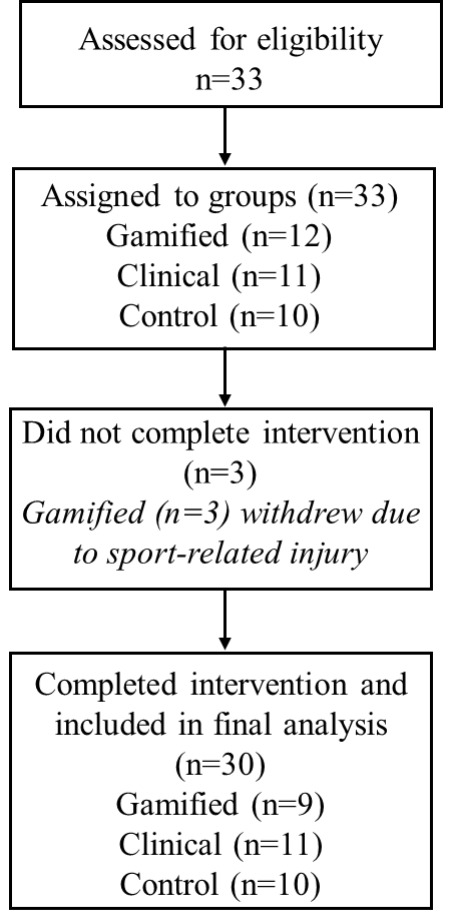
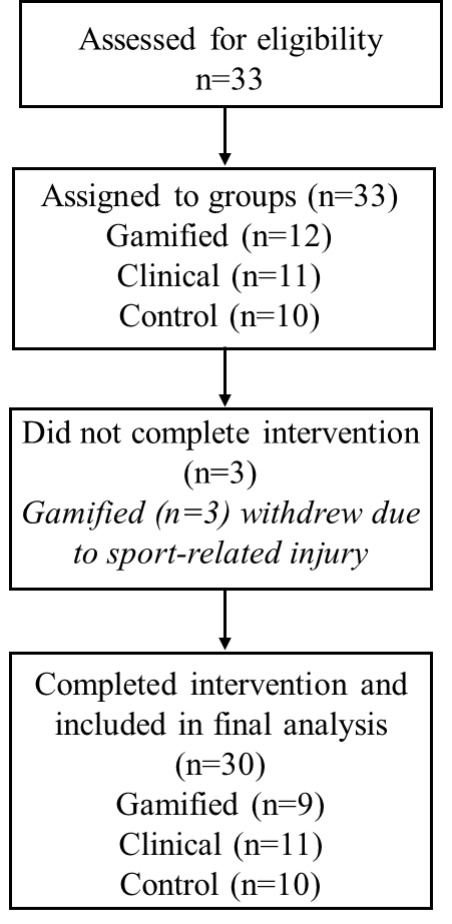
Thirty-three healthy NCAA Division I intercollegiate student-athletes were recruited as a convenience sample through an existing athlete wellness program. Participants were randomly assigned to one of three groups: gamified training (n = 12), traditional training (n = 11), or control (n = 10). Participants were allocated to the gamified, traditional, or control group using a pseudo-randomized procedure constrained to produce approximately equal group sizes. Because a single investigator enrolled participants, generated the allocation, and performed all testing, allocation was not concealed, and outcome assessment was not blinded. The flow of participants through enrollment, allocation, follow-up, and analysis is presented in Figure 1, following the TREND statement for non-randomized designs. All participants provided written and oral informed consent as approved by the University’s IRB.
Instrumentation
Baseline and follow-up dynamic postural stability testing was conducted for all participants using the modified Star Excursion Balance Test (mSEBT) and the Dynamic Postural Stability Index (DPSI).19,20 All testing was performed barefoot, and the testing order was randomized using a traditional die.
Modified Star Excursion Balance Test (mSEBT)
Dynamic balance was assessed using the mSEBT, a reliable and valid tool (ICC = 0.82–0.86)21 that challenges single-limb postural control in three directions: anterior, posteromedial, and posterolateral. The reported minimal detectable change for the normalized composite score is approximately 6–7%, providing a threshold for interpreting change beyond measurement error.22 Consistent with established procedures, testing was conducted barefoot, and the order was randomized. Participants stood on their dominant limb (i.e., their preferred kicking leg) positioned at the intersection of three taped lines extending at 0° (anterior), 135° posteromedial, and 225° posterolateral. They maintained a hands-on-hips posture while reaching with the non-stance limb to lightly tap the floor at the furthest controllable point without losing balance or shifting the stance foot.20 Each direction was practiced four times, followed by three recorded trials. Reach distances were measured in centimeters, and the mean of the three recorded trials in each direction was analyzed. The composite score was calculated as the sum of the anterior, posteromedial, and posterolateral reach distances. Trials were repeated if balance was lost or form deviated.
Dynamic Postural Stability Index (DPSI)
Landing stability was evaluated using the DPSI protocol on the dominant leg. Participants began 70 cm behind a force plate and performed a forward jump over a 23 cm hurdle, landing on one foot and stabilizing as quickly as possible.19 Upon landing, they maintained a hands-on-hips position for 10 seconds while focusing on a fixed point on the wall. Trials were preceded by a familiarization sequence and separated by two-minute rests. Trials were discarded if participants lost balance, made corrective movements, or swayed excessively (operationalized as near loss of footplate position).19 Kinetic data were collected at 1000 Hz using an AMTI force plate (Advanced Mechanical Technology, Inc., Watertown, MA) and Vicon Nexus software (Vicon Motion Systems Ltd., Oxford, UK). Ground reaction forces were normalized to body weight, and DPSI, along with medial-lateral (MLSI), anterior-posterior (APSI), and vertical (VSI) stability indices, were calculated using established formulas (below).19 The DPSI protocol demonstrates high reliability (ICC = 0.96)19; no MDC has been established for the DPSI.
-
DPSI = √[(∑(0 − x)2 + ∑(0 − y)2 + ∑(1 − z)2) / number of data points]
-
MLSI = √[∑(0 − x)2 / number of data points]
-
APSI = √[∑(0 − y)2 / number of data points]
-
VSI = √[∑(1 − z)2 / number of data points]
Following post-testing, participants in the two training groups (gamified and traditional) completed the Intrinsic Motivation Inventory (IMI) (Supplementary Table XX). The IMI has acceptable internal consistency (α≥0.70) and strong construct validity (0.70 to 0.91).23 They were informed that all responses were confidential and instructed to answer honestly. Four subscales relevant to the study aims were assessed: Interest/Enjoyment, Perceived Competence, Effort/Importance, and Value/Usefulness.23 The 25-item IMI uses a 7-point Likert scale ranging from 1 (strongly disagree) to 7 (strongly agree). Negatively worded items were reverse-scored, and subscale scores were computed by averaging responses within each subscale, with higher scores indicating better performance.
Procedures
Prior to the first testing session, study procedures were explained in detail, and participants completed a medical history questionnaire. During the initial training session, the mSEBT and DPSI protocols were reviewed, and participants were given the opportunity to ask questions. The primary investigator enrolled participants, randomized group assignments, and conducted all baseline and post-intervention testing. Training sessions were supervised by the primary investigator and a designated research assistant to ensure protocol adherence. Adherence to the supervised program was high: all 20 training group participants included in the analysis (gamified: n= 9; traditional: n=11) completed all 12 scheduled sessions (100% attendance among completers). The three participants excluded for sport-related injury discontinued before completing the protocol and were not included in the final analysis (Figure 1).
Training Protocol
Following pre-testing on the mSEBT and DPSI, participants assigned to a training condition completed 12 supervised sessions, each lasting 15 minutes, conducted three times per week over four weeks. The training dose (twelve 15-minute sessions delivered three times per week over four weeks) was selected to be consistent with balance- and exergaming-training programs previously shown to improve dynamic postural control over three-to-six-week periods,13 while limiting per-session time so the program could be integrated alongside participants’ ongoing organized team training so it could be integrated alongside participants’ in-season training. Sessions were separated by at least 24 hours, with no more than three completed in a single week. Participants in the control group completed the same pre- and post-testing four weeks apart but did not take part in any study training sessions; during this period, they continued their usual team practices and conditioning and were instructed not to begin any additional balance training.
The gamified group trained using the Wii Fit Plus system (Nintendo, Redmond, WA), performing 5 minutes each on three interactive balance games: Table Tilt, Tilt City, and Ski Jump. Gameplay instructions and performance goals were reviewed during the initial session. Each game progressively challenged postural control through shifts on a stable surface.
The traditional group used a wobble board to complete standard balance exercises, including 5 minutes each of anterior/posterior tilts, medial/lateral tilts, and circular rotations (2.5 minutes in each direction), performed continuously. Participants were instructed to focus on maintaining consistent engagement with each task, rather than maximizing performance or accuracy. All sessions were supervised by the primary investigator or a trained research assistant to ensure consistency and adherence to protocol.
Statistical Analysis
Data were analyzed using IBM SPSS Statistics, Version 29 (IBM Corp., Armonk, NY). No a priori power analysis was conducted; the sample comprised all athletes available through an existing wellness program. A one-way ANOVA compared pre-to-post changes in mSEBT and DPSI among the gamified, traditional, and control groups. Tukey’s post hoc tests were conducted to identify pairwise group differences. Separate one-way ANOVAs were performed to compare Intrinsic Motivation Inventory (IMI) subscale scores (i.e., Interest/Enjoyment, Perceived Competence, Effort/Importance, and Value/Usefulness) between the gamified and traditional training groups. Effect sizes were reported using Cohen’s d, with values of 0.2, 0.5, and 0.8 interpreted as small, medium, and large effects, respectively.24 Statistical significance was set at p < .05.
RESULTS
Thirty participants completed the study and were included in the final analyses (male: n = 5; female: n = 25; age: 19.8 ± 0.9 years; height: 1.72 ± 0.06 m; mass: 71.0 ± 11.6 kg; gamified: n = 9; traditional: n = 11; control: n = 10; Figure 1). Three were excluded due to sport-related injuries that limited their ability to fully participate in athletic activity during the study period, consistent with the predefined exclusion criterion. However, individuals with a history of lower extremity injury were not excluded, as the study adopted an ecologically valid approach reflective of typical athletic populations.25
Modified Star Excursion Balance Test (mSEBT)
Significant group differences were observed for anterior reach (F = 3.8, p=0.030, d=1.61) and composite score (F = 10.6, p<0.001) on the mSEBT. The traditional group demonstrated greater anterior reach improvements than the control group (p = 0.034). In contrast, both the gamified (p=0.001, d=1.84) and traditional groups (p=0.003, d=1.54) showed significantly greater composite score gains compared to the control. No significant differences were found between the two training groups (p=0.851, d=0.010).
Dynamic Postural Stability Index (DPSI)
No significant group differences were found for DPSI or any of its directional components (MLSI, APSI, VSI). mSEBT and DPSI group means, standard deviations, and pairwise comparisons are presented in Table 1.
Intrinsic Motivation Inventory
A significant group difference was found for the Interest/Enjoyment subscale of the Intrinsic Motivation Inventory (F = 9.4, p<0.01, d=1.50), with participants in the gamified group reporting greater (5.04±1.18) Enjoyment than those in the traditional group (3.17±1.31). No significant group differences were observed for Perceived Competence, Effort/Importance, or Value/Usefulness. Full descriptive statistics and subscale comparisons are presented in Table 2.
DISCUSSION
This study evaluated the effectiveness of two balance training approaches (i.e., gamified and traditional) on dynamic postural control and intrinsic motivation in collegiate athletes. Balance is a foundational component of athletic performance and injury prevention, yet adherence to conventional training methods can be limited by monotony and low engagement. It was found that both training groups significantly improved their mSEBT reach distances relative to the control group, with comparable gains in total composite scores. Additionally, the gamified group reported greater interest and enjoyment than those in the traditional group. These findings suggest that accessible, engaging platforms can elicit meaningful improvements in dynamic balance while enhancing the user experience, which is an important consideration for optimizing adherence and extending the clinical utility of balance interventions in athletic populations. Incorporating gamified tools may offer a pragmatic way to boost motivation without sacrificing neuromuscular benefit, especially in settings where training adherence or long-term engagement is a challenge.
Participants in the gamified training group demonstrated improvements in balance similar to those in the traditional wobble board training group. Compared to the control group, both the gamified and traditional balance training groups showed significant improvements on the mSEBT, particularly in anterior reach and total composite scores. Relative to baseline, composite reach improved by 8.5% in the gamified group and 5.2% in the traditional group, versus a 1.5% decline in the control group. Post hoc analyses revealed no significant differences between the two intervention groups (p>0.05), suggesting comparable efficacy. Importantly, participants in the gamified group also reported significantly greater enjoyment and interest, suggesting that gamified systems may improve adherence without compromising training effectiveness. These results are consistent with a growing body of work on gamified and exergaming-based rehabilitation.10–13,17 Exergaming and virtual-reality balance programs (including Wii Fit–based protocols) have produced dynamic-balance improvements comparable to conventional training across populations such as chronic ankle instability, older adults, and neurological rehabilitation, while typically yielding higher enjoyment and engagement.26,27 A recent trial comparing exergaming with conventional balance training on jump-landing dynamic postural stability in athletes with chronic ankle instability similarly reported that both modalities comparably improved jump-landing dynamic postural stability, with exergaming showing a modest advantage in mediolateral stability.26 This finding, equivalent balance efficacy with markedly greater intrinsic interest/enjoyment in an athletic cohort, extends this literature to healthy collegiate athletes and reinforces the position that game-based tools are a credible alternative, rather than a compromise, relative to traditional balance training.
The gamified and traditional training groups yielded comparable improvements in dynamic balance. One possible explanation is that both interventions elicited similar lower-limb motor strategies, particularly in ankle joint kinematics, because of overlapping task demands. For example, in the Wii Fit Ski Jump game, participants dorsi- and plantarflexed their ankles to navigate and jump within the game, movements mirrored in the anterior/posterior tilts performed on the wobble board. Tilt City and Table Tilt required lateral and rotational weight shifts, which mirror medial-lateral and circular wobble board tasks. Additionally, balance tasks that emphasize reaching movements may respond more rapidly to sensorimotor training than tasks requiring rapid stabilization (e.g., single-leg landing), likely involving more complex integration of joint kinetics, postural reflexes, and anticipatory control.28 This may explain the gains observed in the mSEBT but not DPSI and requires further investigation using motor control frameworks to delineate task-specific transfer.
The dissociation between improved mSEBT and unchanged DPSI is best explained by the principle of training specificity. Both interventions trained slow, volitional, feedback-driven weight-shifting and reaching on a stable or mildly unstable surface—movement demands that closely match the mSEBT, a self-paced volitional reaching task. Neither protocol included ballistic, high-impact, or landing tasks. The DPSI, by contrast, quantifies reactive, feedforward stabilization in the first seconds after a single-leg jump landing—a high-velocity task governed by impact absorption and rapid neuromuscular control that neither training group practiced. Transfer therefore occurred within the trained movement class (volitional postural control) but not to the untrained, higher-velocity stabilization class, consistent with prior evidence that balance gains are task- and stance-specific and do not automatically generalize to landing control.19 The mSEBT gains in both training groups relative to control are consistent with central and peripheral neural adaptations to repeated balance training—enhanced proprioceptive feedback via increased mechanoreceptor sensitivity and joint position sense, refined sensorimotor integration supporting more efficient afferent processing and motor planning, and greater corticospinal excitability with optimized motor unit recruitment.29,30 Collectively, these findings underscore the need to align training approaches with the specific neuromuscular demands of the target task to maximize transfer.
The increased enjoyment reported by the gamified group reinforces the potential clinical value of gamified interventions.10 The game-based environment provided goal-oriented tasks, immediate feedback, and performance progression, which may enhance intrinsic motivation. Participants could see their progress through distance traveled, levels completed, and scores earned, which may have contributed to increased engagement. Conversely, the traditional group performed repetitive movements without feedback or variability. These findings are consistent with existing literature indicating that exergaming improves motivation and may enhance training adherence in rehabilitation settings.13,17 Because interest and enjoyment are among the strongest predictors of sustained exercise participation, the large motivational advantage of the gamified condition is clinically meaningful: balance and injury-prevention programs commonly lose effectiveness as compliance declines once supervision ends, and a more enjoyable modality may better maintain engagement in unsupervised or home settings. Within a self-determination-theory framework, intrinsic motivation is supported when an activity satisfies the needs for competence and supports interest/enjoyment.31,32 The gamified environment did this through several features absent from wobble-board training: continuous, quantified performance feedback (scores, levels, and distance traveled) that made competence visible and progressive; novelty and task variety across the three games; and immediate, goal-directed challenge that sustained attention. By contrast, the wobble-board protocol was repetitive, provided no external performance feedback, and offered little variation, conditions less able to satisfy competence and interest needs. These design differences offer a plausible mechanism for the large between-group difference in interest/enjoyment (d = 1.50) despite equivalent balance gains.
Given the similar balance improvements and greater enjoyment, stable surface, game-based training tools may offer a compelling option for clinicians aiming to enhance both outcomes and engagement. These findings reinforce the value of integrating structured balance training into athletic development programs—not only as a performance tool, but also as a preventative strategy against lower extremity injury.2,5,33,34 Interestingly, we found no differences between groups for perceived competence, effort, or value. This similarity may be explained by the orientation session, during which all participants were briefed on the benefits of balance training. Providing this shared context may have shaped participants’ expectations and contributed to comparable responses across groups. Future studies should directly compare single- and double-leg training paradigms to determine which approach more effectively facilitates transfer to single-limb postural control tasks.
Clinical Relevance and Application
The three outcomes map onto distinct rehabilitation targets: the mSEBT is a low-cost measure of dynamic single-limb postural control that predicts lower-extremity injury risk and is widely used for injury screening and return-to-sport, whereas the DPSI is a force-plate index of reactive landing stabilization (ICC ≈ 0.96)19 relevant to ankle and ACL injury, though it has no established MCID, an important caveat for the null DPSI result. The IMI captures intrinsic motivation, which has no clinical MCID but matters clinically as a key determinant of exercise adherence. Taken together, these findings indicate that game-based balance tools can serve as an engagement-enhancing substitute for, or adjunct to, traditional balance exercises without sacrificing dynamic-balance gains. The dose used here—approximately 15 minutes, three times per week for four weeks—was sufficient to produce meaningful mSEBT improvement and could be layered into warm-ups, early-to-mid-stage rehabilitation, or in-season injury-prevention programming, and may be particularly useful for younger athletes or patients whose adherence to repetitive home exercise is poor. Because the gains were task-specific, however, clinicians targeting landing or reactive stabilization (e.g., late-stage return-to-sport) should pair game-based standing-balance work with plyometric and landing tasks rather than expecting automatic transfer. From a feasibility standpoint, gamified systems require additional hardware, space, and setup relative to low-cost tools such as wobble boards, which is a trade-off clinicians should weigh against their setting and caseload.
Limitations
Because this was a clinically feasible, ecological study design, athletes were not excluded based on prior injury history, familiarity with balance training tools, or experience with assessments, as athletes likely have diverse personal experiences and exposures to exercises and treatments. Additionally, using a convenience sample of collegiate athletes limits the generalizability of findings to broader populations, and all student-athletes continued organized team activities (e.g., practices, workouts) during the study. Future research should investigate the effects of training volume, task specificity, and participant background on optimizing gamified and traditional balance interventions using larger sample sizes and include a longer follow-up period. Additionally, gamified balance training for injured athletes and those returning to sport should be investigated, as well as the role of motivation gains in long-term functional outcomes. Assessments were not blinded: a single investigator enrolled participants, assigned groups, and conducted all testing, which introduces potential for assessor bias. This risk is partially mitigated because the primary outcomes were objective (i.e., mSEBT reach distances were measured against a fixed tape scale, and DPSI was derived automatically from force-plate kinetics) rather than rater-scored. Future research should separate the assessor from the interventionist and blind outcome assessment. Finally, the Nintendo Wii Fit Plus system and Wii Balance Board are no longer manufactured, which may limit clinicians’ ability to replicate this protocol. However, similar commercially available exergaming and balance-feedback platforms exist, and future research should examine whether these findings extend to current gamified systems.
CONCLUSION
Both the gamified and traditional balance training interventions resulted in comparable improvements in dynamic standing balance but not landing stabilization, with the gamified group reporting greater enjoyment. These findings support the premise that balance training can be effectively delivered through non-traditional, game-based platforms, which may offer similar neuromuscular benefits while enhancing motivation, an important consideration in populations where adherence influences outcomes.
Conflicts of Interest
Conflict of interest: The authors declare that they have no competing financial interests or personal relationships that could have appeared to influence the work reported in this paper.