INTRODUCTION
Developmental dysplasia of the hip (DDH) is a spectrum of structural abnormalities involving insufficient femoral head coverage, leading to reduced joint stability and abnormal loading.1 This review focuses on adolescents and adults aged 13–50 years, in whom DDH management is complicated by skeletal maturity, growth-related biomechanical change, and return-to-sport demands. DDH is typically defined by a lateral center-edge angle (LCEA) below 20°, with borderline dysplasia at 20°–25°,2 however, LCEA alone may oversimplify diagnosis, and measures such as the Tönnis angle, acetabular index, anterior center-edge angle and acetabular version can improve accuracy in borderline cases.3 Reduced coverage increases acetabular rim shear, predisposing individuals to labral pathology, chondral wear, early osteoarthritis and recurrent subluxation.4,5 DDH prevalence is estimated at 1–3%, though variability in radiographic thresholds and imaging protocols limits diagnostic consistency across studies.1
Management depends on symptom severity, skeletal maturity and radiographic findings. Periacetabular osteotomy (PAO) is the gold-standard surgical option for skeletally mature adolescents with symptomatic dysplasia.6 In borderline dysplasia, surgical decision-making is less clear-cut: both PAO and hip arthroscopy (HA) improve outcomes7–9 but PAO following a failed HA is associated with worse self-reported outcomes, underscoring the importance of appropriate initial selection.10 Surgical choice should therefore be individualized, guided by symptom severity, instability and coexisting intra-articular pathology. For those with borderline dysplasia or who are not yet surgical candidates, conservative physiotherapy targeting neuromuscular control and movement pattern retraining shows promise in symptom management.11
Key aspects of rehabilitation, including timing of intervention, criteria for progressive loading, exercise selection, and use of outcome measures, remain poorly defined in this population, and much of the existing guidance is drawn from adult cohorts and expert consensus rather than adolescent-specific evidence. While DDH treatment outcomes have been described, the literature on rehabilitation across conservative and post-operative management remains limited. This review therefore aims to summarize the available evidence on rehabilitation protocols for the conservative and post-operative management of DDH in adults, examining timing, progression, and exercise selection across both management contexts to identify areas of clinical consistency and gaps where evidence remains insufficient to support standardized practice.
Methods
This literature review synthesized available evidence on physiotherapy rehabilitation protocols for adolescents and adults with developmental dysplasia of the hip (DDH) aged 13–50 years across conservative and post-operative management pathways. Definitions of acetabular dysplasia varied across included sources.
Search strategy
A structured search of PubMed (MEDLINE) and Web of Science Core Collection was conducted to identify peer-reviewed, English-language literature published between 2009 and 2025 addressing rehabilitation of individuals with DDH. The same search strategy was used in both databases, mapped to relevant field and subject-heading syntax using combinations of the following terms:
(“developmental dysplasia of the hip” OR “hip dysplasia” OR “acetabular dysplasia” OR DDH) AND (“physical therapy” OR physiotherapy OR rehabilitation OR “exercise therapy” OR “movement pattern training” OR “resistance training” OR exercise) AND (adolescent* OR “young adult” OR youth OR “young people”)
Eligibility criteria
Adolescents and adults were operationally defined as those aged 13–50 years. Sources were eligible if they were peer-reviewed, included participants aged 13–50 years with hip dysplasia, addressed conservative or post-operative physiotherapy rehabilitation, and reported patient-reported or functional outcomes. Registered trial protocols defining a physiotherapy pathway for this population were also eligible. Sources were excluded if they addressed a non-hip condition, were non-clinical, focused on imaging or surgical technique without a rehabilitation or outcomes component, or included populations outside the target age range.
Study selection and data extraction
Records from both databases were combined and de-duplicated. Titles and abstracts were screened independently by four reviewers, with disagreements resolved by consensus; full texts of potentially eligible records were then assessed against the inclusion criteria. For each included source, data were extracted on study aim and design, participant characteristics including age, intervention or focus area, progression criteria, patient-reported and functional outcome measures and return-to-sport criteria. Findings were synthesized narratively and reported separately for conservative and post-operative management pathways, reflecting their distinct clinical contexts.
Quality appraisal
Included sources were critically appraised using design-matched tools. The Physiotherapy Evidence Database (PEDro) scale was applied to the randomized controlled trials11,12; the Guidance on Conducting and REporting DElphi Studies (CREDES) checklist to the Delphi consensus studies13,14; the Newcastle-Ottawa Scale to the observational designs5,15–19 and the Joanna Briggs Institute Critical Appraisal Checklist for Case Reports to the single case series.20
Results
Study selection and characteristics
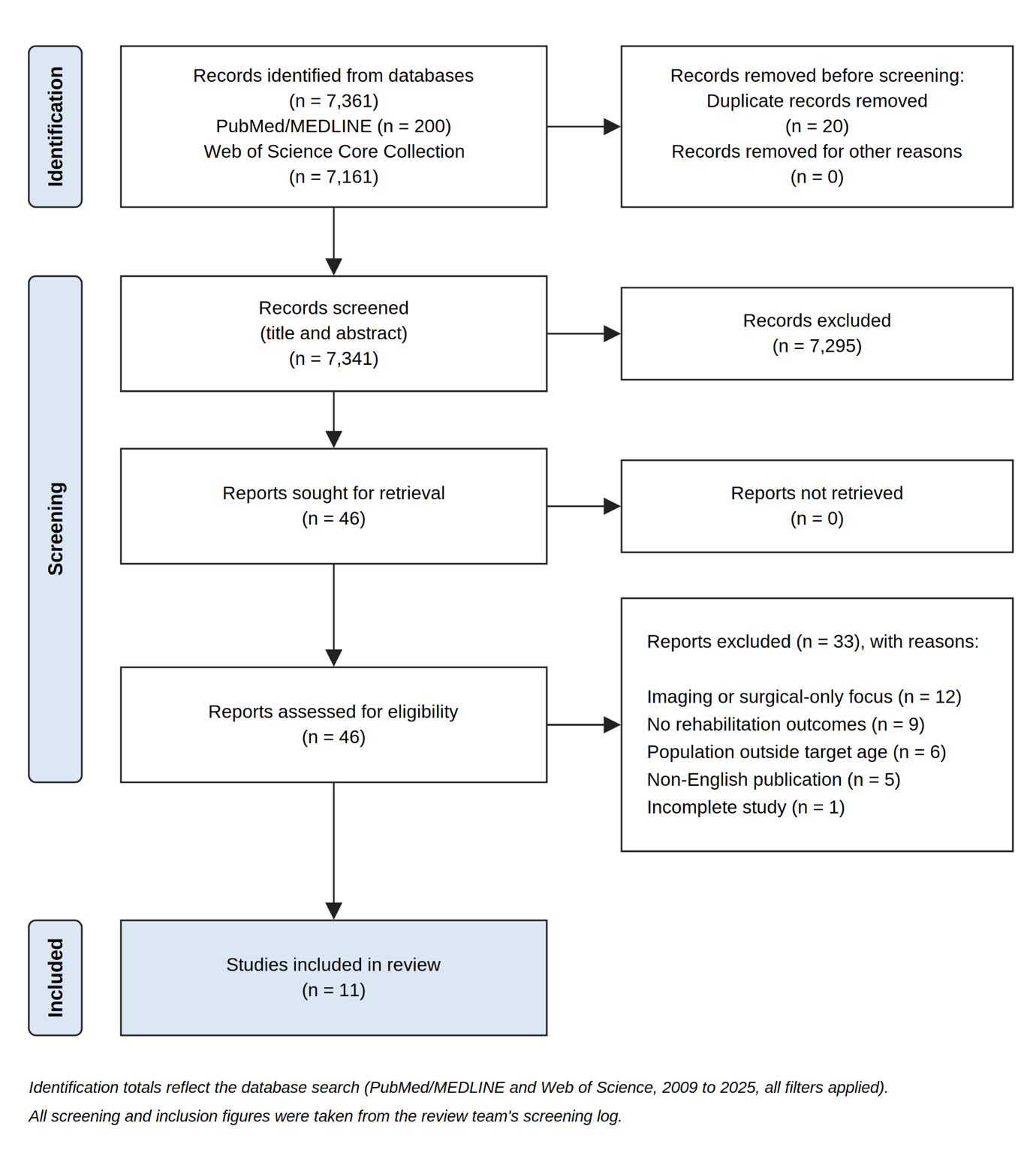
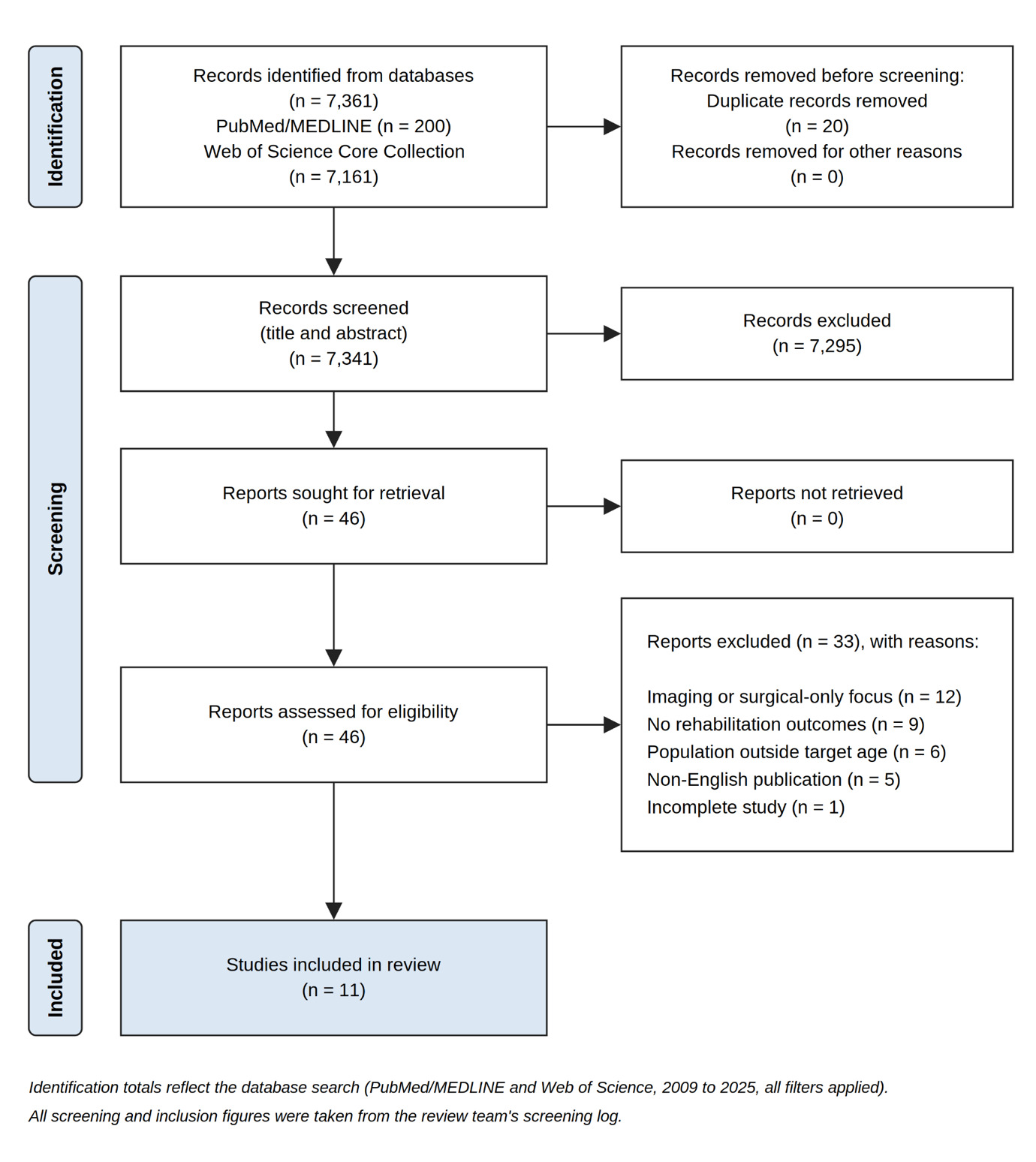
The search and screening process is summarized in Figure 1, reported in accordance with Preferred Reporting Items for Systematic Reviews and Meta-Analyses (PRISMA) 2020 statement. The search identified 7,361 records (PubMed/MEDLINE, n = 200; Web of Science Core Collection, n = 7,161). After removal of 20 duplicates, 7,341 records were screened by title and abstract, of which 7,295 were excluded. Forty-six full-text reports were assessed for eligibility, and 35 were excluded (imaging or surgical-only focus, n = 12; no rehabilitation outcomes, n = 11; population outside the target age range, n = 6; non-English publication, n = 5), incomplete study n=1, leaving 11 studies for inclusion (Figure 1).
The 11 included sources comprised two randomized controlled trials, two Delphi consensus studies, one retrospective case series, and seven observational designs. Study sites spanned North America, Europe, and Australia. Most sources recruited adolescent and adult cohorts aged 13–50 years; one source exclusively included an adolescent cohort aged 5–17 years.17 No source examined physiotherapy outcomes exclusively in adolescents under 18 years. Characteristics of all included sources are summarized in Table 2 (Appendices A and B).
Conservative management
In adult cohorts, non-operative management commonly combined patient education, activity modification, ergonomic advice and avoidance of aggravating movements with progressive strengthening, though exercise prescription varied across studies (Appendix B). Hunt et al.15 reported that 56% elected surgery after three months of conservative care; both groups improved significantly at one year, with no between-group differences in Numeric Pain Scale or Modified Harris Hip Score outcomes (p = 0.67 and p = 0.45, respectively).
Consensus guidance from a Delphi panel of experts in non-operative dysplasia rehabilitation14 recommended strengthening of the hip abductors, external rotators and flexors, progressing from low-load, non-weight-bearing isometrics to weight-bearing exercise as pain and movement quality permitted, with low-impact cardiovascular exercise encouraged and higher-impact activity deferred until pain and neuromuscular control improved. In a randomized comparison of adults with hip-related groin pain (Harris-Hayes et al.,12 mean age 30 ± 5.7 years), joint mobilization and movement pattern training each produced within-group improvements on the Hip Disability and Osteoarthritis Outcome Score (HOOS) subscales and International Hip Outcome Tool (iHOT-33) (p ≤ 0.01), with no significant between-group differences (HOOS-Pain mean difference −4.1, 95% CI −9.1 to 1.0; iHOT-33 −3.2, 95% CI −14.6 to 8.2). In adults with chronic hip pain regardless of diagnosis, reduced hip adduction was associated with improved Modified Harris Hip Score (r = –0.67, p < .01)11; findings should be interpreted cautiously when applied specifically to DDH.
Where reported, return-to-sport progressions advanced from straight-line running to plyometrics, with clearance contingent on normalized strength, single-leg neuromuscular control, sport-specific tolerance and psychological readiness.14 Where conservative management failed to resolve symptoms after 4-8 weeks despite improved strength and control, surgical referral was recommended, though no source specified an outcome-measure threshold to guide this decision. Adherence to conservative rehabilitation was inconsistently reported across included sources.
Post-operative management
Two sources addressed rehabilitation following periacetabular osteotomy (PAO). Disantis et al.14 using a Delphi consensus of 16 physiotherapists, described a five-phase, criterion-based progression from protected weight-bearing through graded loading, lumbopelvic control, and multi-directional strengthening. Return to low-impact running was targeted at weeks 20–26, with full return to sport beyond week 26 contingent on hip abductor strength exceeding 80% of the contralateral side, functional testing and psychological readiness; no outcome data validated these recommendations. McDonough et al.19 in 53 patients aged 13–50 years undergoing PAO, reported significant improvements in pain, function and disability across multiple measures (OA-CAT, WOMAC, HOOS, Modified Harris Hip Score, SF-12) at 6, 12 and 24 months, though generalizability to broader adult populations remains uncertain.
No physiotherapy protocol was reported for rehabilitation following hip arthroscopy in DDH. Philippon et al.20 reported that all 14 professional athletes returned to competitive sport following arthroscopy; however, the cohort presented with traumatic dislocation rather than diagnosed dysplasia and no protocol was detailed, limiting relevance to DDH rehabilitation. Leijendekkers et al.18 reported persistent gait asymmetry and bilateral abductor and extensor weakness following total hip arthroplasty for DDH but similarly described no rehabilitation protocol. Post-operative outcome data specific to DDH therefore remain limited, with no high-quality evidence identified for hip arthroscopy or arthroplasty rehabilitation in this population.
Population Characteristics and Biomechanical Context
Several included sources reported population characteristics and biomechanical findings rather than rehabilitation outcomes but were retained to contextualize the clinical population and inform clinical reasoning. Loverro et al.16 reported greater kinematic variability at the hip and pelvis during gait in individuals with DDH-related hip pain compared with controls, suggesting potential neuromuscular deficits relevant to rehabilitation targeting. Stracciolini et al.17 and Heerey et al.5 characterized injury patterns and dysplasia prevalence in young and athletic populations, providing epidemiological context for rehabilitation need. These sources were included to contextualize the clinical population rather than to report intervention outcomes.
DISCUSSION
This literature review synthesizes current evidence on rehabilitation protocols for adolescents and adults with developmental dysplasia of the hip (DDH) across conservative and post-operative management contexts. Key findings of this review include the paucity of high-quality comparative evidence regarding rehabilitation protocols for adults with DDH. The available rehabilitation guidelines largely consist of expert opinion consensus studies (Delphi method) that outline detailed protocols; however, the efficacy of these protocols has not been examined in robust comparative trials.
Conservative management protocols appear to emphasize optimizing hip biomechanics through addressing the strength of the lumbopelvic and hip musculature, including abductors, extensors, rotators and core stabilizers. Harris-Hayes et al.11 identified task-specific movement training to correct excessive hip adduction as a key component of conservative rehabilitation, with reduced hip adduction associated with improved functional outcomes. Non-operative management consistently incorporated patient education and activity modification. Educational components included pain neuroscience education, joint protection strategies, and ergonomic modification of aggravating activities such as prolonged sitting, crossing legs, and pivoting under load.15,21 Activity modification focused on avoiding high-impact loading and large ranges of motion into flexion and rotation until sufficient dynamic stability was established.21 In contrast post-operative protocols following periacetabular osteotomy (PAO) and hip arthroscopy applied phase-based, criterion-driven progressions to restore hip function, strength, and endurance, as is typical post-operatively. Across both conservative and post-operative management contexts, variation in program duration, supervision, and intensity limited direct comparison between sources. Collectively, the available evidence suggests physiotherapy plays an important role in recovery and long-term hip function in adults with DDH; however, the strength of this conclusion is limited by the predominantly consensus-based methodology and absence of high-quality comparative trials across included sources.
Collectively, the available evidence suggests that targeted exercise and movement pattern retraining may play an important role in improving function and reducing symptoms in adults with hip dysplasia.11–14,19 Harris-Hayes et al.11 in an adult cohort with hip-related groin pain, irrespective of DDH diagnosis, found that neuromuscular retraining was associated with improvements in Modified Harris Hip Score and HOOS, correlated with reductions in excessive hip adduction during functional tasks; however, as DDH was not confirmed in all participants, generalizability to this population specifically requires caution. Harris-Hayes et al.12 also conducted in an adult population with hip-related groin pain irrespective of DDH diagnosis, reported clinically meaningful improvements in pain and function across HOOS subscales and iHOT-33 following movement pattern retraining. As neither Harris-Hayes et al.12 nor Harris-Hayes et al.12 exclusively recruited individuals with confirmed DDH, the applicability of these findings to DDH-specific rehabilitation remains uncertain and warrants further investigation
Structured rehabilitation appears important for maximizing functional recovery following hip preservation surgery such as PAO, though the current evidence base supporting this is limited. McDonough et al.19 in a young adult cohort, provided preliminary evidence for a phase-based rehabilitation approach, with findings suggesting improvements in pain and activity tolerance through gradual restoration of range of motion, strength, and dynamic control. Disantis et al.13 provided Delphi-based consensus guidelines for post PAO rehabilitation, offering clinicians criteria for transitioning between immediate protection, initial strengthening, and return to sport phases. While these consensus recommendations provide useful clinical guidance, they are yet to be validated. Taken together the available post-operative evidence remains limited in both volume and methodological quality, and generalizability to adolescent populations specifically cannot be assumed. Further research is needed to corroborate these findings across broader and younger cohorts.
The available evidence suggests that a multimodal, criterion-based approach incorporating progressive strengthening, neuromuscular retraining, and movement pattern correction may be beneficial for individuals with DDH across conservative and post-operative contexts.13–15,19 However, given the reliance on expert consensus and absence of high-quality comparative trials across included sources, these conclusions should be interpreted with caution.
Clinical Implications
Based on the available evidence, physiotherapy represents an important component of both conservative and post-operative care for adolescents and adults with DDH. Rehabilitation programs may benefit from prioritizing restoration of hip abductor, extensor and deep rotator strength alongside neuromuscular control of the lumbopelvic region.13,14,19 Criterion-based progression and movement pattern retraining were consistently described components of conservative rehabilitation across included sources.14,15
Following PAO, clinicians may consider the phase-based framework described by McDonough et al.19 and the Delphi consensus guideline of Disantis et al.13,14 as preliminary clinical guides. These frameworks suggest early joint protection followed by graded progression to strengthening, balance, and sport-specific training. Criterion-based transition points such as achieving pain-free range of motion, symmetrical hip strength, and controlled single-leg stability may guide advancement through each rehabilitation phase, though these criteria have not yet been validated.
In the opinion of the authors, patient education and psychological readiness should be considered as part of a holistic rehabilitation approach for adults with DDH, despite limited direct evidence addressing these components in the identified literature. While the direct effects of physiotherapy on psychosocial outcomes in this population have not been established through the sources identified in this review, incorporating functional testing and validated patient-reported outcome measures into rehabilitation may support outcome-driven care.
Limitations of the Evidence
The findings of this review should be interpreted within several limitations. The overall evidence base is limited by methodological heterogeneity, small sample sizes, and reliance on expert consensus rather than high-quality controlled trials. Program structure, intensity, and progression criteria varied widely across sources, and only a minority reported long-term follow-up data. Variability in diagnostic classification thresholds and surgical procedures further limits synthesis of the available evidence. No included source examined physiotherapy rehabilitation outcomes exclusively in adolescents under 18 years, representing a notable gap in the current literature. Definitive conclusions regarding optimal rehabilitation protocols for adolescents and adults with DDH cannot be drawn from the current evidence base, highlighting the need for high-quality prospective trials in this population.
Future Directions
Future research should prioritize the development and rigorous evaluation of standardized, criterion-based rehabilitation frameworks specific to adolescents and young adults with DDH, for both conservative and post-operative management. Building on the preliminary Delphi recommendations14,15 future trials should validate progression criteria, define optimal exercise dosage, and establish long-term outcomes related to joint preservation and return to sport. Age stratified studies to specifically examine rehabilitation outcomes in adolescents under 18 years as well as young adults (decade by decade analysis) are needed to address the current evidence gap. Future research should also consider integrating psychosocial outcome measures to better understand how rehabilitation influences anxiety, sleep disturbance and quality of life in this population.
Conclusion
The current evidence describes physiotherapy as a component of both conservative and post-operative rehabilitation for adolescents and adults with DDH, with multimodal, criterion-based approaches incorporating progressive strengthening and neuromuscular retraining most consistently described across included sources. However, the evidence base remains limited by its reliance on expert consensus, methodological heterogeneity, and the lack of adolescent specific evidence. Firm conclusions regarding optimal rehabilitation protocols cannot therefore be drawn from the current literature. Future research should prioritize standardized, age-specific rehabilitation frameworks and validated progression criteria to optimize long term outcomes in adolescents and young adults with DDH.
Conflicts of Interest
The authors report no conflicts of interest.