INTRODUCTION
In-season pitch volume has been shown to correlate to arm soreness in collegiate baseball players.1 Arm soreness is a common ailment following a pitching appearance likely due to adaptations of the soft tissues in response to the repetitive loading of the throwing arm. Specifically, ongoing and accumulated fatigue and soreness of the flexor-pronator mass region of the elbow may be a predecessor for ulnar collateral ligament (UCL) injury. The complex interplay of the static stabilizer, the ulnar collateral ligament, and the dynamic stabilization of the flexor- pronator mass allow for baseball pitchers to withstand both velocity and the rotational force needed for pitching at high levels.
Specific types of baseball pitches require varying amounts of activation of the flexor-pronator muscles to execute the pitch while providing appropriate stability to the elbow. Solomito et al. looked at the differences between the fastball and the curveball with regards to the supination moment and elbow varus moment during each pitch.2 They found that for each 1Nm increase in the supination moment, there was a 1Nm increase in the elbow varus moment for the fastball, and 1.1Nm increase in the elbow varus moment for the curveball. Many pitchers use a variety of pitches during pitching performances from 4-seam and 2-seam fastballs to off-speed pitches such as a slider, curveball, or change-up requiring varying amounts of strength and stability from the medial elbow. While the primary dynamic stabilizer of the medial elbow is the flexor- pronator mass, authors have disagreed on which elbow stabilizing muscle is the most important. Some argue flexor carpi ulnaris (FCU) is the most important3 as it is the most intimate with the UCL,4 while others have reported the flexor digitorum superficialis (FDS) is the largest active valgus stabilizer5 confirmed with EMG studies6 during the late cocking through acceleration phases of throwing with throwing fastballs. Regardless, the flexor-pronator mass plays a significant and important role in supporting the UCL during baseball pitching activity and the propensity for soreness following this activity.
It has been reported that professional players who have spent time on the injured list (IL) for flexor-pronator forearm injuries/sprains had an increased rate of ensuing overall throwing arm injuries (shoulder, elbow, and forearm) and an increased rate of subsequent UCL reconstruction.7 Different recovery strategies such as limiting pitch count, managing time between live outings, and monitoring workload have all been used as an effort to prevent recurrent or additional injury in the throwing athlete. A new alternative recovery modality is the use of a bioactive fabric, non-compressive sleeve embedded with nano-semiconductor fibers that mimic low-level laser therapy (LLLT) to alleviate joint and tendon pain by utilizing light transmitted at near-infrared wavelengths to induce biochemical changes that promote tissue healing. The use of these sleeves has demonstrated objective improvement in Achilles tendinopathy in an animal model (rabbits) resulting in decreased swelling, temperature, and improved histology. It should be noted this was not a mechanistic study.8 The purpose of this study was to investigate the efficacy of a bioactive fabric sleeve in enhancing subjective recovery in high-level pitchers who experience soft tissue soreness around the elbow. The investigators hypothesized that the use of the bioactive fabric, non-compressive sleeve would lead to a significant reduction in subjective elbow soreness the day following in-game pitching competition.
METHODS
Full approval of the Institutional Review Board (IRB) was obtained, and all participants signed a written informed consent. Thirteen Division I collegiate baseball pitchers from one institution were enrolled into the study for participation. Inclusion criteria included any member of the opening day pitching staff for the collegiate baseball team. Exclusion criteria included any pitcher who was currently injured or recovering from a surgery and was not cleared to pitch in games. Treatment conditions were randomly assigned to each third of the spring season, consisting of control sleeve 1, control sleeve 2, and the treatment sleeve. The control sleeves were P-Tex Compression Arm Sleeves in black and were identical. (Dick’s Sporting Goods. Coraopolis, PA) The size parameters were the same as the intervention sleeves with two sizes, (S/M and Large) based upon mid-bicep circumference. The control sleeves were a Nylon/Spandex blend – 85% nylon/ 15% Spandex. These compression sleeves are marketed to support arm muscles, improve circulation, and accelerate recovery times. The treatment sleeve was a black bioactive, non-compressive, fabric sleeve, described above. (Reparel, Inc. Chico, CA)
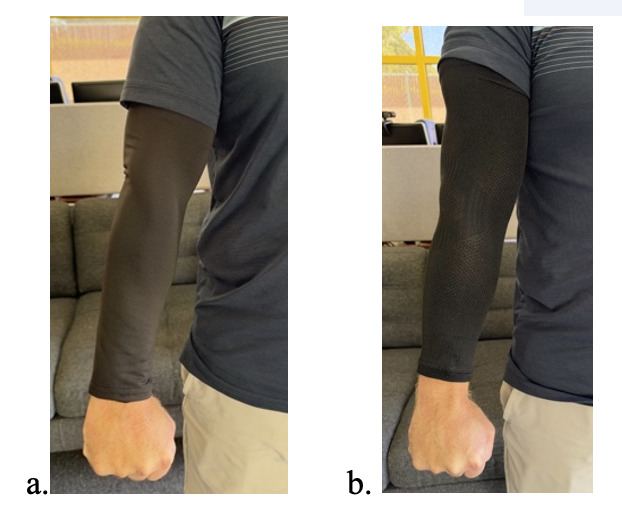
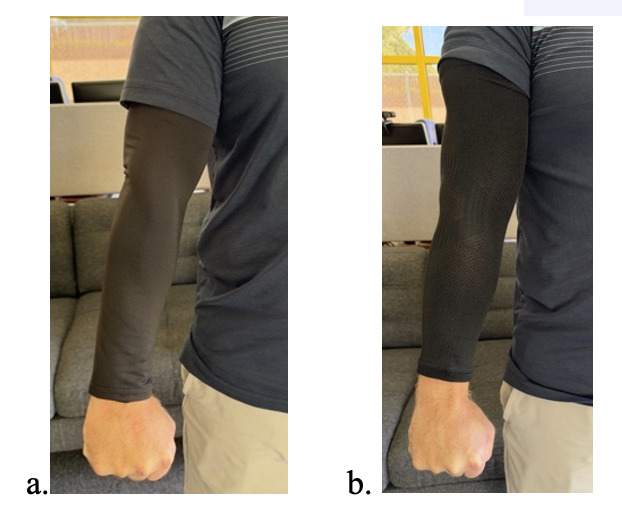
Three phases were established over the duration of the regular spring baseball season and study, splitting the season into equal thirds. Each participant received three personal sleeves, with instructions to use each sleeve for 1/3 of the season. Each participant’s treatment phase was randomized and blinded to a specific 1/3 of the season so not all participants wore the treatment sleeve at the same time during the season. Individual sleeve size was based on the circumference of the biceps region mid-humerus measured by the head athletic trainer of the team. Sleeves were worn where the superior edge reached the upper proximal humerus of the arm and the distal portion reached the proximal wrist. (Figure 1a, 1b)
Participants were instructed to use the validated visual analog scale (VAS) pain score to assess subjective pain and soreness with a focus on the medial elbow soft tissue of their throwing arm. A numeric pain scale score of “0” signifies no pain or soreness and a score of “10” being severe pain or soreness. Each participant was instructed to wear the specific sleeve provided for the third of the season they were currently in to sleep the night after they had pitched in the game and remove it the following morning. The participants were individually contacted on the night of their pitching appearance, whether a starting pitcher or a reliever, and again the next morning to obtain their individual elbow soreness score, 0-10. All data points were collected by the same member of the research team and were stored as de-identified data for each particular pitcher known only to the research coordinator.
Statistical Methods
A multivariable mixed-effects linear regression model was used to analyze changes in subjective pain and soreness between the bioactive, non-compressive, fabric sleeve and control sleeves, adjusting for time of season and accounting for multiple data points per pitcher. Effect sizes are
reported using standardized estimates. Analyses were completed in RStudio using a two-sided level of significance of 0.05.
RESULTS
Overall, 52 games were played during the season, broken into thirds with Part 1 representing the first 18 games, Part 2 representing the next 17 games, and Part 3 representing the final 17 games. Thirteen pitchers completed the study, average age was 19.8 years old, 85% right-handed and 15% left-handed. The average weight was 92.85kg (204.7lbs) and average height was 1.88m (74.15in). (Table 1)
Two pitchers missed games secondary to an injury to the throwing arm. One missed 37 of 55 games and the other missed 1 of 55 games. All other pitchers were available for all 55 games. There were 715 total game exposures and 38 exposures lost to injury (5.31%).
Overall, 100% of participants responded with both after the game and next morning scores. Only two scores were removed from the outcome data as one was after an in-game injury to the throwing forearm, and the other was on a road trip where the sleeve had been damaged and did not fit properly. Overall, 186 scores were collected the night after the game and 186 scores were collected the next morning The average number of pitching appearances per pitcher was 14.4 (Table 2).
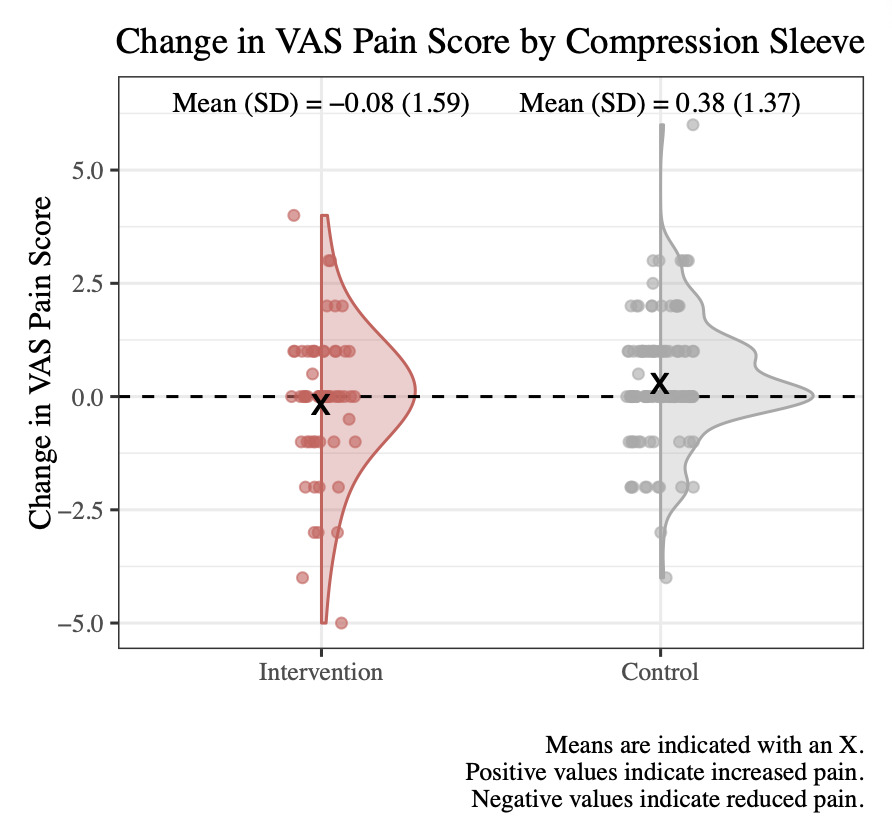
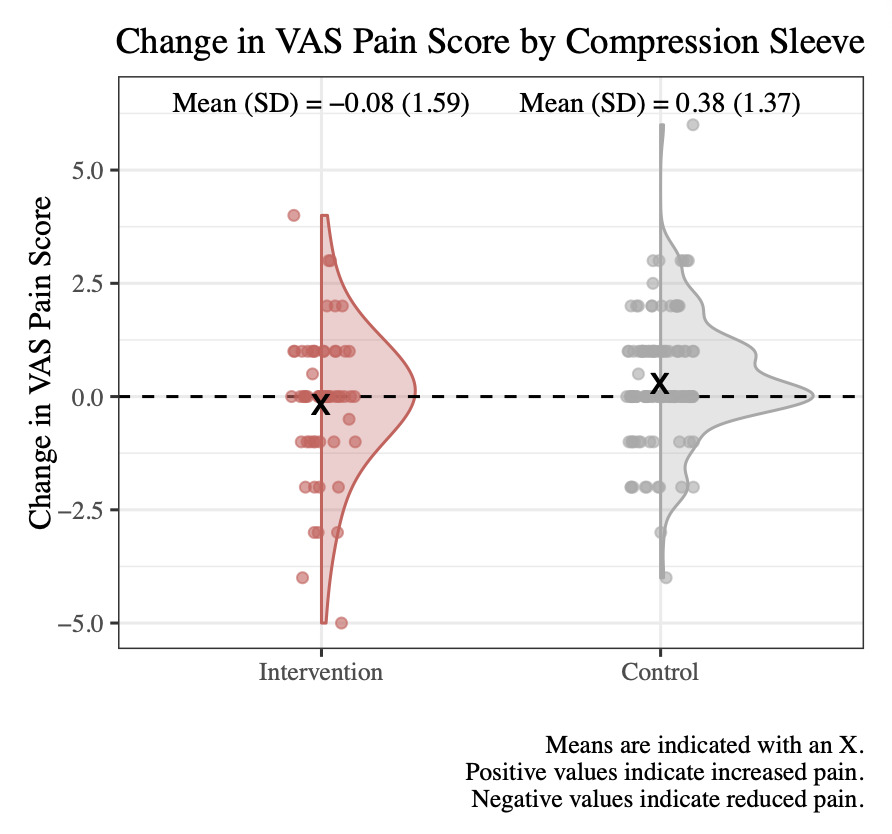
The overall average change in pain from the night of the game to the next morning was 0.2 points (standard deviation [SD]:1.5, range: -5 to +6). The average change in pain was -0.8 points (SD: 1.6, range: -5 to +4) for the bioactive study sleeve and +0.4 points (SD: 1.4, range: -4 to +6) for the control sleeves. When wearing the bioactive study sleeve, pitchers experienced a larger average reduction in pain (soreness) than when wearing the control sleeves (β = -0.42, 95% CI = [-0.85, -0.02], p = 0.044) (Figure 2). Adjusting for sleeve type, overnight pain reduction in the final third of the baseball season (“Season 3”) was significantly reduced compared the middle of the season (“Season 2”, β = -0.52, 95% CI = [-1.00, -0.03], p = 0.038) (Table 3). No adverse sleeve related events such as skin irritation were reported.
DISCUSSION
There is a special interest in recognizing, treating, and preventing a flexor-pronator injury in high level throwing athletes, especially as it pertains to potential UCL injury. The unique combination of velocity and repetitions a pitcher makes places him at a significant risk of sustaining a throwing arm elbow injury. The interplay of the medial-sided elbow static and dynamic stabilizers during the throwing motion remains critical with the potential for the UCL to bear more of the forces if there is fatigue of the flexor-pronator musculature.
The valgus force on the arm during throwing is the highest during the late cocking and early acceleration phases. According to Fleisig et al, 64Nm of varus torque is generated by professional baseball pitchers.9 Fifty-four percent of this generated 64Nm, or about 34.6Nm is theorized to be supported by the UCL during the varus torque moment counteracting the valgus moment. In cadaveric studies only 32Nm of torque is withstood by the UCL before failure,10 leading to the understanding of the importance of the dynamic stabilization of the medial elbow during the baseball throwing motion. Lazu et al. found a significant correlation between pitch count/volume in college baseball players and their forearm soreness (r=0.72)1 over the course of the season. Lazu et al. further described a correlation between the change in pitch volume and forearm soreness (r=0.64) over the course of the season.1 In professional baseball, there is a significant amount of time spent on the Injured List (IL) due to forearm injuries/sprains. Hodgins et al. reported from 2010-2014 the time spent on the IL for forearm injuries was 117 days for major league baseball players and 93.9 days for minor league players, based on data collected from the professional baseball health and injury tracking system.7 Hodgins also reported that these athletes had both a statistically significantly (p<0.001) higher rate of subsequent injuries to their throwing arms (shoulder, elbow, forearm) and a statistically significantly (p<0.001) increased need for subsequent UCL reconstruction.
Injury prevention and recovery have been a focus of interest in those who treat throwing athletes. Limiting injury to the flexor-pronator musculature of the forearm could positively impact missed time from game competition. Athletes, athletic trainers, physical therapists, and rehabilitation professionals utilize soft tissue manipulation (massage, stretching, cooling/ice), as well as compression garments to aid in recovery.11 Many athletes have used compression garments in other settings; before, during, and after live game performance, during training sessions, and after performance (overnight). There are many ways traditional compression sleeves are thought to improve recovery and performance. These include increasing local blood flow, providing additional stability/support, aiding in optimized temperature control, and a reduction in muscle vibration damage.12 Weakley et al preformed a systematic review of 183 studies to evaluate the effects of compression garments on “commonly assessed outcome measures in response to exercise, including: performance, biomechanical, neuromuscular, cardiovascular, cardiorespiratory, muscle damage, thermoregulatory, and perceptual responses.”12 They found little evidence to support improvements in either kinematic or kinetic outcomes, but concluded that compressive sleeves/garments likely reduce muscle oscillatory (movement) properties and have a positive effect on sensorimotor systems and reports of perception of reduced muscle soreness.12
There have been other attempts at investigating methods for mitigating or recovering from inflammation. Bontemps et al. examined far infrared-emitting (FIR-emitting) garments for sports performance and recovery.13 From the 11 studies included in their systematic review, they found that while no statistically significant findings were reported, the Cohen’s effect size for delayed onset muscle soreness (DOMS) in young soccer players were moderate to large at 48 hours and 72 hours (ES=0.73, ES=0.84 respectively) after performing 100 consecutive drop jumps when wearing the garments for three consecutive nights.14 When elite soccer athletes wore the FIR-emitting garment during a 2-week pre-season camp for five consecutive nights, Nunes et al. found smaller but positive effect size sin the players with the FIR-emitting garments when comparing to a placebo. They noted small positive effect sizes among various tasks: week 2 for squat jump performance (ES=0.38) and week 1 for countermovement jump performance (ES=0.26), 10-meter sprint (ES=0.35); alongside a large effect size for training strain (ES=-1.19, p<0.05).15 Zinke et al. noted that when wearing the FIR-emitting garments over three consecutive nights following a resistance training day, athletes had improved recovery lowering their muscle pain intensity (ES=0.8 and ES=0.6) at 24 hours and 48 hours post training.16 They also described improved perception of recovery at both 24 hours and 48 hours after training (ES=0.7, ES=0.7), and improved sleep quality on night three after training (ES=0.8).16
This study design was successfully implemented with high level throwing athletes using the validated VAS pain score, focused on the participants throwing forearm flexor-pronator musculature region. The results of the study are consistent with other studies in the literature with regards to FIR-emitting garments. The study demonstrated that over the course of the season the bioactive fabric sleeve showed a statistically significant reduction in reported pain the morning after pitching via the soreness score (p=0.044) for baseball pitchers when compared to the traditional compression sleeve, but the clinical relevance of the magnitude of the decrease in pain is not completely understood. Further, additional questions exist regarding the importance of the compression versus the bioactive material itself, as the intervention bioactive material sleeve group which is non-compression demonstrated the significant improvement.
There are a number of limitations of this study. This was a pilot study and thus a pre-study power analysis was not performed. While the statistical analysis accounted for differences in pitcher utilization, differences in workload and cumulative fatigue over the season could play a role in these results. While the elbow soreness score is not a validated elbow score per se, it is taken from the validated VAS. Thus, it was deemed appropriate to use in this capacity as it is a subjective measure unique to each athlete, however no official validation for this particular utilization has been performed. Additionally, with smaller numbers, a 0-10 scoring range may introduce bias. Though it was demonstrated significant improvement of the elbow pain and soreness, the absolute subjectively reported number introduces the question of true clinical significance. One reassuring finding, however, was the overall mean reduction being a negative number with the intervention sleeve, while the control sleeve demonstrated an overall worsening or positive number. Pitchers who recorded less appearances in games were included as well as this gives a more robust observation of all pitchers and potential benefits. It could be argued a lower volume pitcher could develop more soreness than a higher volume pitcher as he is less conditioned to game competition.
There was no objective measure of compliance of whether participants actually wore the sleeve as instructed, the hours of wear throughout the night, or whether or not the sleeve was removed. Though reporting back to the athletic trainer and study team the sleeve was being worn, there is not absolute certainty. Furthermore, actual pitching workload as defined by pitch count and innings pitched, was not included in this study. This study attempted to discern the soreness a pitcher felt in the medial elbow after a game and again the following morning regardless of amount of the volume of pitching. By breaking the season into thirds, this allowed a more robust analysis, for example, of a pitcher who threw more at the start of the season and then threw less, or a pitcher who started as a reliever and became a starter. This allowed these factors to be more flushed out evenly. Lastly, though the sleeves were similar in color and sizing, they were not the exact same. The intervention biofabric sleeve is less compressive, slightly thicker, and has a slightly different, rougher feel than the control sleeves which are a bit thinner and smoother with more compression. The participants did not know which of the sleeves were control, but may have been able to guess, thus, it is possible that subjects were not blinded to the sleeve/condition.
CONCLUSION
This results of this study indicate that a bioactive, non-compressive, fabric sleeve significantly reduces the subjective reports of medial sided elbow pain and soreness after competitive pitching more than a standard compression sleeve in collegiate pitchers. A larger, multi-institutional study will be performed improving upon the limitations and further determining if this recovery modality is of benefit to the throwing athlete.
Conflicts of interest
The authors report no conflicts of interest pertaining to this study. Reparel Inc. provided funding in the form of product and support.