Introduction
Tennis is characterized by repetitive high-velocity movements that place substantial demands on the upper extremity.1 Efficient performance depends on force transfer throughout the kinetic chain, linking the lower extremities, trunk, shoulder, elbow, and wrist. Consequently, both performance and injury risk are influenced by the interaction of biomechanical, physiological, and environmental factors. Over the past three decades, professional tennis has undergone substantial evolution. Modern play is characterized by greater topspin production, higher racquet-head speeds, prolonged baseline exchanges, increased physical demands, and dense competitive schedules.2,3 These changes have altered workload exposure and may have modified the mechanical environment experienced by the upper extremity.
Although shoulder disorders have received considerable attention, elbow-related complaints remain a common source of pain and performance limitation in both recreational and elite players.4,5 Recent debate within professional tennis has additionally focused on tennis ball characteristics and their potential influence on player workload. While direct evidence remains limited, these observations raise important questions regarding cumulative mechanical exposure.
Contemporary sports medicine increasingly recognizes injury as the result of interactions among workload, fatigue, recovery capacity, and movement efficiency rather than isolated tissue overload.6,7 Within this framework, elbow symptoms may represent the consequence of cumulative exposure exceeding biological adaptation capacity. Therefore, the purpose of this narrative review was to examine current evidence regarding elbow injury risk in tennis, explore whether modern playing conditions may have altered the mechanical environment of the elbow, and propose a conceptual framework integrating workload, biomechanics, kinetic-chain function, recovery capacity, and ball-related factors.
Methods
This narrative review was designed to synthesize literature relevant to elbow injury risk in tennis and to identify concepts that may influence clinical decision-making and future investigation. Literature was identified through searches of PubMed, Scopus, SPORTDiscus, and Web of Science using combinations of the terms “tennis,” “elbow injury,” “lateral epicondylalgia,” “tennis elbow,” “biomechanics,” “kinetic chain,” “workload,” “overuse injury,” “tennis ball,” and “upper-extremity injury.” Additional relevant publications were identified through citation tracking of key review articles and consensus statements.
Studies addressing tennis injury epidemiology, upper-extremity biomechanics, workload, tendon pathology, kinetic-chain function, fatigue, and equipment-related factors were considered. Both original research studies and high-quality review articles were included because of the exploratory and conceptual nature of the review. Particular attention was given to literature addressing the evolution of modern tennis, cumulative mechanical exposure, fatigue-related changes in movement and neuromuscular function, and factors potentially influencing elbow loading. The available evidence was subsequently synthesized into thematic domains addressing injury epidemiology, biomechanical evolution of the modern game, cumulative workload exposure, fatigue, kinetic-chain function, recovery capacity, and equipment-related considerations. These domains formed the basis for development of the proposed Cumulative Elbow Load Model (CELM).
Results
Epidemiology of Upper Extremity Injuries in Tennis
Upper-extremity injuries are frequently reported among musculoskeletal complaints in tennis players and are predominantly associated with overuse mechanisms.8–10 Epidemiological studies consistently report that most tennis-related injuries develop gradually as a consequence of repetitive mechanical loading rather than acute traumatic events.11 Injury incidence appears to be influenced by factors such as playing volume, competitive level, and cumulative exposure.12,13
Shoulder, elbow, and wrist disorders are commonly reported across different tennis populations. Epidemiological reviews describe these conditions in recreational and competitive players, while tournament-surveillance data confirm their occurrence in professional players competing at the French Open.8,10,12,14 In elite athletes, repetitive execution of high-velocity strokes, extensive training volumes, dense competition schedules, and frequent travel may further increase cumulative mechanical demands.2,3,15,16 The elbow occupies a critical position within the kinetic chain, functioning as a link between proximal force generation and distal force transmission.17,18 This biomechanical role has led to increasing interest in factors beyond local tissue loading that may contribute to upper-extremity injury.
The Evolution of Modern Tennis
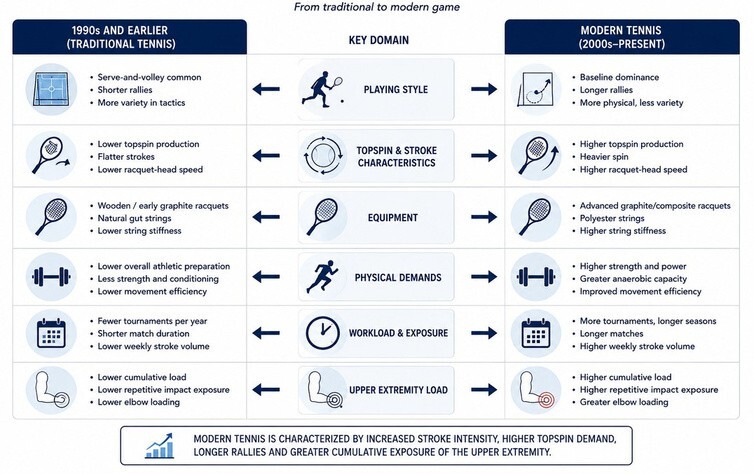
Professional tennis has evolved considerably over the past three decades. Modern play is characterized by greater topspin production, higher racquet-head speeds, prolonged baseline exchanges, and increased physical demands compared with previous decades.2 Technological advances, particularly the widespread adoption of polyester strings, have contributed substantially to these changes by enabling players to generate greater spin while maintaining control at high swing velocities.3 Contemporary stroke mechanics commonly incorporate semi-Western or Western grips, substantial trunk rotation, and aggressive racquet acceleration.19–21 The major mechanical and workload-related changes characterizing the evolution from traditional to modern professional tennis are summarized in Figure 1.
Contributors to Cumulative Elbow Loading
Among the factors recently attracting attention within professional tennis are the characteristics of tennis balls. Although concerns regarding ball variability have been widely discussed among players, coaches, and clinicians, scientific evidence directly linking tennis ball properties to elbow injury remains limited. Tennis balls are regulated by the International Tennis Federation (ITF), which establishes standards for mass, diameter, rebound height, and deformation characteristics.25,26 Ball behaviour changes during repeated impacts as its mechanical properties evolve throughout play.27,28
From a biomechanical perspective, ball-racquet impact represents a critical event in force transmission throughout the upper extremity.17,19 Impact forces are influenced by multiple variables, including ball velocity, racquet-head speed, string-bed characteristics, impact location, and ball deformation.20,29 The concept of cumulative exposure has emerged as a central principle in contemporary sports medicine. Rather than resulting from a single mechanical event, several overuse injuries that may occur to athletes are now understood as the consequence of repeated loading interacting with tissue adaptation over time.30,31 This concept is particularly relevant in tennis, where players may perform thousands of strokes during a single training week and hundreds of thousands of racquet-ball impacts throughout a competitive season. Workload reflects the interaction between external and internal load, with external load encompassing the volume and characteristics of training and competition, and internal load representing the athlete’s individual physiological response to these demands.3,7,15 Although exposure to load is necessary for adaptation, injury risk may increase when cumulative demands exceed recovery capacity.32,33 The dense competitive calendar of professional tennis, characterized by frequent travel, repeated competition, and limited recovery opportunities, may further contribute to this imbalance.16
Fatigue represents an important modifier of cumulative loading. Beyond its effects on performance, fatigue may alter movement efficiency, neuromuscular control, force production, and coordination.32,34,35 As fatigue accumulates, compensatory movement strategies may emerge, potentially increasing mechanical demands on distal segments of the kinetic chain. Reduced lower-extremity or trunk contribution may increase reliance on the upper extremity to maintain stroke performance, thereby exposing the elbow to greater cumulative stress.36,37 For example, reduced contribution from the lower extremities or trunk during repeated serves or groundstrokes may increase the relative contribution required from the shoulder and elbow to maintain stroke velocity. Within the kinetic-chain framework, such redistribution of mechanical demand may progressively concentrate load on distal segments.
Fatigue may preserve overall task performance in terms of alterations in the neuromuscular strategies used to achieve the movement. Athletes may maintain ball velocity and overall performance while adopting different neuromuscular recruitment strategies to achieve the same task.34,38 Experimental and electromyographic studies have demonstrated that fatigue can alter muscle activation timing, increase co-contraction, and modify the relative contribution of individual muscles involved in force production and stabilization.34,38 Within the tennis kinetic chain, these neuromuscular adaptations may reduce the efficiency of proximal-to-distal force transfer.39–41 Consequently, altered neuromuscular recruitment and force-transfer strategies may increase mechanical demands on distal structures, including the shoulder and elbow, despite preservation of overall task performance. From this perspective, fatigue may be viewed not only as an accumulation of physiological load but also as a state of reduced neuromechanical efficiency that alters load distribution throughout the system.34,35
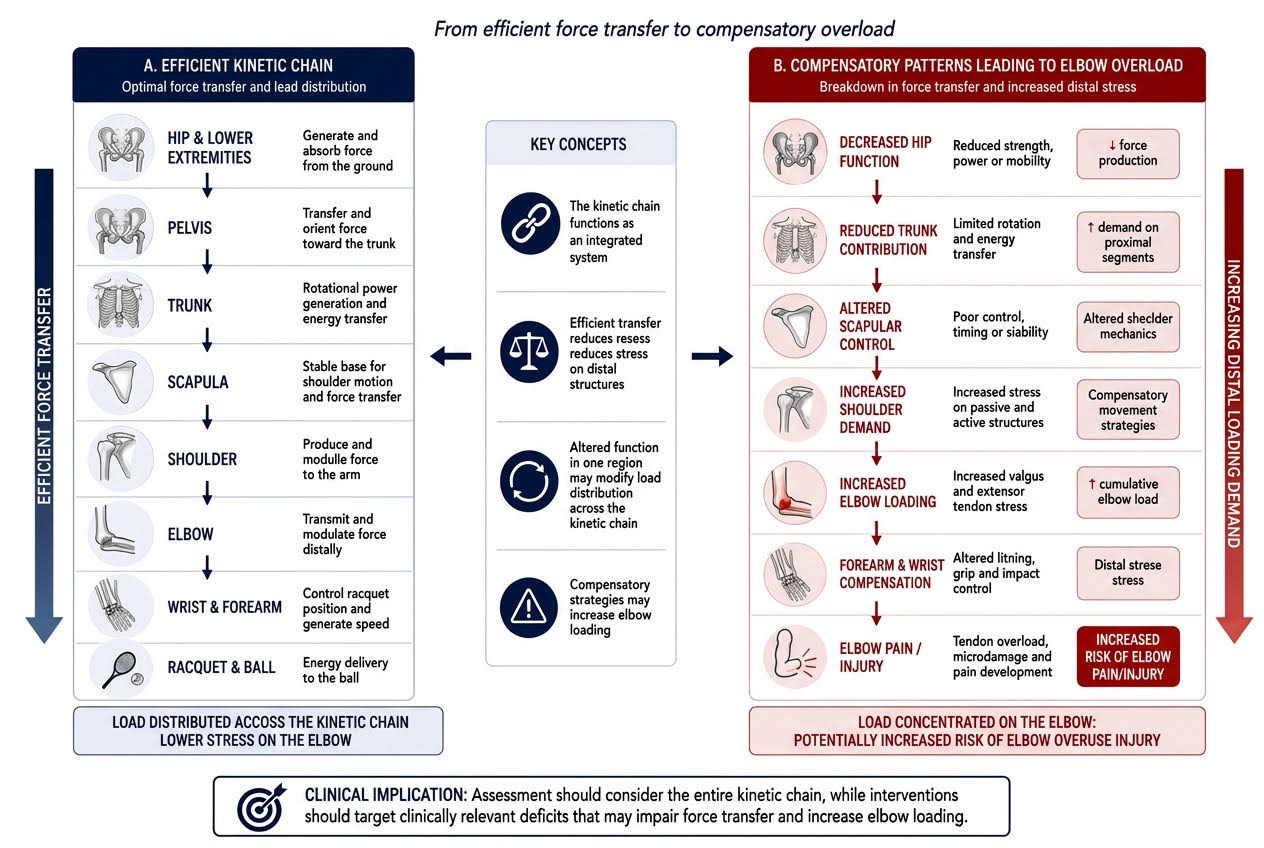
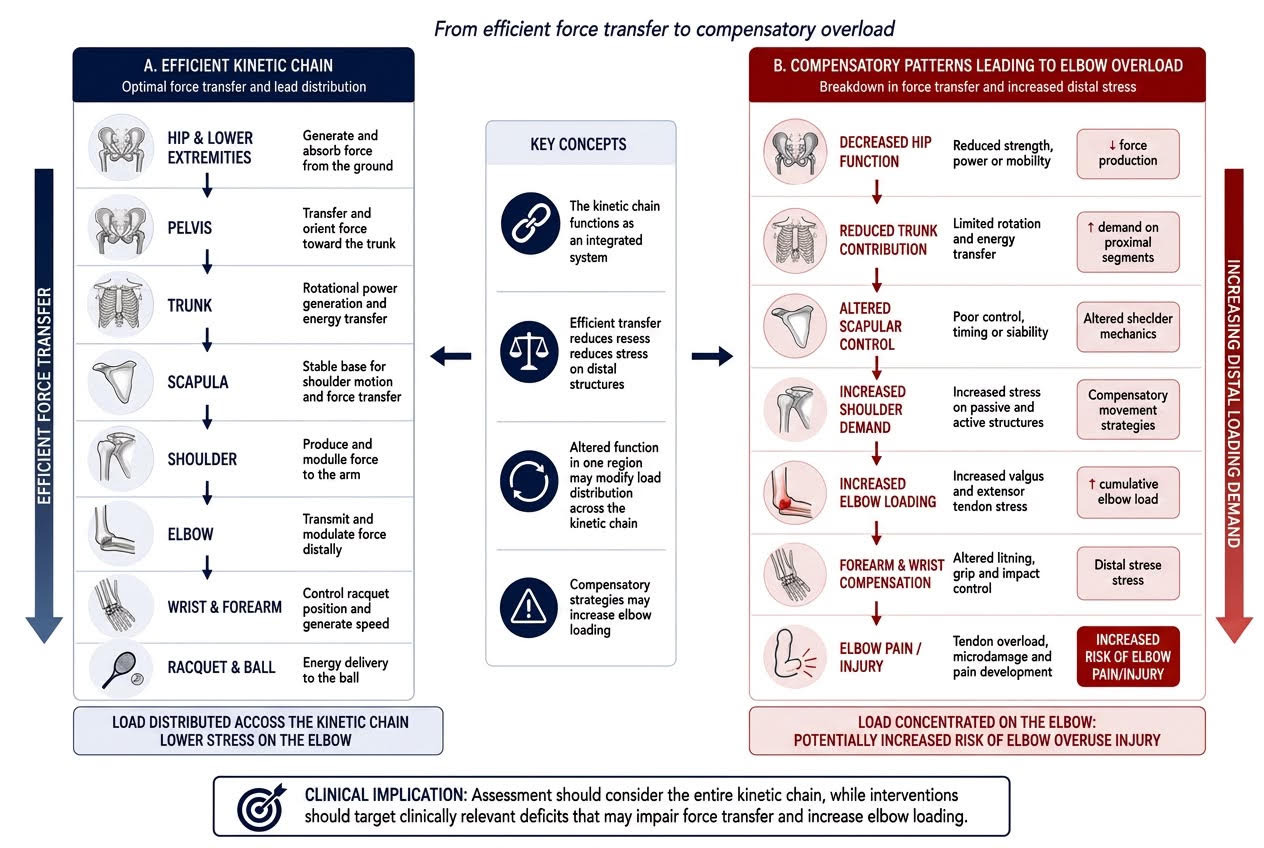
The kinetic-chain concept provides a biomechanical framework through which these interactions can be understood.40 Efficient tennis stroke mechanics and execution depend on coordinated force transfer from the lower extremities through the pelvis, trunk, scapula, shoulder, elbow, and wrist before reaching the racquet.20,21,42,43 When this sequence functions efficiently, mechanical demands are distributed throughout the system. Conversely, deficits involving proximal force generation, mobility, or neuromuscular control may alter load distribution and increase stress on distal structures. Because the elbow functions as a transitional link between proximal force generation and distal force transmission, it occupies a particularly vulnerable position within the kinetic chain.4,44,45 Consequently, elbow symptoms may not solely reflect local tissue pathology but may represent the cumulative effect of workload exposure, fatigue-related adaptations, and inefficiencies in force transfer throughout the system.46,47 The proposed redistribution of mechanical load across the kinetic chain is illustrated in Figure 2.
The Cumulative Elbow Load Model (CELM)
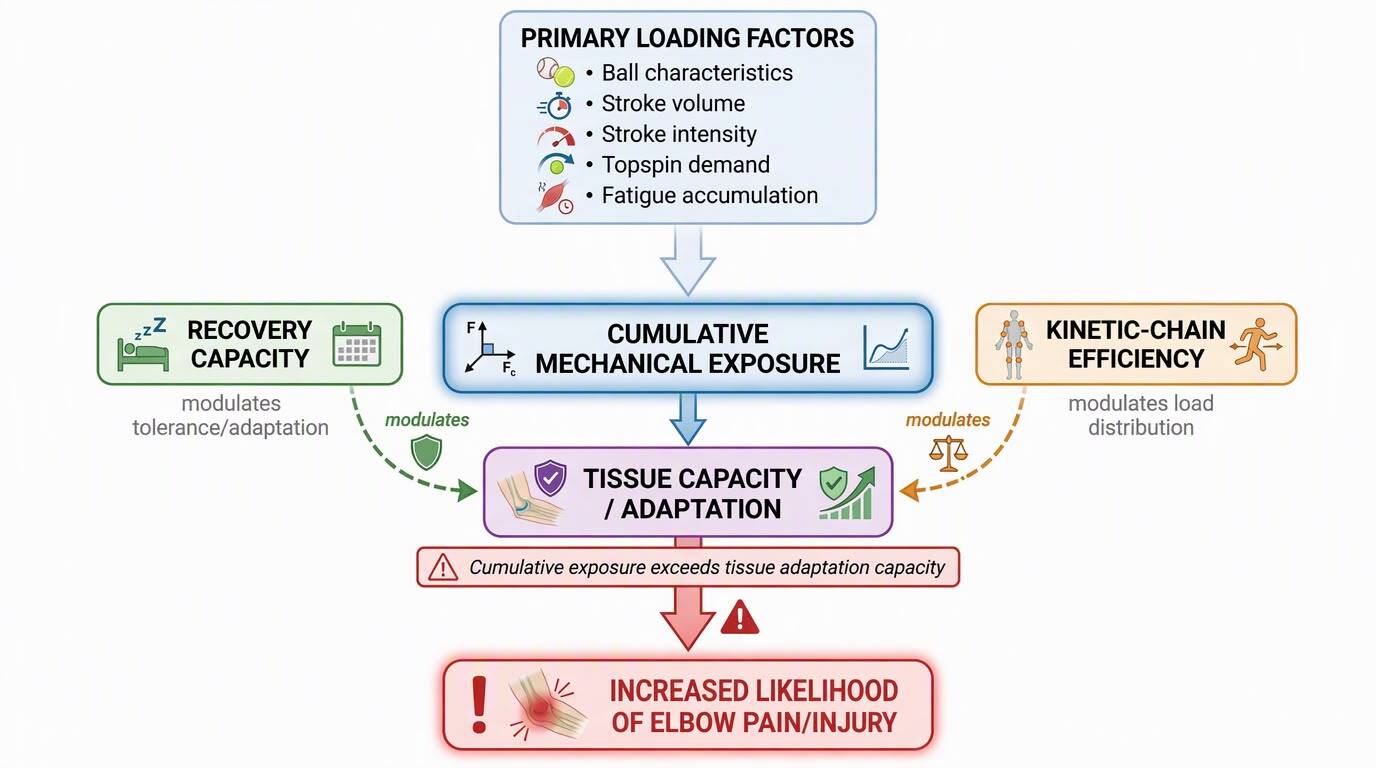
Based on the literature reviewed and contemporary concepts in sports medicine, the authors propose the Cumulative Elbow Load Model (CELM) as a conceptual framework for understanding elbow injury risk in tennis. The model proposes that elbow symptoms and injury may increase when cumulative mechanical exposure persistently exceeds the athlete’s capacity for biological adaptation.34,35 Rather than attributing symptoms to a single causative factor, the CELM considers elbow injury risk as the result of interactions among multiple loading factors and protective modifiers operating within a dynamic system.
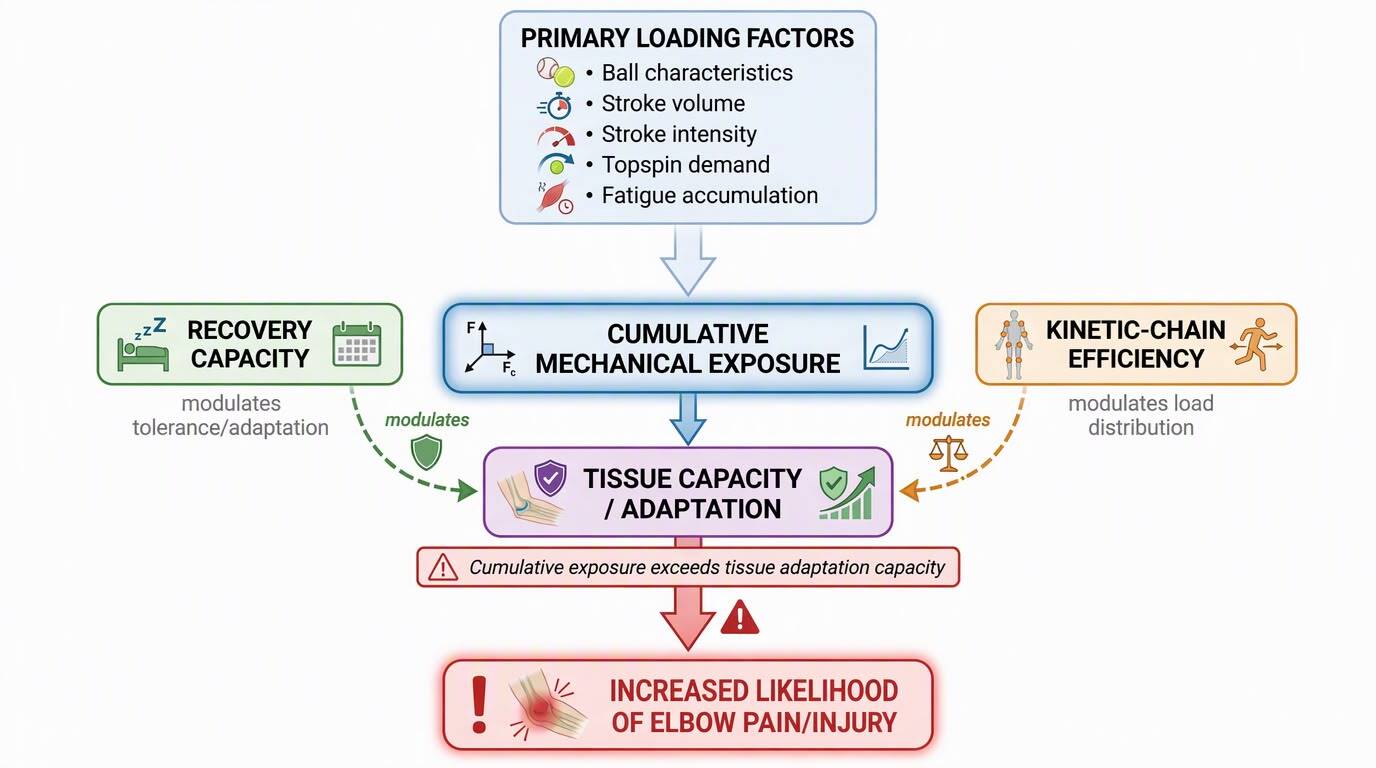
The primary loading factors incorporated within the model include ball characteristics, stroke volume, stroke intensity, topspin demand, and fatigue accumulation. These factors may interact throughout training and competition to determine the athlete’s cumulative mechanical exposure. Fatigue may be particularly relevant because its effects extend beyond physiological exhaustion and may alter neuromuscular control, coordination, movement efficiency, and force-transfer strategies within the kinetic chain.34,38 Conversely, recovery capacity and kinetic-chain efficiency are considered protective modifiers that may influence the athlete’s ability to tolerate and adapt to repeated mechanical exposure. Within this framework, recovery capacity includes restoration of physiological and neuromuscular function, whereas kinetic-chain efficiency reflects the ability to generate and transfer force effectively while maintaining movement quality.
Importantly, the CELM is intended as a conceptual framework rather than a mathematical or predictive model. The relative contribution of individual factors cannot currently be quantified within a unified model, and the proposed relationships should therefore be interpreted as hypothesis-generating. Cumulative mechanical exposure should not be interpreted as a direct cause of elbow pathology; rather, injury risk may increase when mechanical demands persistently exceed the athlete’s capacity for tissue adaptation.34,38
The proposed interaction among cumulative mechanical exposure, recovery capacity, kinetic-chain efficiency, and tissue adaptation is illustrated in Figure 3.
Discussion
The literature reviewed in this narrative article supports consideration of elbow injury in modern tennis within a cumulative-load framework rather than exclusively through isolated local tissue models. The available literature suggests that workload exposure, fatigue accumulation, recovery capacity, movement efficiency, and equipment-related factors may interact to influence tissue adaptation and elbow injury risk.33 Within this context, elbow symptoms may represent the clinical manifestation of cumulative mechanical exposure exceeding biological capacity. Over the past three decades, professional tennis has undergone substantial biomechanical and physical evolution.22,23 Modern play is characterized by greater topspin production, higher racquet-head speeds, prolonged baseline exchanges, and increasingly demanding competitive schedules.2,24 These changes have likely increased cumulative upper-extremity loading and may have altered the mechanical environment experienced by the elbow. While traditional models have focused primarily on local tendon overload, current concepts in sports medicine increasingly emphasize the interaction between loading and adaptation across the entire athlete. Recent discussion surrounding tennis ball characteristics has generated considerable interest among players, coaches, and clinicians. Although direct evidence linking ball characteristics to elbow injury remains limited, several theoretical mechanisms justify further investigation. Variables such as ball mass, felt density, deformation characteristics, durability, and moisture absorption may influence impact behaviour and perceived effort during play.48 However, the present review does not suggest that tennis balls independently cause elbow pathology. Rather, they should be considered potential modifiers of cumulative mechanical exposure within a broader multifactorial framework.
The interaction between workload, fatigue, and kinetic-chain function appears particularly relevant.32,33 Repetitive exposure to high stroke volumes, intense match play, and dense tournament schedules may progressively increase mechanical demands on the upper extremity.49,50 Simultaneously, fatigue may alter force production, movement efficiency, and neuromuscular control, potentially resulting in compensatory loading patterns. Because efficient stroke mechanics and execution depend on coordinated force transfer throughout the kinetic chain, deficits involving the lower extremities, trunk, scapula, or shoulder may increase distal mechanical demands on the elbow. Consequently, elbow symptoms should not be interpreted solely as evidence of local pathology but may also reflect dysfunction occurring elsewhere within the kinetic chain.43,51,52 Neuromechanical fatigue may represent an important link between cumulative workload and altered load distribution within the kinetic chain.34,35 Importantly, recovery should therefore be considered not only as restoration of physiological capacity but also as restoration of neuromuscular coordination and movement efficiency.34,35,38,53,54
The Cumulative Elbow Load Model was developed to integrate these concepts within a single framework. The model proposes that injury risk may increase when cumulative loading factors outweigh the protective influence of recovery capacity and kinetic-chain efficiency.31 Importantly, the model is intended as a conceptual framework rather than a predictive tool. Its primary purpose is to facilitate clinical reasoning and provide a foundation for future investigation into the complex interactions underlying elbow disorders in tennis. Rehabilitation should consider restoration of local tissue capacity and addressing deficits that may contribute to excessive cumulative loading.55,56 This systems-based perspective may provide a comprehensive understanding of elbow disorders and help optimize both treatment and injury-prevention strategies in modern tennis.
Clinical Implications
The findings of this narrative review support consideration of elbow pathology in tennis within a broader cumulative-load perspective. Assessment of tennis athletes presenting with elbow symptoms should extend beyond the symptomatic region and include consideration of workload exposure, recovery status, stroke characteristics, and kinetic-chain function.49,57 Because deficits occurring elsewhere within the system may influence distal loading patterns, evaluation of lower-extremity contribution, trunk mechanics, scapular control, and shoulder performance may provide important clinical information.21,52,58
Rehabilitation should aim not only to restore local tissue capacity but also to address factors that may contribute to excessive cumulative loading.40,59,60 Progressive tendon loading remains an important component of treatment61–63; however, optimization of movement efficiency, workload management, and recovery strategies may be equally relevant.56 Similarly, injury-prevention programs should focus on maintaining an appropriate balance between mechanical exposure and adaptation capacity through effective monitoring of training loads, competition schedules, recovery practices, and kinetic-chain function. The Cumulative Elbow Load Model may provide clinicians with a practical framework for integrating loading, recovery, and movement-related factors into clinical decision-making. By encouraging a systems-based approach to assessment and management, the model may help identify contributors to excessive cumulative loading and support more comprehensive rehabilitation and injury-prevention strategies in tennis athletes.
Future Research Directions
Several important questions remain unresolved. Future studies should investigate whether measurable differences in tennis ball characteristics influence upper-extremity biomechanics, cumulative workload, and injury risk. Additional research should explore the effects of fatigue on stroke mechanics and kinetic-chain function, as well as the longitudinal relationship between workload exposure and symptom development. Future studies incorporating electromyographic assessment may help clarify how fatigue-related changes in neuromuscular coordination influence force-transfer patterns and cumulative elbow loading.34,38 Prospective investigations incorporating workload monitoring, wearable technologies, biomechanical assessment, and injury surveillance may help clarify the interaction among loading, recovery, movement efficiency, and tissue adaptation. Finally, empirical validation of the Cumulative Elbow Load Model is required before its application as a clinical or predictive tool.
Limitations
This narrative review has several limitations. First, it is narrative rather than systematic in design. In addition, much of the available evidence is derived from elite and professional tennis populations. Therefore, the applicability of the proposed conceptual model to recreational players should be interpreted with caution until further research becomes available. Second, direct evidence linking tennis ball characteristics to elbow injury remains limited, and much of the discussion is based on biomechanical rationale and clinical observation. Finally, the Cumulative Elbow Load Model is a conceptual framework that has not yet undergone prospective validation and should therefore be interpreted as hypothesis-generating rather than predictive.
Conclusion
Current evidence supports consideration of elbow disorders in tennis within a broader framework of cumulative mechanical exposure rather than solely through isolated local tissue overload. Contemporary tennis has evolved into a high-demand environment characterized by increased stroke intensity, greater topspin production, prolonged competitive exposure, and substantial physical demands, all of which may influence upper-extremity loading.2,3 Current evidence supports the proposed multifactorial model in which workload, fatigue, recovery capacity, movement efficiency, and equipment-related factors interact continuously to influence tissue adaptation and injury risk.30 Although direct evidence linking tennis ball characteristics to elbow pathology remains limited, ball-related factors may represent one component within a broader cumulative load framework.
The Cumulative Elbow Load Model integrates these concepts into a unified framework and proposes that injury risk may increase when cumulative mechanical demands persistently exceed biological adaptation capacity. While further validation is required, the model may provide a useful foundation for future research and a practical framework for understanding, preventing, and managing elbow disorders in tennis athletes.
Conflicts of Interest
The authors declare that they have no known competing financial interests or personal relationships that could have appeared to influence the work reported in this paper.
Declaration of AI Use
ChatGPT was used to support the organization and refinement of author-generated text. FigureLabs was used to assist with the graphical development of figures based on author-provided concepts and instructions. The authors reviewed, revised, and verified all content, citations, terminology, and clinical interpretations and take full responsibility for the final manuscript.