INTRODUCTION
Contemporary return-to-play (RTP) testing after lower-extremity injury is built almost entirely around sagittal-plane tasks. Single-leg hop for distance, triple hop, crossover hop, 6-meter timed hop,1 and isokinetic or isometric quadriceps strength testing remain the pillars of most RTP batteries, typically expressed as a limb symmetry index (LSI) with a common ≥90% threshold for symmetry.2–8 This approach is supported by meaningful evidence: Grindem and colleagues9 demonstrated that athletes who passed RTP criteria built around quadriceps strength and hop symmetry experienced a substantially lower reinjury rate than those who did not, and each additional month of delay in RTP up to nine months was independently protective.
At the same time, this sagittal-plane framework has known blind spots. Wellsandt and colleagues10 showed that comparing an involved limb to an uninvolved limb can overestimate readiness, because the uninvolved limb itself often loses capacity after injury, inflating the apparent symmetry score. Separately, Paterno and colleagues11 found that frontal-plane knee mechanics and postural stability deficits, not sagittal-plane jump height alone, were independently predictive of second anterior cruciate ligament (ACL) injury after reconstruction. Taken together, this body of work suggests that the RTP toolbox is well developed for forward and vertical loading but comparatively underdeveloped for isolating an athlete’s capacity to produce force in the frontal plane — despite frontal-plane control being directly implicated in reinjury risk.
This gap is not merely theoretical. Basketball players spend approximately 31% of their live game actions engaged in lateral shuffling,12 and the mechanisms behind non-contact ACL injury, lateral ankle sprain, and hip/groin strain frequently involve a cutting, sliding, or decelerating action in the frontal or transverse plane rather than a purely forward hop or vertical landing. A test that isolates lateral force production, is reliable enough for serial tracking, and is efficient enough to fit into a busy clinical schedule would fill a genuine gap in the RTP evidence base. Recent work by Leidersdorf and colleagues13 on the single-leg lateral countermovement jump (LCMJ) offers exactly this kind of test, and the purpose of this commentary is to examine what that evidence supports (and does not yet support) regarding the use of the LCMJ in clinical practice.
THE FRONTAL-PLANE BLIND SPOT IN RTP TESTING
Most RTP batteries ask an athlete to move in one direction: forward, or straight up and down. This is a reasonable starting point — forward hop distance and vertical jump height are simple to standardize, require no specialized equipment beyond a tape measure or contact mat, and correlate reasonably well with lower extremity strength and power14,15 and global lower-extremity function.16,17 But few standard RTP tools ask an athlete to push explosively off a single leg in the frontal plane, despite this being precisely the demand placed on the tissue during a defensive slide, a plant-and-cut, or an unanticipated lateral perturbation — common mechanisms for ACL injury, lateral ankle sprain, and adductor-related groin injury.
The consequence is a testing battery that can certify an athlete as “ready” by sagittal-plane standards while leaving a frontal-plane deficit completely uncharacterized. A clinician relying solely on hop-based LSI has no direct window into whether an athlete can produce adequate lateral force off the involved limb, only whether that limb can propel the athlete forward and land it safely. Given that frontal-plane mechanics independently predict second ACL injury risk,11 this is a meaningful omission, and it is precisely the space the LCMJ was designed to occupy.
THE LATERAL COUNTERMOVEMENT JUMP: TEST DESCRIPTION
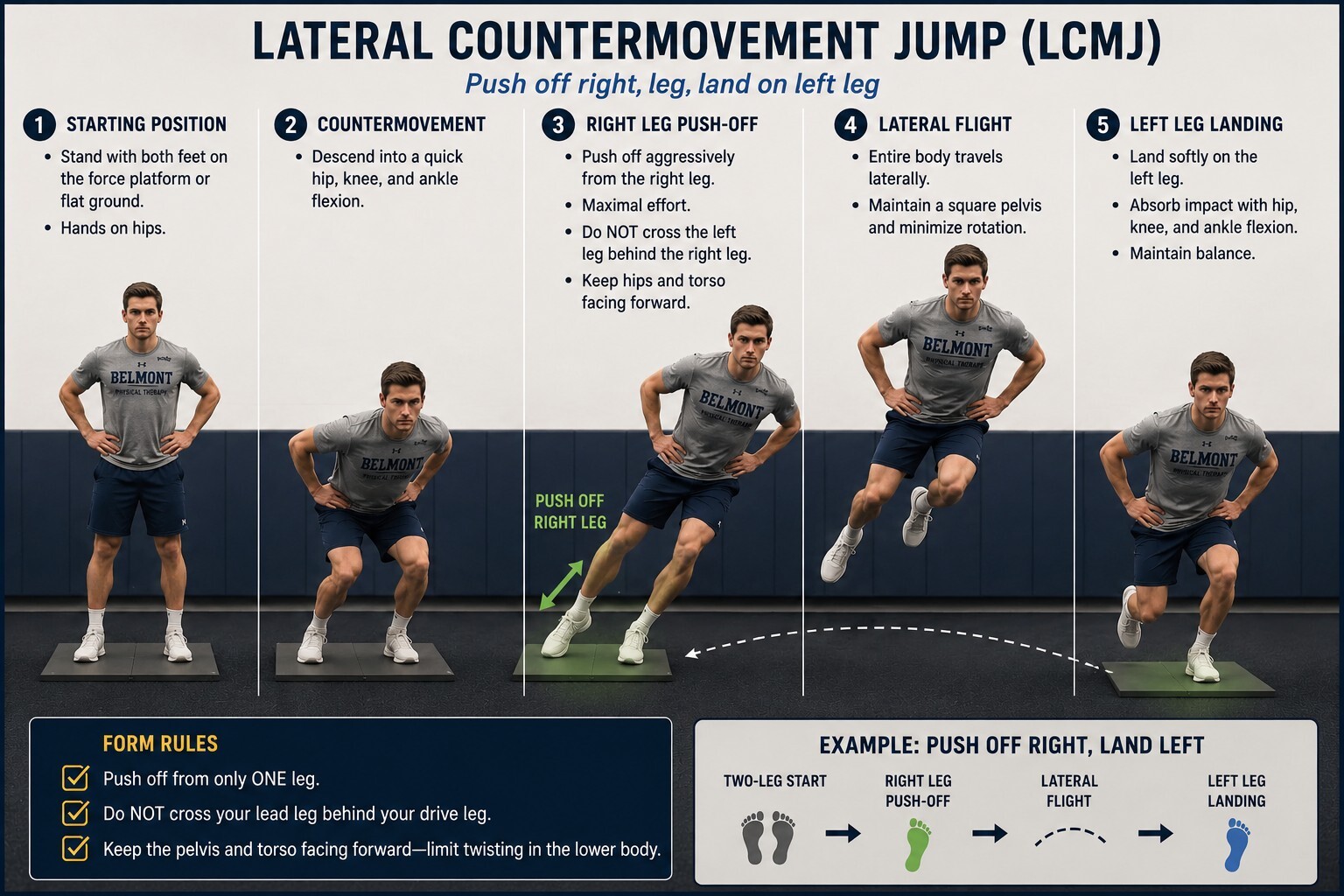
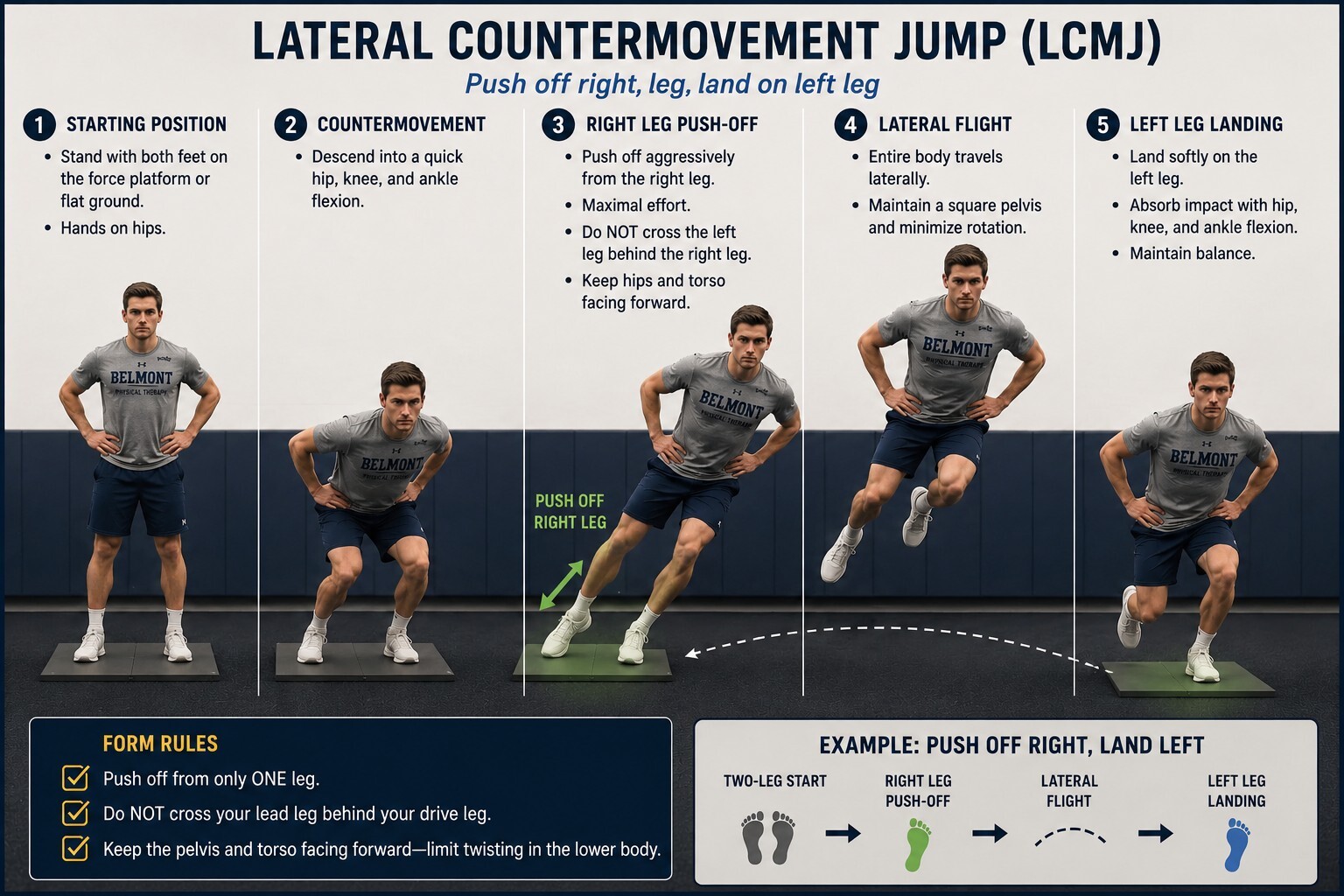
The LCMJ is performed on a single triaxial force platform capable of testing vertical (Z-axis) and lateral (X-axis) ground reaction forces. The athlete begins standing on the platform (hands on the hip), holds a brief quiet stance for a weighing phase, and then pushes explosively off a single leg, jumping laterally off the platform (lateral-to-medial with respect to the stance leg) (Figure 1). Athletes are cued for maximal effort and are asked not to cross the lead leg behind the drive leg, which limits transverse-plane substitution and keeps the output attributable primarily to the frontal plane. A brief submaximal familiarization trial precedes two maximal trials per leg, and the test requires no jump-and-catch landing mechanics beyond what the athlete already tolerates in a standard plyometric progression.13
Force-plate software can extract a range of kinetic variables from this single movement: peak vertical force, peak lateral force, force values normalized to body mass (relative vertical and lateral force), net relative force, vertical and lateral rate of force development, lateral impulse, relative lateral impulse, and total movement time. Not all of these, however, have demonstrated the reliability required for clinical decision-making, which is the first question any clinician should ask of a new test before adopting it.
WHAT THE EVIDENCE SHOWS: RELIABILITY
Leidersdorf and colleagues13 examined within- and between-session reliability of LCMJ kinetics in 20 professional basketball players using Bland-Altman analysis, coefficient of variation (CV), and intraclass correlation coefficients (ICC), applying commonly used clinical thresholds of CV <10% and ICC >0.70. Within a single session, nine of the ten variables tested met this threshold; only vertical rate of force development fell short. Between sessions — the more clinically relevant standard for tracking an athlete across a rehabilitation timeline — only four of the ten variables held up: peak vertical force, peak lateral force, relative lateral force, and lateral impulse. Every rate-of-force-development variable and total movement time failed to meet the between-session threshold.
This pattern is not unique to the LCMJ. Temporal, rate-based metrics have consistently shown lower test-retest stability than peak-force metrics across other jump-based assessments, including the traditional bilateral countermovement jump.18,19 The clinical implication is straightforward: clinicians who wish to track an athlete’s lateral force capacity serially through an RTP timeline should anchor their decisions to data related to peak vertical force, peak lateral force, relative lateral force, and lateral impulse. Rate-of-force-development values from this test, although appealing conceptually, should not be used to justify or delay a return-to-play decision given their instability between visits.
WHAT THE EVIDENCE SHOWS: DISCRIMINANT VALIDITY
Before earning a place in a busy testing battery, a test must be reliable and able to distinguish higher from lower performing athletes. Leidersdorf and colleagues13 addressed this in a separate cohort of 140 professional and collegiate basketball players, who completed both the LCMJ and a 5-5 lateral shuffle task modeled on a basketball defensive slide.20 Athletes were split into “fast” and “slow” shuffling groups by median split, and only one of the four reliable LCMJ metrics differed significantly between groups: relative lateral force (9.51 ± 0.80 N/kg in the fast group versus 8.93 ± 0.87 N/kg in the slow group, a 6.3% difference, effect size 0.70, p <0.0001). Peak vertical force, peak lateral force, and lateral impulse were all reliable; however, when expressed in absolute rather than mass-normalized values, they did not differentiate the groups (Table 1).
This is a clinically important distinction. It was not the athlete’s raw lateral force output that separated fast from slow shufflers: rather, it was their lateral force expressed relative to body mass. A larger or heavier athlete may generate more absolute lateral force without necessarily moving any better in the frontal plane. Clinicians utilizing the LCMJ should therefore prioritize relative (mass-normalized) lateral force as the primary metric of interest, consistent with how the profession already normalizes strength and power outputs elsewhere in performance testing.
TRANSLATING THE EVIDENCE TO RETURN-TO-PLAY DECISION-MAKING
The above described reliability and discriminant-validity data were generated in healthy, uninjured elite athletes, not in a post-surgical or post-injury RTP population. Direct extrapolation therefore requires clinical judgment. With that caveat clearly stated, several practical applications follow logically from the available evidence.
A Frontal-Plane Complement to Existing LSI Batteries
Rather than replacing hop or strength-based LSI testing, the LCMJ is best used as an added component to the RTP battery, specifically assessing frontal-plane force production. An athlete who clears a conventional sagittal plane battery (hop symmetry, quadriceps LSI) but demonstrates a persistent side-to-side deficit in relative lateral force on the LCMJ has an objectively documented limitation that is directly relevant to the mechanism of many lower extremity reinjuries.11
Timing Within the RTP Continuum
Because the LCMJ requires a maximal single-leg push-off, it should be introduced only when an athlete tolerates single-leg plyometric loading in a structured progression conceptually similar to when a clinician would introduce a single-leg hop for distance exercises or performance testing. At this stage, the test is appealing because it is quick, requires minimal practice , and creates less cumulative mechanical loading than repeated hop-and-stick or agility-based batteries, helping preserve testing capacity when an athlete has a limited loading tolerance.
Which Metrics to Track
Consistent with the reliability data above, clinicians should track peak vertical force, peak lateral force, relative lateral force, and lateral impulse when following an athlete serially, and should place the greatest emphasis on relative lateral force, given its ability to discriminate between faster and slower lateral movers. Rate-of-force-development values and total movement time, while intuitively appealing, should not be used to gauge RTP decisions given their poor between-session stability.
Building a Two-Dimensional Force Profile
Because vertical and lateral force capacities appear to represent partially distinct qualities,21 pairing LCMJ results with a standard bilateral countermovement jump (CMJ) profile allows a clinician to see, immediately, whether an athlete’s limitation is primarily vertical, primarily lateral, or both. An athlete with an adequate CMJ profile but a persistent lateral force deficit on the LCMJ is a clear candidate for targeted frontal-plane loading, including resisted or assisted lateral bounds, lateral sled drags, and lateral lunge-pattern strengthening.
Pairing Physical Capacity with Sport-Specific Skill
Relative lateral force on the LCMJ explained a meaningful, but partial, share of the difference between fast and slow shufflers.13 These deficits may not neciarily be exposed on a forward hop test. Adequate lateral force assessment paired with poor performance on a sport-specific lateral agility task, (such as a shuffle test or modified T-agility test), a technical or coordination limitation such as trunk position, the use of a hip strategy, or force application angle exposes deficits that saggital plane physical capacity testing alone will not reveal.20 In practice, this supports pairing the LCMJ (a physical-capacity test) with a sport-specific change-of-direction task before clearing an athlete for full lateral game demands, rather than relying on either test alone.
LIMITATIONS AND CAUTIONS
-
Population: The underlying reliability and discriminant-validity data were collected in healthy elite and collegiate basketball players, not in an injured or post-surgical cohort. Benchmark values (e.g., 9.51 N/kg in “fast” shufflers) should not be applied directly to a recovering athlete without population-specific validation.
-
Design: the discriminant-validity findings are cross-sectional. They show that relative lateral force differs between fast and slow shufflers, but do not establish that increasing lateral force improves shuffle performance or reduces reinjury risk.
-
No injury-outcome validation yet exists for LCMJ-derived limb symmetry thresholds, unlike the quadriceps-strength and hop-symmetry literature that underlies current RTP criteria.9 This is the single largest gap separating the LCMJ from becoming a formal RTP gatekeeping criterion rather than a supplementary data point.
-
Equipment: a triaxial force platform is required to capture true lateral kinetics, which may not be available in many clinical settings. Clinicians without this equipment can still apply the underlying principles, thereby explicitly programming and qualitative monitoring of the lateral force production without instrumented kinetics.
-
Sport and task specificity: Findings reported herein are specific to basketball and the particular 5-5 shuffle task used; generalization to other sports or lateral movement patterns should be made cautiously, although preliminary reliability data for related single-leg lateral jump tasks exist in other team-sport and youth hockey populations.18,22
A RESEARCH AGENDA
Several steps would meaningfully strengthen the case for incorporating the LCMJ into formal RTP criteria. Prospective cohort studies should track LCMJ limb symmetry during rehabilitation after a variety of lower quarter injuries, then follow athletes longitudinally for reinjury outcomes which is the same evidentiary standard that now supports quadriceps-strength and hop-based LSI criteria.9 Second, replication in sports beyond basketball (i.e. soccer, tennis, field hockey), where lateral demands differ in frequency, velocity, and context, would determine how broadly these findings apply. Combined kinetic-kinematic analyses of the LCMJ, including trunk position, hip abduction and extension strategy, and center-of-mass height duing task performance would help clinicians identify not only whether a lateral force deficit exists, but why it occurs, and offer clues on how best to address it most efficiently.20
CLINICAL BOTTOM LINE
ACKNOWLEDGEMENT
The authors gratefully acknowledge the Professional Football Athletic Trainers Society (PFATS) for the thoughtful insight, professional expertise, and clinical perspective provided during the development of this clinical commentary. The authors particularly appreciate PFATS’ commitment to advancing evidence-informed approaches to athlete health, injury risk assessment, and performance within football.