INTRODUCTION
Elite tennis players subject their dominant (D) shoulder to repetitive loading patterns that result in bony and soft tissue adaptations over time in a manner similar to other overhead athletes.1–3 Glenohumeral (GH) internal rotation (IR) loss in the D shoulder has been well documented in elite tennis players at multiple levels.4–8 This range of motion (ROM) loss in overhead athletes has been theorized to occur via a combination of factors including humeral retrotorsion,9,10 posterior capsule thickening,11,12 and posterior muscle tendon unit shortening (thixotropy)11,13–15 as a result of repetitive eccentric loading.
Posterior shoulder tightness in overhead athletes manifests as both IR and Horizontal Adduction (HADD) loss in the D shoulder, the latter having been far less explored in current literature.16,17 Posterior shoulder tightness (PST) and the concomitant ROM loss may be asymptomatic or pathologic in nature.18 PST in athletes has been associated with in-season injury,17 increased shoulder pain,19 and shoulder impingement syndrome.20 Therefore, an increased understanding of the amount of HADD ROM in uninjured elite level tennis players is needed in order to effectively interpret HADD ROM data in injured athletes within this population. For elite tennis players, there is a lack of data regarding the presence and magnitude of D shoulder HADD loss that can be used to guide both injury prevention and rehabilitation practices.
Ishigawa et al.11 found no correlation between measures of posterior capsule tightness measured with ultrasound and passive HADD ROM in collegiate baseball pitchers. A correlation did exist between posterior capsular tightness and IR ROM measurements. They concluded that measures of IR and HADD may measure different structures that limit shoulder ROM in the overhead athlete. Shanley et al.17 reported significant injury risk in overhead athletes with IR ROM loss, but not with HADD loss on the dominant throwing shoulder. These studies that indicate unique and specific information is gained by measurement of HADD and IR ROM and provide rationale for the monitoring of both HADD and IR ROM in the overhead athlete.
The purpose of this study was to objectively measure passive D-ND HADD ROM and examine D-ND differences in HADD ROM in elite tennis players.
METHODS
Subjects free from a shoulder injury in the prior year that prevented tennis competition or training and had no history of shoulder surgery or peripheral neurological disorders in either upper extremity were recruited from competitive junior tennis players, collegiate athletes, and professional tennis players. Individuals that participated in United States Tennis Association (USTA) and/or ITF (International Tennis Federation) sanctioned events and performed regimented tennis training were classified as elite junior tennis players for this investigation. Age range for elite junior players in this study was 12 to 17. Subjects playing professionally in the Association of Tennis Professionals (ATP) or Women’s Tennis Association (WTA) or at the collegiate level National Collegiate Athletic Association (NCAA) were also included in this investigation and were 18 years of age and older.
Following the completion of a demographic information survey and an informed assent or consent based on subject age, subjects were assigned a number that represented their involvement in this study. This number was used in lieu of their name to minimize the risk of their identity being disclosed to persons other than the primary investigator. Participants represented a convenience sample of consecutively assessed elite tennis players. For clinical application, the sample was divided into two age categories, junior players (<18 years of age) and players 18 to 30 years of age. This study was reviewed and approved by the IRB of Physiotherapy Associates, Exton PA. All subjects were measured during a single session using an identical methodology in bilateral shoulders in a random order, preventing any effects of order bias. Randomization of starting extremity was decided by flipping a coin.
Horizontal Adduction Measurement
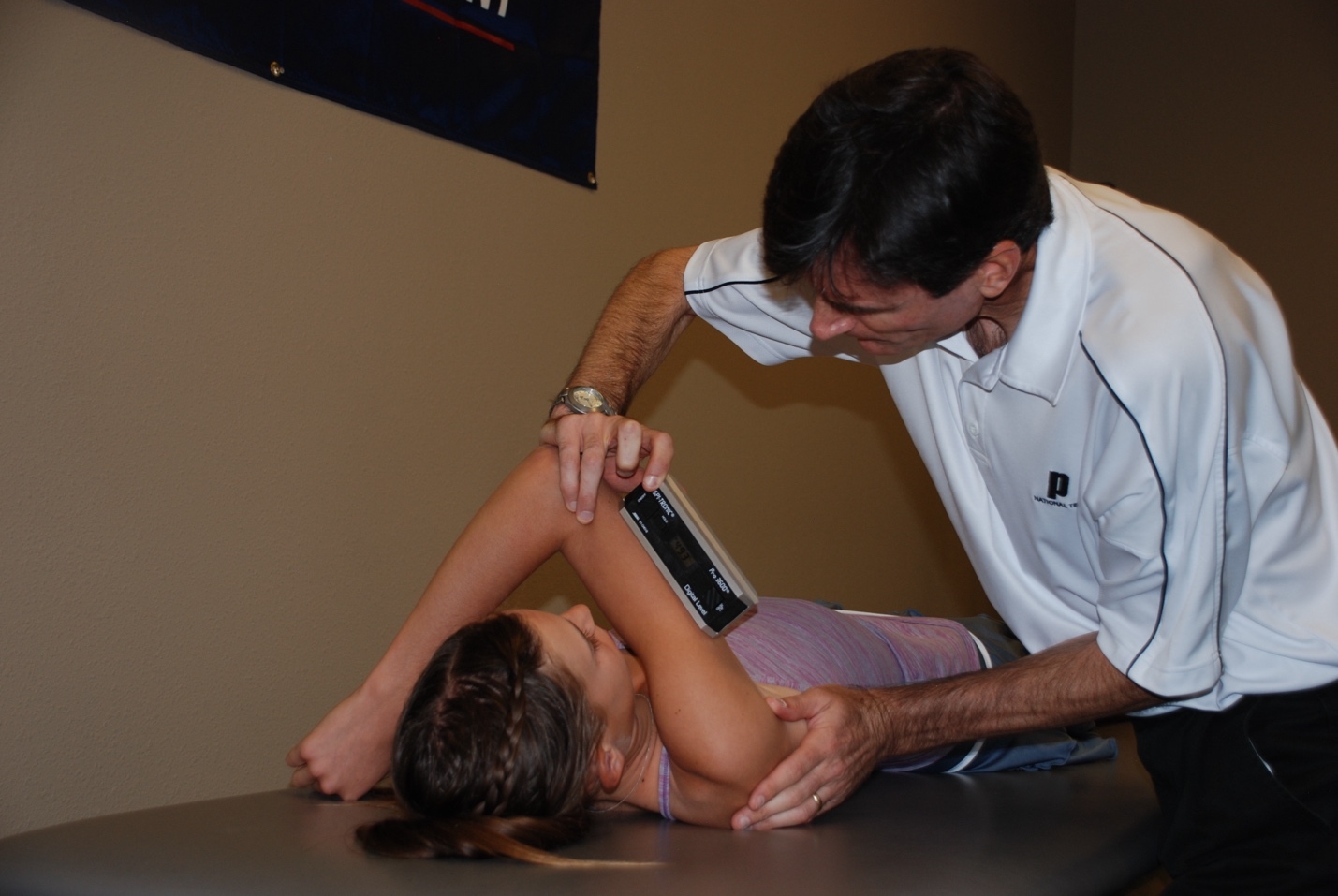
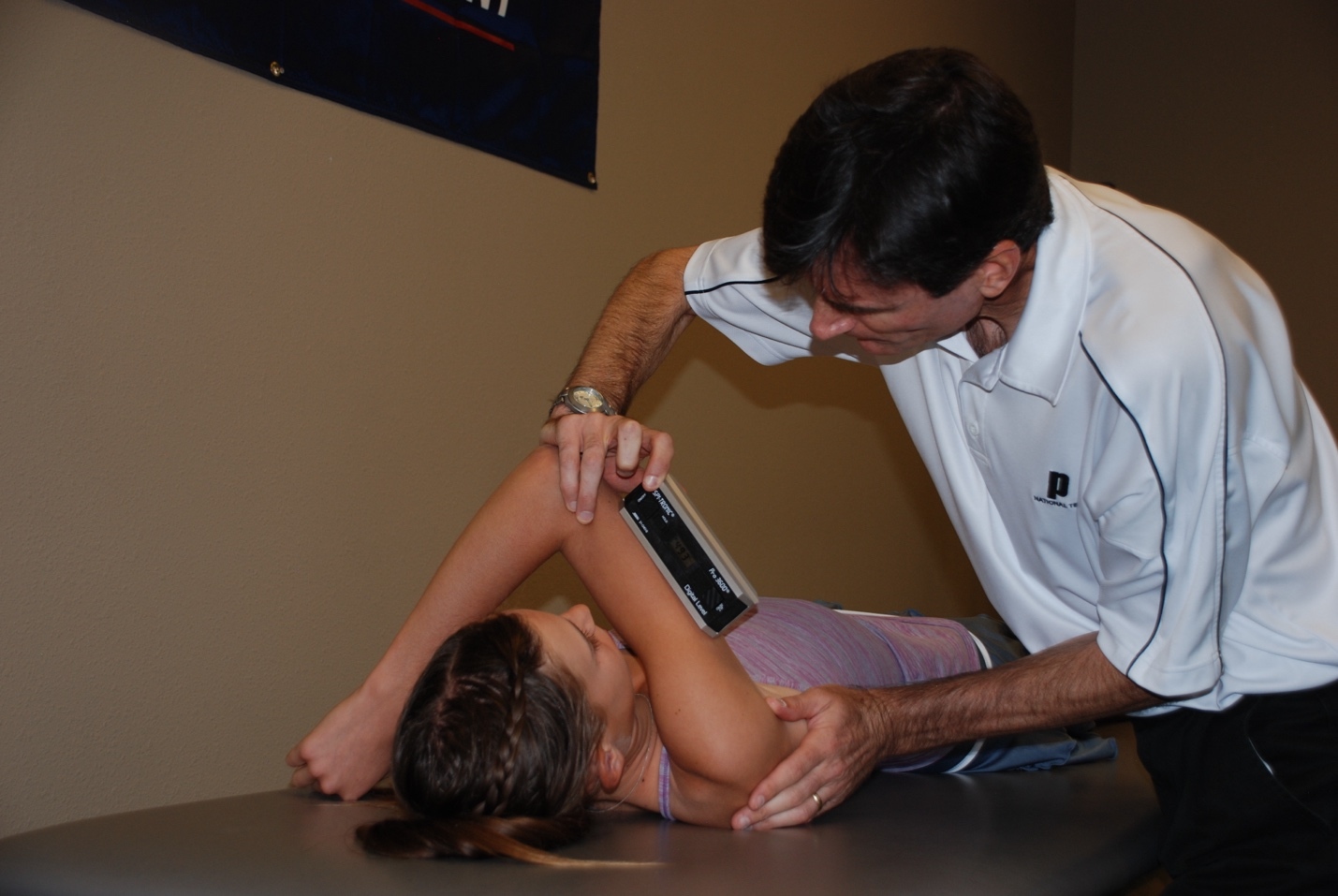
Subjects were positioned in a supine position by the primary investigator a physiotherapist, without a pillow under their head. Their arm was passively flexed to 90° in the sagittal plane. Subjects were asked to retract their scapulae bilaterally and then lie in a relaxed position for the duration of the testing. The lateral border of their scapula was stabilized in retracted position by one hand of the examiner using a medially directed pressure to prevent/minimize scapular substitution. From this position the examiner moved the subject’s extremity across their body at 90° of elevation and neutral rotation until first resistance was encountered. There was no overpressure applied to the extremity at any time. Gravity was used as a constant force to maintain the end-point position similar to the method used by the author during measurement of passive GH IR.4–6 A digital inclinometer (Pro Series 3600, Level Developments LTD, Chicago IL) was placed along the midline of the humerus at a mid-humeral shaft position to obtain a reading of the position of GH joint HADD. Figure 1 shows the primary investigator performing the described method of measurement. One trial of measurement was utilized to represent the subjects HADD range of motion for this investigation. After measurement of the initial extremity, the contralateral extremity was measured using identical methods. This method of HADD ROM measurement has been subjected to test-retest reliability study with ICC values of 0.93 and SEM of 1.6 degrees using identical methodology.21,22
Data Analysis
All statistical analyses were performed using SPSS (IBM, Chicago, IL) following data entry into a Microsoft Excel spreadsheet. Descriptive statistics (mean ± standard deviation) were calculated for the total male and female samples and independently for the two age categories. The distribution of the dominant to non-dominant (D-ND) difference scores was assessed for normality within each sex and age subgroup using the Shapiro-Wilk test. Differences between the dominant and non-dominant extremity were evaluated within each group using paired-samples t-tests, with the standardized mean difference (Cohen’s dz) reported. Because the D-ND difference scores in the female total and 18-30 groups showed mild departures from normality, Wilcoxon signed-rank tests were also conducted for these within-group comparisons and confirmed the parametric results. Differences in the magnitude of the D-ND deficit between the junior and 18-30 age groups, which are independent samples, were evaluated within each sex using independent-samples t-tests (Welch’s t, appropriate given the unequal subgroup sizes), with Mann-Whitney U tests used for confirmation. Statistical significance was set at α = 0.05.
RESULTS
Table 1 presents the demographic parameters measured on all subjects. These include age of both the total group (178 males and 139 females) measured in this investigation as well as the sub-groups of juniors (29 males and 85 females) and 18–30-year-old players (149 males and 54 females). Table 1 also lists the percent of players in each group who utilized a two-handed backhand. Nearly all players (84-100%) used a two-handed backhand negating any ability to test for differences among players using the two-handed versus one-handed backhand stroke and its potential effect on HADD ROM.
Table 2 displays the D-ND GH joint HADD ROM from the male and female subjects as well as the D-ND differences between extremities for the total groups and subgroups of elite junior players and 18–30-year-old players.
Dominant arm HADD ROM was significantly lower than the non-dominant extremity in every group (all p < 0.001). Among all male subjects the dominant arm averaged 7.58° less HADD than the non-dominant arm (95% CI 6.55 to 8.62; t(177) = 14.51; dz = 1.09), with deficits of 4.69° in junior males (t(28) = 4.56; dz = 0.85) and 8.15° in 18–30-year-old males (t(148) = 14.01; dz = 1.15). Among all female subjects, the dominant arm averaged 3.80° less HADD (95% CI 2.79 to 4.80; t(138) = 7.44; dz = 0.63), with deficits of 3.95° in junior females (t(84) = 6.57; dz = 0.71) and 3.55° in 18–30-year-old females (t(53) = 3.88; dz = 0.53). Wilcoxon signed-rank tests confirmed each within-group difference (all p < 0.001). (Table 3)
The magnitude of the D-ND deficit differed between age groups in males but not in females. Male 18–30-year-old players demonstrated a greater deficit than junior males (8.15° versus 4.69°; Welch t(48) = 2.93; p = 0.005; Cohen’s d = 0.50), a result confirmed by a Mann-Whitney U test (p = 0.004). In females the deficit did not differ between junior and 18–30-year-old players (3.95° versus 3.55°; Welch t(97) = 0.37; p = 0.71; Mann-Whitney p = 0.62).
DISCUSSION
The purpose of this study was to examine HADD ROM in elite tennis players and determine if significant D-ND differences were present in healthy, uninjured players. The results clearly show a significantly lower D arm HADD ROM compared to the ND arm in elite tennis players and may assist with providing baseline ROM data to aid in the interpretation of shoulder HADD ROM measures in uninjured elite tennis players.
Larger D-ND differences were measured in the male players (7.58°) as compared to the female players (3.80°). The overall sample of male players was older and may reflect chronic adaptations that continue to develop in the posterior shoulder of male players with continued skill development and extensive repetition. Kibler et al,1 found internal rotation ROM and total rotation ROM to decrease significantly with increasing number of tournaments and age. Similar progressive chronic adaptations may occur in HADD ROM however this has not been previously published in the literature, and the methods employed in this study only address a single measure of HADD ROM and cannot provide evidence regarding long term ROM changes.
Elite players demonstrated 4 and 8° D-ND differences in HADD ROM in female and male players respectively. The present study did not directly include methodology to determine the underlying mechanism of this loss of D HADD ROM relative the contralateral extremity, however, prior studies on overhead athletes have identified bony modifications,3,4 posterior capsule thickening,11,12 and muscle tendon unit shortening (thixotropy)11,13–15 on the dominant extremity as potential contributors. These mechanisms could each help explain HADD ROM differences due to the extensive and repetitive eccentric deceleration during both the follow-through phase of the tennis serve2,23 and forehand groundstroke as the arm undergoes extensive IR and cross arm adduction, placing stress on the posterior shoulder structures.
HADD ROM has been studied in other overhead athletes using similar measurement techniques when comparing the dominant to the non-dominant (control or baseline) extremity. Table 4 provides a summary of the relevant studies from the musculoskeletal literature in overhead athletes for comparison.
Many of the studies in youth baseball players similar in age to the elite junior tennis players measured in this study have demonstrated D-ND differences consistent with the range of the differences found in the present study. Of particular interest is the study by Marcondes et al.8 of 22 amateur elite level tennis players with a mean age of 26 years reporting a 4.7° difference between extremities. This is the only other known published study investigating HADD in elite tennis players. The larger subject population in the current study and use of age specific subgroups can provide additional descriptive information for clinicians who work with elite level tennis players who present for rehabilitation of shoulder injury or for preventative musculoskeletal screening evaluation. Knowledge of anatomical adaptations in the overhead athlete are essential to take into consideration during assessment and application of objective measurements of ROM particularly in the unilaterally dominant upper extremity athlete.4–7,18,29
The limitations of this study include that only elite level tennis players were measured and the results are not generalizable to other levels of tennis players. All players included in this study were uninjured, so no generalization to HADD ROM in elite tennis players with injuries cannot be made directly. Additionally, this study included only a one-time measurement of HADD ROM in elite tennis players with no longitudinal comparison. Finally, there was no intervention used in this study only the single measurement of HADD ROM in elite tennis players. Kibler et al1 have demonstrated the transient nature of shoulder range of motion measurement in overhead athletes. Repeated longitudinal assessments were not possible for this study of elite level tennis players and hence the data presented here represent a one-time, single assessment of glenohumeral joint HADD ROM. The protocol used in this study is similar to clinical measures and practices utilized by sports medicine professionals when evaluating overhead athletes during preventative screening examinations and when designing rehabilitation programs for injured overhead athletes. Further study is warranted on HADD ROM using longitudinal, multiple session surveillance to provide additional understanding of this important variable moving forward.
CONCLUSION
A standardized single session supine method of HADD ROM measurement in elite level tennis players demonstrated a significant difference in D HADD compared to the ND HADD of between 4-8° in elite junior and older (18–30-year-old) players. Bilateral differences were less in female players than in males. The findings of the present study are consistent with D-ND differences found in other overhead athletes in the current literature. These results may provide information for the interpretation of shoulder HADD ROM measurements in elite tennis players during rehabilitation and preventive screening.