INTRODUCTION
Women’s ice hockey is experiencing rapid and sustained growth at all levels of competition.1,2 In the United States, female participation in hockey increased by more than 5% between 2024 and 2025.1 This was the largest non-pandemic rise since USA Hockey began tracking female-specific data. The global number of registered female players has climbed from 153,665 in 2007 to more than 229,000 in 2022.1,2
Despite this growth, women’s ice hockey remains comparatively understudied. Existing female-athlete injury literature has primarily focused on sports such as basketball and soccer, with particular emphasis on anterior cruciate ligament (ACL) injury risk. In contrast, in women’s ice hockey, hip and groin injuries represent a substantial injury burden.3,4 Recent NCAA injury surveillance data show that hip and groin injuries account for 11.5% of all reported injuries in women’s ice hockey and occur more frequently during practice than competition.5 Establishing female-specific hip strength profiles is particularly important given documented sex differences in pelvic morphology, force production capacity, and neuromuscular strategies, all of which may influence hip loading patterns during skating.6,7
Ice hockey skating places substantial eccentric and concentric loads on the hip adductor and abductor muscles.8 Higher skating velocities require prolonged and increased adductor magnus activation, increased stride rate, and rapid transitions into hip abduction, resulting in considerable mechanical stress on the hip musculature.9 These biomechanical features help contextualize the prevalence of hip and groin symptoms observed in ice hockey athletes and support the clinical value of monitoring hip strength over time.
Although no studies have reported specific hip strength data related to groin strains in women’s hockey, this area has been studied in men’s hockey. In men’s professional ice hockey, reduced hip adductor strength and an adductor-to-abductor (ADD:ABD) strength ratio below 0.80 have been associated with a markedly increased risk of groin-strain injury.10 Prospective studies in male athletes further suggest that while athletes with a prior history of groin pain report greater discomfort and reduced perceived function during strength testing, absolute strength values may remain relatively stable across a competitive season.11 Male hockey data cannot be assumed to directly correlate with female data, as females have shown biomechanical differences in tri-planar hip range of motion.12 Whether these male-derived strength and injury associations translate to female collegiate ice hockey players remains unknown, as sex-specific reference values, seasonal strength trajectories, and limb dominance patterns have not been well characterized and may affect how hip strength deficits are addressed clinically to reduce the risk of groin injury.
Therefore, there is a critical need for female- and sport-specific information on hip strength profiles in women’s ice hockey, including seasonal variations, limb-dominance patterns, and considerations for implementing multi-timepoint testing in an elite team setting. Accordingly, the objectives of this study were to:
Characterize changes in isokinetic hip adduction and abduction strength and the isometric adductor-to-abductor (ADD:ABD) ratio in NCAA Division I women’s hockey players over more than two seasons. Secondary purposes were to examine between-limb differences and describe practical considerations for repeated team-based testing.
METHODS
Study Design
This longitudinal repeated-measures observational study followed NCAA Division I women’s ice hockey athletes across two competitive seasons and the subsequent pre-season. Hip strength was assessed at five time points (three pre-seasons and two post-seasons) to quantify in-season change (pre-season to post-season within a season) and off-season change (post-season to the subsequent pre-season). Analyses evaluated the overall effect of time point, with planned follow-up comparisons used to interpret in-season and off-season patterns.
Participants
Participants were NCAA Division I women’s ice hockey athletes who voluntarily participated in hip strength testing as part of a longitudinal monitoring program. This study was approved by the University of Minnesota Institutional Review Board (STUDY00021690). Written informed consent was obtained from each participant by the primary investigator. Athletes represented all on-ice positions, including goaltenders, defensemen, and forwards.
Before testing, participants completed a self-reported questionnaire capturing demographic information and leg dominance using the REDCap survey instrument.13 Leg dominance was defined as the preferred stepping leg as reported by the athlete. Testing was conducted based on participant availability. Pre-season testing was completed over the course of a week each September, with post-season testing following the season and playoffs, with some players participating in international hockey activities that extended their postseason testing dates by as much as four weeks. Not all participants completed testing at all five time points. Incomplete testing primarily reflected expected roster changes in a longitudinal collegiate team cohort, driven by factors including graduation, injury, or transfer to another institution.
Procedures
Hip Strength Assessment
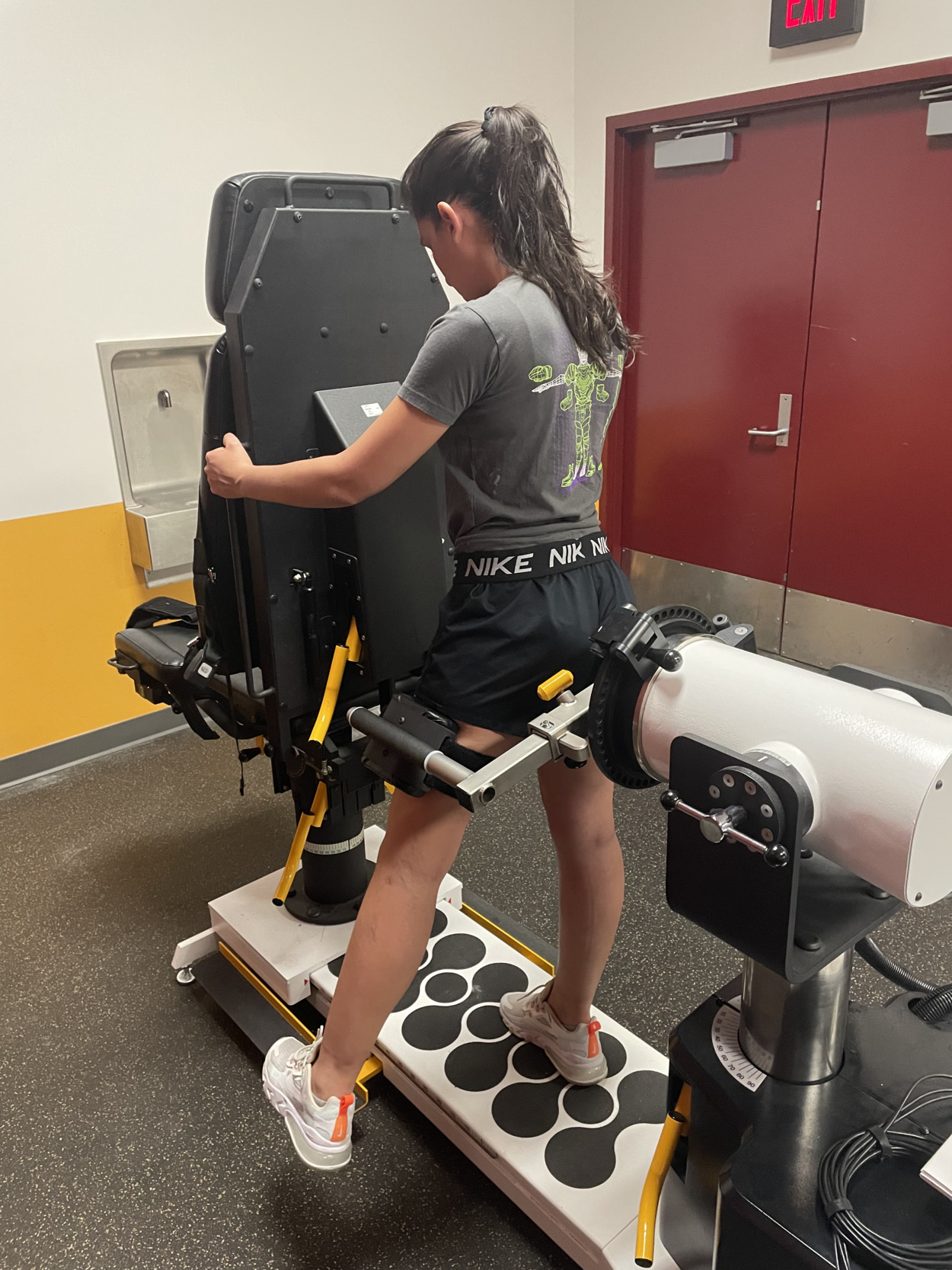
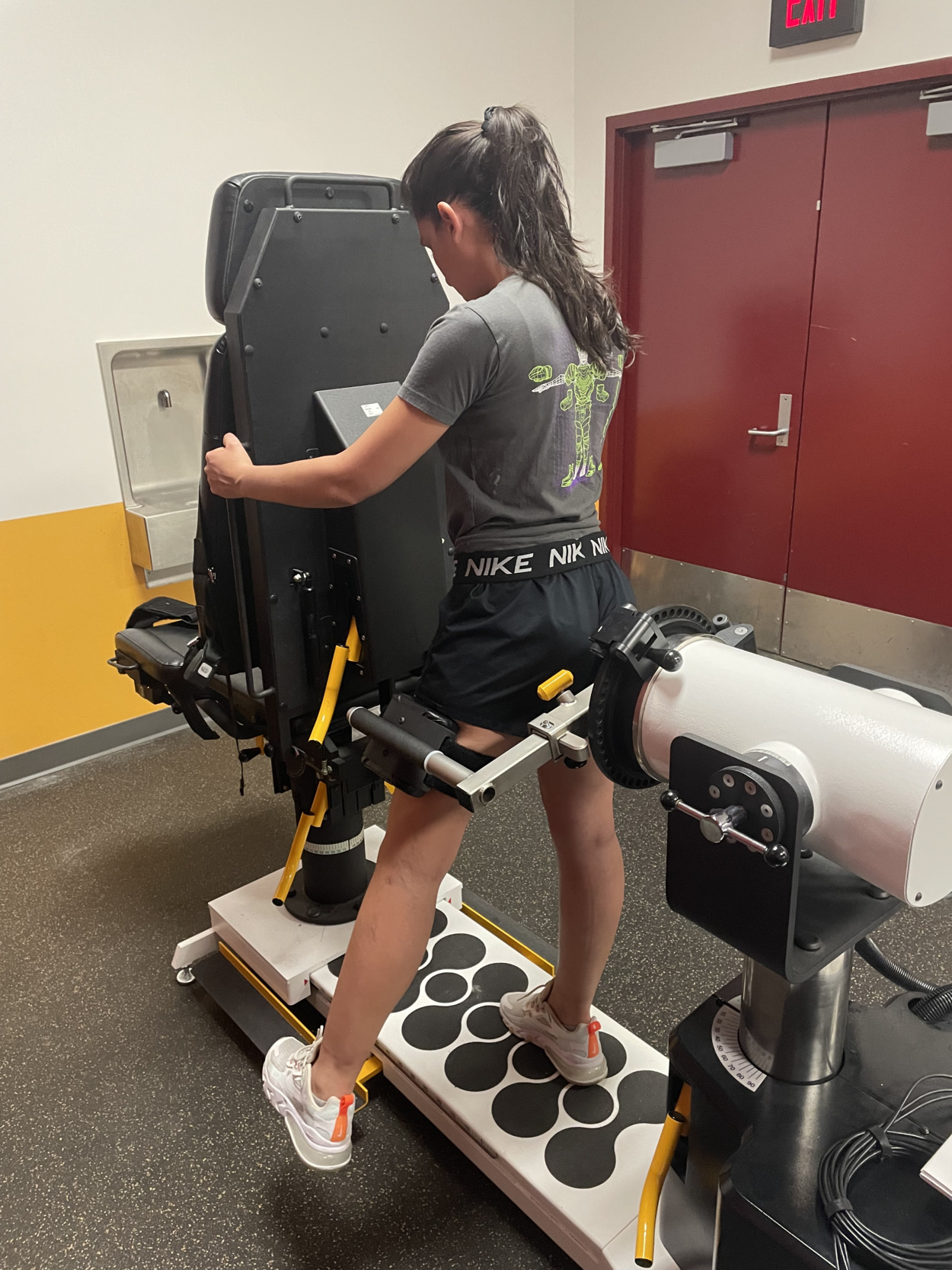
Hip adduction and abduction strength were assessed using a HUMAC NORM isokinetic dynamometer (CSMi, Stoughton, MA). All testing was performed in a standing position to approximate sport-specific functional demands (Figure 1).14 Participants stood on the HUMAC platform, facing the chair back, and held the chair handles with both hands for stability. Hips were aligned in neutral (0° abduction/adduction). The dynamometer axis of rotation was aligned with the greater trochanter of the tested limb. The thigh pad was positioned approximately four finger-widths proximal to the lateral tibiofemoral joint line and secured with a strap. After thigh-pad shifting was identified during the first testing session, an additional external strap was applied in a figure-eight configuration to enhance stabilization and was used for subsequent testing. This setup was selected to minimize extraneous movement while allowing athletes to maintain an upright posture more consistent with skating demands.
Testing Protocol
The testing protocol was developed based on previously established validity and reliability of isokinetic hip strength assessments at selected angular velocities and aligned with prior literature supporting the use of isometric measures for calculation of adductor-to-abductor (ADD:ABD) strength ratios.14,15 Testing was conducted by one of two trained clinicians (an athletic trainer or a physical therapist) using a standardized protocol across all sessions. Hip strength was assessed at five time points: Season 1 pre-season (S1-Pre), Season 1 post-season (S1-Post), Season 2 pre-season (S2-Pre), Season 2 post-season (S2-Post), and the subsequent pre-season (Season 3 pre-season; S3-Pre). The final time point (S3-Pre) represents the subsequent pre-season and does not reflect a full third competitive season. Isokinetic testing of hip adduction and abduction was performed at angular velocities of 90°·s-1 and 120°·s-1. Isometric testing was conducted in standing with the hip positioned at 0° of abduction for both muscle groups. All testing was completed bilaterally, and participants were given the option to choose which limb to test first.
Before testing, participants could complete an optional dynamic warm-up using a consistent routine. The warm-up consisted of spiderman lunges, lateral lunges, lateral leg swings, hamstring scoops, and quadriceps pulls; each was performed for 10 repetitions. A warm-up was offered to the athletes to provide mechanical preparation prior to maximal-effort testing. Participants also performed submaximal practice trials immediately before data collection, which functioned as a localized warm-up for the target musculature. The dynamometer was calibrated according to manufacturer guidelines. For isokinetic testing, participants were instructed to abduct the hip to approximately 45° to establish the testing range of motion. Participants completed three submaximal practice repetitions, followed by a 30-second rest period, and then performed five maximal-effort repetitions. For each condition and limb, the highest peak torque obtained during the five isokinetic repetitions was recorded.
For isometric testing, participants completed one submaximal practice repetition followed by two maximal five-second contractions, with a 30-second rest period between contractions, for both hip adduction and abduction. A 60-second rest period was provided between testing conditions. Standardized verbal encouragement was provided throughout testing (e.g., “push hard” for abduction and “pull hard” for adduction). Consistent with prior literature, adductor-to-abductor (ADD:ABD) strength ratios were calculated using the highest isometric peak torque values from the two test repetitions.16
Primary investigators (athletic trainer and/or physical therapist) had an established professional relationship with the team; however, strict measures were in place to mitigate potential bias during data collection. Investigators did not process the data in real time during the testing sessions, preventing immediate performance feedback from influencing subsequent trials. Additionally, investigators had no access to participants’ historical testing data during the collection window, removing the potential for subconscious benchmark coaching.
Implementation of Repeated Hip Strength Testing
Implementation considerations for repeated hip strength testing were informed by informal observation during testing sessions, including workflow integration, coordination with sports medicine staff, and general logistical challenges encountered in an applied team setting. These observations were used to provide context for the implementation-related findings.
Statistical analysis
All statistical analyses were performed in the R statistical software.17 The “lme4” and “lmerTest” packages were used for mixed models.18,19 Descriptive statistics are reported as means ± standard deviations unless otherwise noted.
For both isokinetic and isometric testing conditions, adduction and abduction peak torque was normalized to body mass (Nm·kg-1). ADD:ABD ratios were calculated from the corresponding raw peak torque values because body-mass normalization would not alter the within-athlete ratio. Linear mixed-effects models were used to evaluate normalized isokinetic peak torque of the hip adductors and abductors and the isometric adductor-to-abductor (ADD:ABD) ratio, using a Type III ANOVA framework. Athlete was included as a random intercept to account for repeated measurements. Fixed effects included time point (5 levels; S1-Pre, S1-Post, S2-Pre, S2-Post, S3-Pre) and side (dominant, non-dominant) for all outcomes. For isokinetic outcomes, test speed (90°·s-1, 120°·s-1) was included as a within-athlete factor; although not a primary factor of interest, it was retained to evaluate potential higher-order interactions. In the absence of significant interactions, statistical comparisons focused on differences in the main effects of time point and tested side. The isometric ADD:ABD ratio was modeled separately from normalized adduction and abduction isokinetic torque because it was calculated from isometric trials only; therefore, testing speed was not included as a model term. The ADD:ABD model included time point, side, and the time point by side interaction as fixed effects, with athlete included as a random intercept.
When an outcome differed significantly across time points in the Type III ANOVA, post hoc contrasts were examined using estimated marginal means with Sidak adjustment. Rather than exhaustive pairwise testing, contrasts were prioritized a priori to assess clinically relevant in-season change (pre-season to post-season within a season) and off-season change (post-season to subsequent pre-season). Model assumptions were evaluated by inspection of residual Q–Q and residual-versus-fitted plots, with no meaningful violations observed. Statistical significance was set at p < 0.05. Effect sizes were estimated using partial eta squared (partial η2; 0.01 = small, 0.06 = medium, 0.14 = large) and Cohen’s d (0.2 = small, 0.5 = moderate, 0.8 = large) and interpreted alongside p-values to aid clinical interpretation.20
RESULTS
Descriptive Overall Results
Table 1 summarizes participant demographic characteristics and positional distribution.
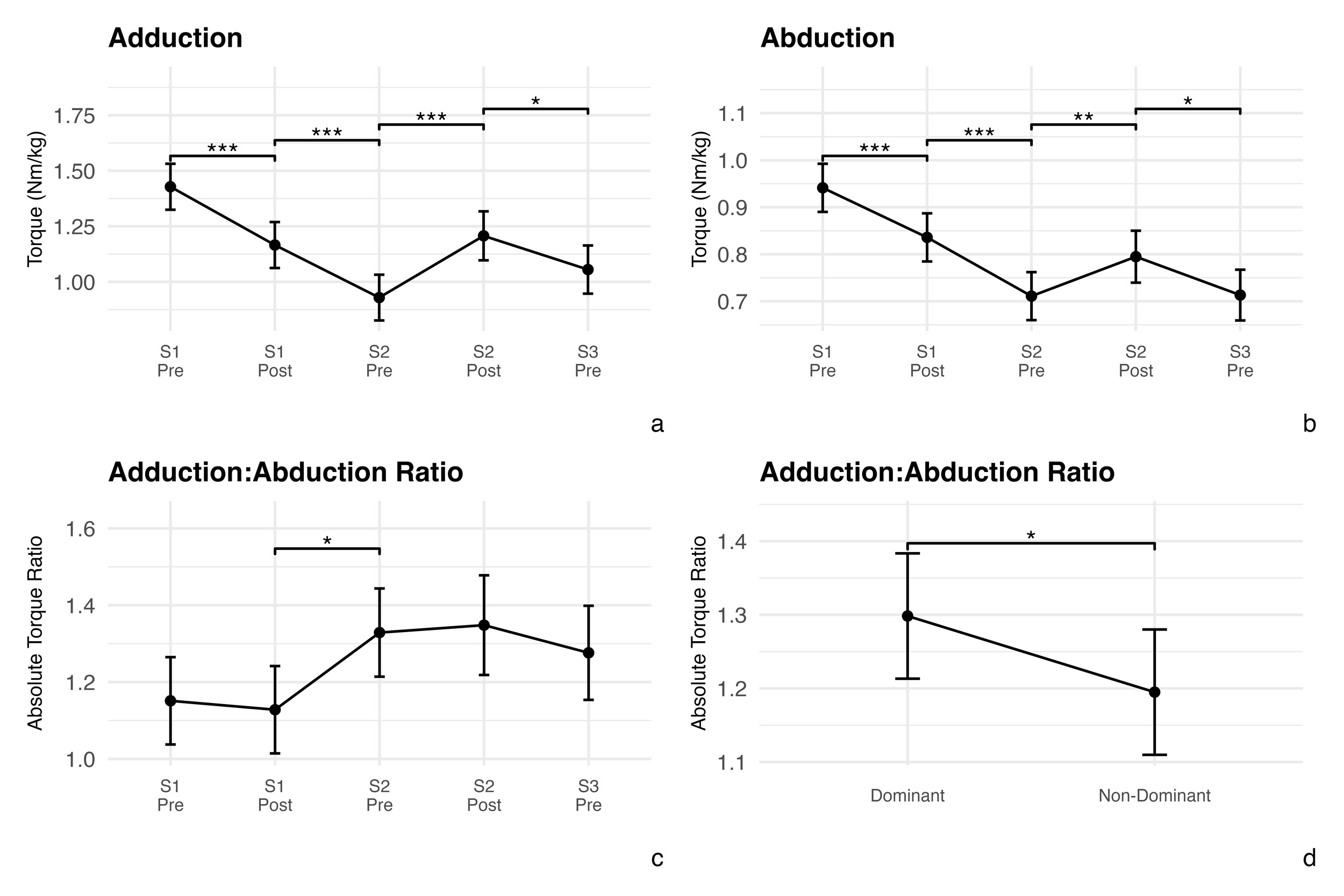
Descriptive values for all testing conditions, sides, and time points are presented in Table 2. The primary outcomes used for inferential analyses, bodyweight-normalized isokinetic hip adduction and abduction peak torque and the isometric ADD:ABD ratio, are shown in Figure 2.
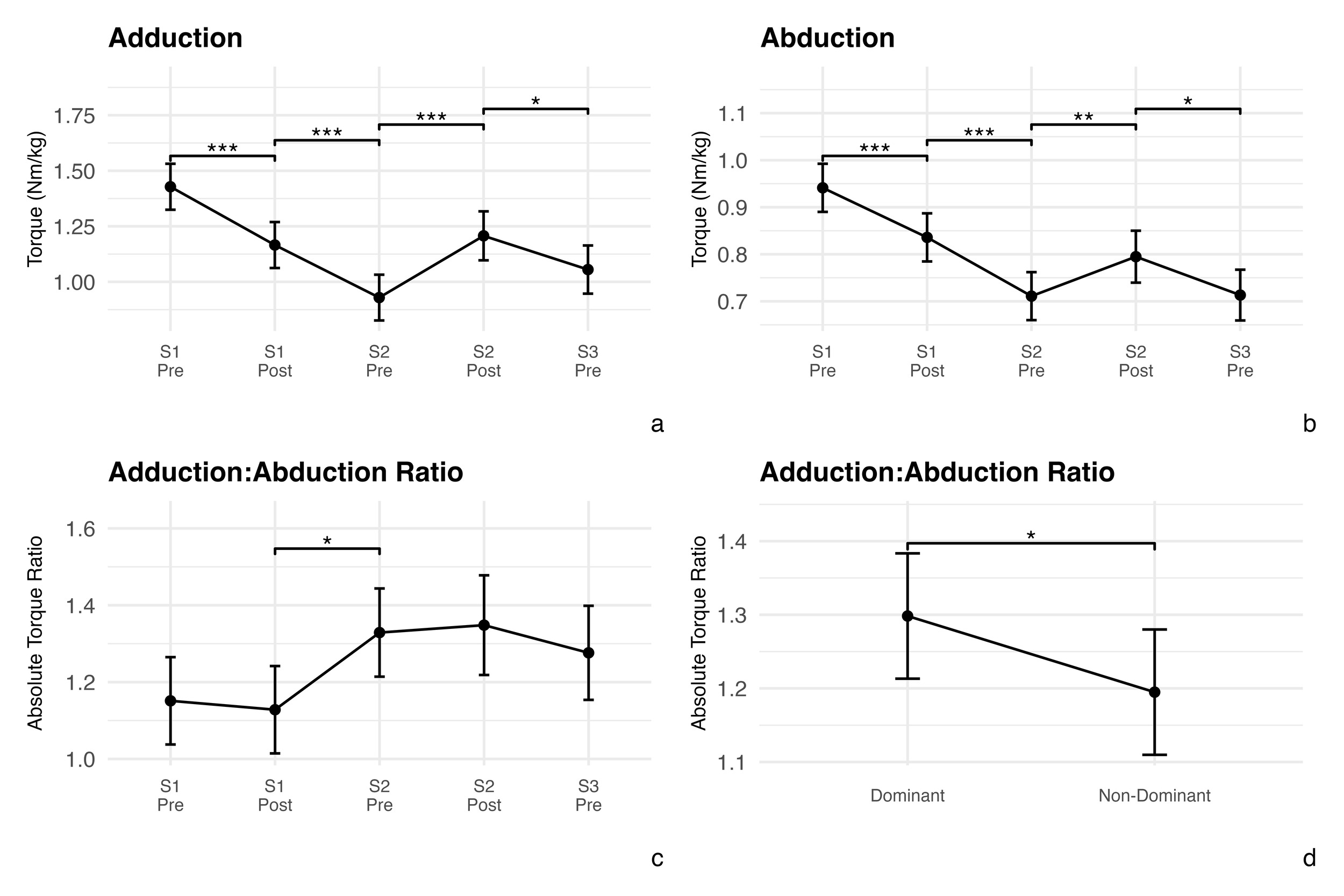
For normalized isokinetic hip adduction torque, no significant interactions were observed among time point, testing speed, and side; therefore, the interpretation focused on the main model terms. Normalized hip adduction torque differed across seasons (F(4, 419.43) = 30.45, p < 0.001) with a large effect size (partial η2 ≈ 0.23). Normalized hip adduction torque also differed by testing speed (F(1, 386.30) = 4.93, p = 0.03), with slightly greater peak torque at 90°·s-1 than at 120°·s-1 (mean difference = 0.06 Nm·kg-1, 95% CI 0.01 to 0.12). The magnitude of the speed-related difference was small (partial η2 ≈ 0.01). Hip adduction torque did not differ by side (F(1, 386.30) = 2.30, p = 0.13).
Hip Abduction Torque
For normalized isokinetic hip abduction torque, no significant interactions were observed among time point, testing speed, and side; therefore, the interpretation focused on the main model terms. Normalized hip abduction torque differed across seasons (F(4, 420.19) = 24.07, p < 0.001) with a large effect size (partial η2 ≈ 0.19). Normalized hip abduction torque also differed by testing speed (F(1, 384.61) = 30.38, p < 0.001), with greater peak torque at 90°·s-1 than at 120°·s-1 (mean difference = 0.08 Nm·kg-1, 95% CI 0.05 to 0.11). The magnitude of the speed-related difference was moderate (partial η2 ≈ 0.07). Hip abduction torque did not differ by side (F(1, 384.61) = 0.17, p = 0.68).
Adductor-to-Abductor Torque Ratio
No significant interaction was observed between time point and side; therefore, interpretation focused on the main model terms. The isometric ADD:ABD ratio differed across time points (F(4, 208.19) = 3.37, p = 0.01), with a moderate effect size (partial η2 = 0.06). The ADD:ABD ratio also differed by side (F(1, 172.40) = 5.54, p = 0.02), with the dominant limb demonstrating a slightly higher ratio than the non-dominant limb (mean difference = 0.10, 95% CI 0.02 to 0.19). The magnitude of the side-related difference was small (partial η2 = 0.03).
Torque Changes Across the Seasons
When examining how normalized adduction torque changed across the seasons, post hoc contrasts (Figure 2) showed a mixed pattern across the testing cycle, with decreases from S1-Pre to S1-Post and from S1-Post to S2-Pre, increases from S2-Pre to S2-Post, and subsequent decreases from S2-Post to S3-Pre. Specifically, hip adduction torque decreased from S1-Pre to S1-Post and from S1-Post to S2-Pre (estimates = −0.26 and −0.24 Nm·kg-1, both p < 0.001; Cohen’s d = −0.91 and −0.81). In contrast, adduction torque increased from S2-Pre to S2-Post (estimate = 0.28 Nm·kg-1, p < 0.001; d = 0.96) and then decreased from S2-Post to S3-Pre (estimate = −0.15 Nm·kg-1, p = 0.03; d = −0.52). All effect sizes were either large or moderate.
Abduction torque followed a similar pattern, decreasing from S1-Pre to S1-Post and from S1-Post to S2-Pre (estimates = −0.11 and −0.12 Nm·kg-1, both p < 0.001; d = −0.67 and −0.79). Abduction torque increased from S2-Pre to S2-Post (estimate = 0.08 Nm·kg-1, p = 0.01; d = 0.53) and then decreased from S2-Post to S3-Pre (estimate = −0.08 Nm·kg-1, p = 0.03; d = −0.52). All effect sizes were either large or moderate.
The ADD:ABD ratio had one off-season contrast reach a statistically significant difference; the ADD:ABD ratio increased from S1-Post to S2-Pre (mean difference = 0.20, p = 0.02, Cohen’s d = 0.61) with a moderate effect size. None of the remaining prioritized contrasts were statistically significant.
Implementation Considerations
Repeated hip strength testing was implemented within a Division I women’s ice hockey environment but required flexibility in scheduling and planned workflow. Testing time per athlete decreased over the study period as assessor familiarity improved, with most sessions completed within approximately 15–20 minutes compared with longer durations during early testing when equipment setup was less efficient. Team testing at each time point was typically completed over multiple days to accommodate athlete availability.
Athletes provided informal feedback regarding testing logistics. The initial testing session was conducted on campus, approximately three-quarters of a mile from the locker room and practice facility, which several athletes reported was challenging to locate and time-consuming to access. When testing was relocated to the team’s locker room and practice facility, athletes expressed greater satisfaction, particularly because eliminating travel time substantially reduced the overall time commitment.
Implementation considerations included variability in athlete warm-up status immediately before testing. Some athletes reported feeling adequately warmed up due to walking across campus or completing a training session, while others completed brief dynamic activities before testing. Equipment-related challenges were most notable during the first testing session of isokinetic hip abduction testing. Thigh-pad shifting was observed in two to three athletes during the first testing session, primarily among athletes with larger thighs. After this was identified, a figure-eight elastic strap was added to improve stabilization and was used consistently for subsequent testing. In some sessions, trials were repeated when compensatory strategies (e.g., trunk side-bending) or substitution patterns were observed despite cueing. Across sessions, athletes generally required less positioning correction as they became familiar with the test setup. Assessor cueing was frequently necessary to minimize compensatory trunk movement and maintain upright posture. These observations highlight practical factors relevant to implementing repeated hip strength monitoring in an applied team setting.
DISCUSSION
The primary finding was that isokinetic hip adduction and abduction strength varied significantly across the multi-season testing period, indicating meaningful seasonal fluctuations in hip strength capacity in this population. In contrast, the isometric hip ADD:ABD ratio showed less seasonal variation, with only one prioritized off-season contrast (S1-Post to S2-Pre) reaching a significant difference, and the dominant limb demonstrated a small but detectably higher ratio than the non-dominant limb. Testing implementation also identified practical logistical considerations for longitudinal strength monitoring in a team setting.
Only one prior study has examined changes in hip adduction and abduction strength over a full hockey season. Wörner et al. evaluated Swedish professional men’s ice hockey players using isometric strength testing with a fixed handheld dynamometer at the beginning, middle, and end of the season.11 That study reported a modest decrease in adductor strength from early to mid-season and slightly higher abductor strength at the end of the season compared with earlier time points, with substantial inter-individual variability—more than 25% of players demonstrated meaningful changes in adduction strength in opposing directions.11 Although the present study differs in population, sex, and testing methodology, the current findings similarly demonstrate that hip adduction and abduction strength vary across the competitive seasons. In contrast to prior work in male professional players using handheld isometric testing,11,21 the current study used standing isokinetic testing at 90°·s-1 and 120°·s-1 to assess isokinetic peak torque and standing isometric testing to calculate the ADD:ABD ratio in female collegiate athletes. Despite these differences, the presence of seasonal fluctuations in hip strength across both studies suggests that variability in hip strength may be a common feature of hockey participation rather than a sex- or method-specific phenomenon. At the same time, the lack of longitudinal data specific to females limits direct comparisons and underscores the need for sex-specific reference values and monitoring strategies. The observed changes across time points may reflect cumulative skating-related loading, differences in training emphasis across the year, or variability in recovery demands, underscoring the potential value of repeated hip strength monitoring in women’s ice hockey.
A secondary finding of this study was that the dominant limb demonstrated a small (partial η2 = 0.03) but 0.10 higher isometric adductor-to-abductor (ADD:ABD) strength ratio. To the authors’ knowledge, differences between limbs in the ADD:ABD ratio have not been previously examined in female hockey players. This finding contrasts with findings in male American ice hockey players across Bantam, high school, junior, and collegiate levels, in whom ADD:ABD ratios were not significantly different between limbs regardless of leg dominance or shooting hand.21
In the present study, limb differences were observed only for the isometric strength ratio. In contrast, isokinetic hip adduction and abduction strength at 90°·s-1 and 120°·s-1 did not differ between dominant and non-dominant limbs. This pattern is consistent with prior work reporting minimal side-to-side differences during isokinetic testing in college-aged non-athletes and runners.22,23 However, it has not been previously assessed in hockey athletes. Together, these findings suggest that between-limb differences in women’s hockey may be more apparent under isometric conditions and when expressed as an ADD:ABD ratio than as isolated isokinetic peak torque. The sustained maximal contraction used during isometric testing and the expression of adduction relative to abduction may allow smaller between-limb differences to become more apparent. Whether this pattern reflects testing mode, the use of a ratio, or a true underlying asymmetry remains unclear and warrants further investigation.
In men’s ice hockey, reduced adductor-to-abductor (ADD:ABD) strength ratios have been associated with elevated risk of groin strain, with several studies identifying ratios below 1.0 as clinically relevant thresholds.10,16 Tyler et al. reported a 17-fold greater risk of adductor strain in professional male players with an isometric ADD:ABD ratio below 0.80, whereas uninjured players demonstrated mean ratios closer to 0.95.10 Although comparable risk thresholds have not been established in women’s ice hockey, prior work suggests that absolute isokinetic strength ratios are similar between sexes, supporting careful consideration of these concepts in female athletes.24
In the present study, athletes consistently showed mean isometric ADD:ABD ratios above 1.0 at all testing points. Although the ratio was affected by time point, only one prioritized off-season contrast reached a significant difference. This finding suggests that single-time-point assessments may not fully characterize changes in strength profiles across the season. Relative changes in strength across the season may be more clinically informative than absolute thresholds alone. Seasonal fluctuations in hip strength further reinforce the potential value of repeated monitoring to contextualize strength ratios within the broader demands of the competitive cycle. In addition, femoroacetabular impingement syndrome is prevalent in hockey populations and has been associated with reduced hip adduction and abduction strength, underscoring the importance of ongoing hip strength assessment within a comprehensive clinical framework.25,26 In this study, the ADD:ABD ratio was examined as a monitoring variable that may help contextualize hip strength capacity when interpreted alongside other clinically relevant factors. These measures should be interpreted alongside prior hip/groin history, current symptoms, training exposure, skating load, and other performance measures within a broader clinical assessment. The ADD:ABD ratio should not be interpreted in isolation.26–28
This study is the first to establish baseline hip adduction and abduction strength values and adductor-to-abductor (ADD:ABD) strength ratios in women’s collegiate ice hockey athletes. The isometric ADD:ABD ratios observed across five time points spanning two competitive seasons and the subsequent pre-season may provide an initial reference point for clinicians working with this population. Importantly, interpreting the ratio alone may be insufficient, as absolute peak torque values varied substantially across the season and among athletes. Considering both the ratio and body-weight–normalized peak torque may better identify athletes with global hip weakness who could otherwise appear normal when strength is expressed as a ratio alone. Together, these measures can help guide individualized strengthening and rehabilitation decisions when deficits are identified.
Seasonal patterns observed in this study highlight the importance of strategically timing hip strength assessments. The only statistically significant change in the ADD:ABD ratio occurred during an off-season interval, from post-season to the subsequent pre-season, suggesting that single-time-point testing or even within-season testing alone may not fully capture meaningful changes in athletes’ strength profiles. However, the clinical relevance of this magnitude of change remains uncertain, and this finding should be interpreted as supporting the potential value of repeated monitoring rather than establishing a clinically meaningful threshold. Comprehensive pre-season testing may provide useful context for evaluating responses to off-season training and changes in skating exposure.
Although mid-season testing was not performed in this study, targeted in-season reassessment may be valuable, particularly for athletes with a history of hip or groin pathology, to monitor strength maintenance across the competitive cycle.26,29 Together, pre-season and post-season assessments represent practical anchor points for informing training modifications, rehabilitation progression, and return-to-play decision-making.
From a clinical perspective, these findings support using both the isometric ADD:ABD ratio and body-weight–normalized isokinetic peak torque when interpreting hip strength in women’s collegiate hockey athletes. Because absolute hip adduction and abduction strength fluctuated across the competitive cycle, a “normal” ratio at a single time point may mask global weakness if both muscle groups are reduced. Structured hip-strengthening programs have been shown to reduce groin injury risk in other contact sport and hockey populations.30,31 The current findings support periodic strength monitoring to characterize changes in strength profiles over time. When communicated between sports medicine and performance staff, longitudinal strength data may provide useful context for pre-season assessment and interpretation of changes across the training cycle.14,16,31
The reported implementation experience provides practical guidance for clinicians seeking to perform repeated hip strength monitoring in applied team settings. Implementing standing hip adduction and abduction testing with an isokinetic dynamometer was practical in a team setting but required careful attention to standardization and workflow. With 18-25 athletes tested at each time point and each participant taking 15-20 minutes to complete the protocol, testing was time-consuming and required multiple days, depending on each athlete’s availability. One tester could complete testing, but having two staff available increased efficiency: one tester could conduct the protocol on the HUMAC NORM while the other provided cueing and assisted with participant and dynamometer positioning. Scheduling also improved once the dynamometer was moved into the hockey team’s practice facility. Consistent with prior reports of acceptable reliability for this approach, our implementation highlighted practical factors that can influence test quality, including the need for frequent cueing to minimize trunk compensation, occasional repeated trials when substitution strategies were used, and additional stabilization to maintain consistent thigh pad positioning.14
Across the testing cycle, strength values did not show a consistent, progressive increase, suggesting that the observed seasonal variation was unlikely to be explained solely by repeated exposure to the test. Nevertheless, prior work supports the use of separate familiarization sessions for hip strength testing,32 and practice repetitions may improve measurement reliability by reducing compensatory movement, an effect demonstrated in knee isokinetic testing but not yet established for the hip.33 Finally, the marked improvement in efficiency and athlete satisfaction after relocating testing closer to the training environment underscores how equipment accessibility and travel burden can meaningfully affect the implementation of longitudinal monitoring in collegiate sport.
Limitations
Several limitations should be considered. First, data were collected from a single Division I women’s hockey program; training structures and workloads differ across programs, which may influence seasonal strength patterns and limit generalizability. Future work should include multiple teams and settings, as well as subgrouping participants by position to establish broader reference values.
Second, testing was completed as efficiently as possible within team availability windows of four weeks or less. However, post-season testing timing varied because some athletes were unavailable due to international competition, returning home, surgery, or other medical care following the season. Seasonal patterns should be interpreted as estimates based on available longitudinal team data, rather than as complete repeated measurements from the entire roster at every time point. Although mixed-effects models allowed athletes with incomplete repeated testing to contribute their available data, incomplete testing may have reduced the precision of estimates and limited the ability to detect smaller time-point or interaction effects. These pragmatic testing constraints limit the ability to define a narrow pre-season or post-season testing period that is generalizable across teams or settings.
Warm-up procedures may also have contributed to variability. To improve testing efficiency in the team setting, the dynamic warm-up was optional for athletes who had already completed a prior activity. Regardless of whether the dynamic warm-up was completed, all athletes performed submaximal practice trials immediately before data collection, which served as a localized warm-up for the hip musculature.
Third, minor procedural refinements also occurred as practical testing issues were identified. For example, additional thigh stabilization was introduced after pad shifting was observed in a small number of athletes during the first testing session, and trials were repeated when compensatory movement was evident. Although these refinements were intended to improve standardization and affected only a limited portion of testing, variation in warm-up status and these early procedural adjustments may have contributed some measurement variability and should be considered when interpreting longitudinal changes in strength.
Seasonal changes in hip strength observed in this study may reflect a variety of variables not measured in this study, including normal variation in training, competition, recovery, and skating exposure across a collegiate hockey season.28 The present analyses focused on group-level seasonal effects and did not characterize individual athlete trajectories, which may differ substantially in both magnitude and direction across testing cycles. Future work should examine these player-level response patterns directly and pair repeated hip strength testing with objective workload or player-tracking metrics, such as time on ice and stride counts, to better understand how individual changes in load and exposure relate to changes in hip strength over time at the player and team level.
Finally, although isokinetic dynamometry is considered a gold standard for strength assessment, access is limited by cost and logistics. Because isometric strength testing is commonly used to calculate the ADD:ABD ratio, isometric measures were included to facilitate comparison across settings; however, clinicians without isokinetic systems may need to rely on fixed handheld or inline dynamometry, which has demonstrated acceptable reliability when used with external fixation.34 These limitations should be considered when interpreting the magnitude and generalizability of the observed seasonal changes; however, the repeated-measures design and multi-season sampling provide useful context for understanding longitudinal hip strength patterns in women’s collegiate hockey.
CONCLUSION
The results of this study indicate that body-mass-normalized isokinetic hip adduction and abduction strength varied substantially across a multi-season testing cycle in Division I women’s ice hockey, including decreases during both observed off-seasons. The isometric ADD:ABD ratio varied less across time and was slightly higher in the dominant limb. Together, these findings support repeated assessment of absolute hip strength and strength ratios to characterize longitudinal strength profiles and inform implementation of team-based monitoring in this population.
Conflict of Interest
The authors report no conflicts of interest.
ACKNOWLEDGEMENTS
Jonathan Washatka was partially supported by the NIH/NIAMS T32 AR050938 Interdisciplinary Musculoskeletal Research Training Program. The use of the REDCap survey tool was supported by the National Center for Advancing Translational Sciences (NIH), grant UM1TR004405. The content is solely the responsibility of the authors and does not necessarily represent the official views of the NIH. We thank the student-athletes who volunteered their time.