INTRODUCTION
Anterior cruciate ligament (ACL) injuries are among the most common and devastating sports-related injuries, particularly in athletes engaged in multidirectional sports that demand rapid changes in direction, cutting, pivoting, and jump-landing.1–3 Approximately 250,000 ACL injuries occur annually in the United States, accounting for over 50% of all knee injuries, with incidence continuing to rise across all levels of competition.4–6
The consequences of ACL injury are substantial. Surgical intervention and prolonged rehabilitation generate significant healthcare costs and physical and psychological burden.7–9 ACL reconstruction (ACLR) has become the preferred intervention to restore mechanical stability to the knee joint, a key requirement for athletes seeking to return to sport (RTS) and, its rate has increased significantly over the past decade.10,11 Despite this, fewer than two-thirds of athletes return to their pre-injury level of sport, reinjury rates remain high, particularly in Level I sports involving jumping, cutting and pivoting following ACLR.12–19 Despite advances in surgical and rehabilitative techniques, athletes often experience prolonged rehabilitation and recovery periods, time lost from competition and diminished athletic performance.10 Additionally, there is up to an 80% likelihood of developing arthritis in the affected knee within 15 years of an ACL rupture.1 Beyond these physical consequences, injured athletes frequently experience depression, anxiety, and lowered self-esteem, highlighting the profound psychological burden of ACL injury.20–22
RTS decision-making has traditionally relied heavily on physical performance-based metrics such as hop tests, strength measurements23,24 While essential, these assessments often neglect the psychological barriers that equally influence an athlete’s ability to resume competitive activity.25,26 Even after receiving medical clearance, athletes commonly experience fear of reinjury, diminished limb confidence, and reduced self-efficacy, factors that can significantly delay or prevent successful RTS after ACLR.26–31 Although psychological tools exist to assess these constructs, many address isolated aspects of psychological recovery and fail to capture its complexities over time. With rehabilitation interventions predominantly focused on physical outcomes, psychological readiness remains critically under integrated into RTS decision-making.32–34
The existing literature reveals a significant lack of consensus regarding which psychological constructs require assessment and how best to integrate them with functional testing and subjective outcomes. To address these critical gaps, the purpose of this review was to examine the psychological instruments used in RTS decision-making among athletes recovering from ACLR and identify gaps in current assessment practices.
METHODS
This scoping review was conducted in accordance with the Joanna Briggs Institute (JBI) methodology for scoping reviews35 and reported in accordance with the Preferred Reporting Items for Systematic Reviews and Meta-Analyses extension for Scoping Reviews (PRISMA-ScR) guidelines.36
A comprehensive literature search was conducted across MEDLINE (via PubMed), SPORTDiscus, Web of Science, Scopus, and CINAHL to identify studies investigating psychological factors and assessment tools used in RTS decision-making following ACLR. The search was performed in November 2024. The search strategy, including controlled vocabulary (e.g., MeSH terms) and free-text terms, was developed by the review team and reviewed by research librarians prior to execution. Search terms included combinations of, ‘anterior cruciate ligament reconstruction,’ ‘ACLR,’ ‘psychological factors,’ ‘psychosocial factors,’ ‘fear of reinjury,’ ‘confidence,’ ‘self-efficacy,’ and ‘return to sport’, combined using Boolean operators AND, OR. The search was limited to peer-reviewed articles published in English between 1999 and 2024, involving athletes who underwent ACLR. Studies that examined solely physical or biomechanical factors without evaluating psychological or psychosocial variables relevant to RTS were excluded. Reference lists of eligible studies were manually screened to identify additional relevant publications. Titles and abstracts were independently screened by two reviewers (the first author and a trained reviewer) using predefined inclusion and exclusion criteria. Potentially eligible studies then underwent independent full-text review by the same two reviewers. Discrepancies in study selection were resolved through discussion to achieve consensus. Studies with unresolved or unclear eligibility were referred to the co-author for final determination.
Eligibility Criteria
Studies were included if they met the following criteria:
-
Participants: Athletes who underwent ACLR
-
Focus: Investigation of psychological or psychosocial factors influencing RTS after ACLR, including use of at least one psychological assessment tool.
-
Outcomes: Return to sport outcomes reported; studies comparing successful vs unsuccessful RTS based on psychological factors included.
-
Study Design: Peer-review original research (RCTs, cohort, case-control, cross-sectional, or qualitative studies exploring psychological experiences during rehabilitation)
-
Language: English only
-
Publication Period: 1999 - 2024
Data Extraction
Data extraction was independently performed by the first author and a trained reviewer using a standardized data extraction form developed for this review. Any discrepancies or uncertainties were resolved through discussion, with unresolved cases referred to the co-author for final determination.
The following data were extracted from the studies:
-
Study characteristics: Author(s), publication year, title, inclusion/exclusion criteria
-
Demographics: Sample size, age (mean and range), gender distribution, time post-surgery
-
Psychological assessment: Psychological assessment tools used and key findings
-
Functional Testing: Types of physical performance tests completed, outcomes and findings related to these tests
-
Self-Reported Function: Patient-reported functional measures
RESULTS
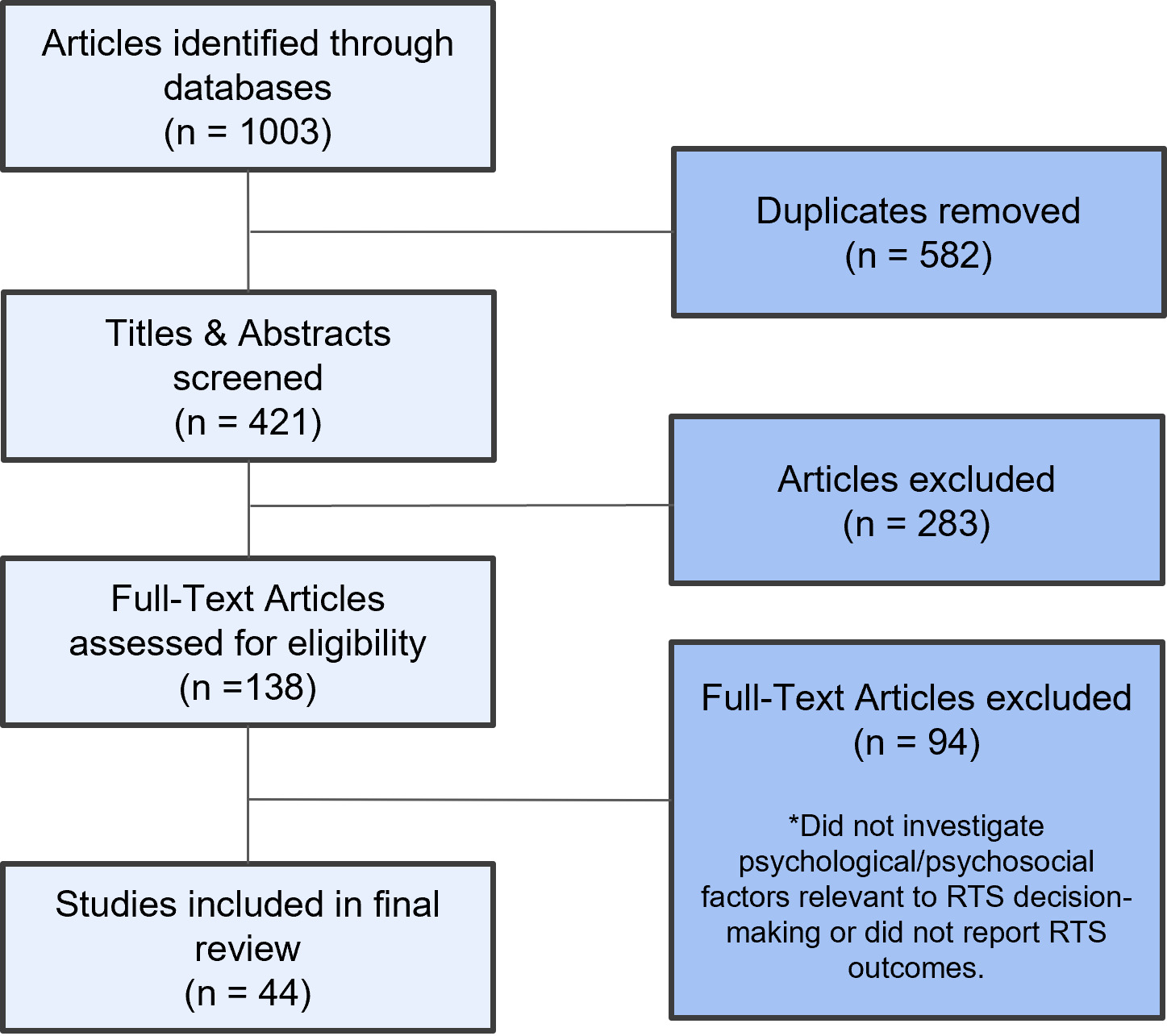
The literature search identified a total of 1,003 articles (Web of Science, n=221; Scopus, n=244; SPORTDiscus, n=152; PubMed, n=169; CINAHL, n=217). After duplicate removal, 421 unique records underwent title and abstract screening. Following independent full-text review against the predefined eligibility criteria, 44 studies met the inclusion criteria and were included in this scoping review (Figure 1). The included studies were published between 1999 and 2024. Study characteristics and participant demographics including author and year of publication, sample size, sex distribution, age, level of activity, ACLR status, time since surgery, and RTS timeline are summarized in Table 1 (Appendix A).
Across the 44 included studies, 12 distinct psychological assessment tools were identified. The Anterior Cruciate Ligament-Return to Sport after Injury (ACL-RSI) scale was the most frequently utilized instrument, appearing in 35 of 44 studies. The Tampa Scale of Kinesiophobia (TSK) was reported in 11 studies, and the Knee Self-Efficacy scale (K-SES) in eight studies. The remaining nine psychological assessment tools appeared infrequently across studies. The frequency of psychological assessment tool use across the included studies is presented in Figure 2 (Appendix B). A summary of the psychological assessment tools and corresponding outcomes identified in the included studies is provided in Table 2 (Appendix C).
DISCUSSION
This scoping review synthesizes existing literature on tools used to assess psychological factors in RTS decision-making following ACLR. A total of 12 psychological assessment tools were used in RTS decision-making following ACLR across 44 studies, reflecting the breadth of instruments used in the literature to capture the psychological dimensions of RTS decision-making. The Anterior Cruciate Ligament Return to Sport after Injury (ACL-RSI) scale, the Knee Self-Efficacy Scale (KSES), and the Tampa Scale of Kinesiophobia (TSK), emerged as the most frequently employed instruments, each capturing distinct yet complementary psychological constructs relevant to RTS outcomes. The predominance of these three tools across the literature, combined with their conceptual distinctions, forms the basis for the key findings discussed.
The ACL-RSI scale was the most frequently utilized tool, appearing in 35 out of 44 studies with a combined sample size of approximately 5,509 participants. It is a validated and reliable scale designed to assess three psychological domains, emotional response, confidence in performance, and risk appraisal, that collectively reflect an athlete’s readiness to return to their pre-injury activity level.14,17,37–39 Scores range from 0 to 100, where lower scores are associated with reduced likelihood of RTS and elevated risk of second ACL injury.19,34,40–42 Clinically, proposed cutoff scores include <5617,43,44 and <81.4%45 to identify athletes at risk of not returning to their pre-injury level, while a score of <77 at 12 months has been identified as a sensitive marker for second injury risk in athletes aged ≤ 20 years.42
Despite its widespread use, sole reliance on the ACL-RSI total score has limitations. Identical total scores can mask meaningfully different psychological profiles, and the interaction between individual items may offer greater clinical insight than the aggregate score alone.46 While low scores indicate risk, very high psychological readiness may paradoxically also represent a risk factor, particularly in pediatric athletes who report greater readiness than adolescents and adults.18 Overconfidence may encourage premature RTS before full neuromuscular recovery is achieved.14,15,47 Furthermore, an athlete’s score does not exist in isolation, rather, it is intricately linked to physical recovery and personal perceptions. Greater quadriceps strength is a strong predictor of higher psychological readiness, with strength measured as early as 3 months post-surgery being significantly associated with ACL-RSI scores at 9 months.40,43,47,48 Higher ACL-RSI scores are also associated with more symmetric landing mechanics, yet, it is an athlete’s perceived physical competence, rather than their objective physical competence, that is more strongly associated with psychological response.49
The three ACL-RSI subscales are conceptually distinct and demonstrate different trajectories over time, a nuance that is lost when the total score is considered.14,17,46,50 Although some studies have grouped confidence and risk appraisal for analytic purposes, they are meaningfully different constructs.19,38 Kim et al. found that while emotion and confidence subscales improved significantly over time at 6, 12, and 24 months post-ACLR, risk appraisal did not, and was the subscale most clearly differentiating athletes who returned to sport from those who did not, leading the authors to identify it as the most negative psychological factor affecting post-ACLR activity.38 Zwolski et al. further showed perceived physical competence was associated with emotion and risk appraisal but not confidence,49 while McPherson et al. found differences in emotional and confidence responses between injured and non-injured athletes, with no group difference in risk appraisal.42 A network analysis by Liew et al. revealed the strongest correlations between risk appraisal items, “fear of re-injury” and “afraid of accidentally injuring knee”, and between confidence items “confidence in knee not giving way” and “confidence in knee holding up”, further underscoring that these subscales capture distinct psychological facets.46 Collectively, these findings suggest that risk appraisal warrants particular clinical attention as it may influence RTS outcomes in a uniquely persistent manner.
A further layer of complexity arises from the distinction between knee-specific confidence (believing in the knee’s stability and health) and sport-specific confidence (believing in one’s ability to perform athletically). Liew et al. found that knee-specific confidence does not consistently translate to sports-specific confidence,46 and while greater knee-specific confidence may correlate with improved motor function, it has also been speculatively linked to increased reinjury risk, possibly due to athletes adopting performance-oriented movement strategies that might compromise knee stability.46 This underscores a key limitation of relying solely on the ACL-RSI confidence subscale, which operates at the sport-performance level and may not capture an athlete’s trust in the reconstructed knee itself, providing a strong rationale for supplementing the ACL-RSI with a knee-specific instrument such as the K-SES18.
The Tampa Scale of Kinesiophobia (TSK) in both its 11-item (TSK-11) and 17-item (TSK-17) versions, appeared in 11 of the 44 studies, with a combined sample of approximately 645 participants. It is a validated and reliable tool for assessing fear of movement and reinjury across musculoskeletal populations, including those recovering from ACL injuries.51,52 Kinesiophobia is defined as the fear of movement stemming from a feeling of susceptibility to pain or reinjury.53,54 Scores on the TSK-11 range from 11 to 44, while TSK-17 scores range from 17 to 68, with higher scores reflecting greater fear of movement in both versions.14,51,53–55 A TSK-17 score > 37 is often indicative of clinical significant kinesiophobia.54,56
The impact of kinesiophobia on rehabilitation and RTS outcomes is substantial. Elevated TSK scores correlate with worse self-reported knee function, lower activity levels, reduced RTS rates, and increased risk of a second ACL injury.53 Critically, kinesiophobia can hinder active participation in rehabilitation and lead to suboptimal functional recovery, making its identification and management a vital component of comprehensive post-ACLR rehabilitation.
While kinesiophobia and psychological readiness are related, they are conceptually distinct constructs. The ACL-RSI includes a fear of reinjury item within its emotion domain, indicating some overlap with the TSK. However, the ACL-RSI encompasses a broader range of psychological factors, including confidence and risk appraisal, that extend beyond the fear of movement alone.37 Conversely, the TSK specifically captures pain-related fear of movement, which may represent a different construct than the sport-specific fears, emotions, and confidence assessed by the ACL-RSI.57,58 Importantly, an athlete may demonstrate sufficient ACL-RSI scores while still harboring clinically significant kinesiophobia that impedes rehabilitation participation and functional recovery. This distinction is clinically meaningful, a lower ACL-RSI score signals broader psychological unreadiness, while an elevated TSK score specifically highlights fear-driven movement avoidance as a contributing barrier. These two tools are therefore not interchangeable but complementary, together providing a more comprehensive assessment of the psychological landscape post-ACLR.
The Knee Self-Efficacy Scale (K-SES) appeared in 8 of 44 studies with a combined sample of 2496 participants. Self-efficacy refers to an individual’s belief in their ability to perform tasks or activities successfully,18,46 and in this context, to perform movements and meet sport demands without risking reinjury.15,57 The most commonly used version, the 18-item K-SES (K-SES18), comprises two subscales: K-SES present, assessing current self-efficacy in daily activities, sporting activities, and knee function tasks, and K-SES future, assessing confidence in future knee function.15,18,59 Items are scored on an 11-point Likert scale (0-10), with a mean score of ≥ 7 on either subscale indicating fair knee-related self-efficacy.15,41 Among athletes returning to sport, K-SES present scores improved from approximately 3.4 preoperatively to 8.9 – 9.4 by 8 – 12 months post-ACLR, while K-SES future scores improved from approximately 4.5 preoperatively to 8.0 – 8.7 over the same time period.16,18,41,60
The K-SES18 demonstrates a nuanced relationship with objective physical function. Athletes who recovered symmetrical muscle function by 12 months post-ACLR reported significantly higher K-SES18 present scores than those who did not, suggesting that self-efficacy and physical recovery are closely linked during the first year post-surgery.61 However, absolute knee flexor strength, rather than relative symmetry, showed a weak but significant correlation with the K-SES18 present scores, implying that absolute strength may be more important for building self-efficacy than limb symmetry.60 Preoperative self-efficacy has been shown to predict a return to acceptable physical activity levels and both subjective and objective knee function and muscle function at one year post-ACLR, while higher knee self-efficacy has been linked to better functional performance, lower fear of reinjury, and faster rehabilitation progression.16,28,60–62
The K-SES18 captures a psychological construct that is empirically distinct from the ACL-RSI. Where K-SES18 present scores differed significantly between athletes with and without recovered muscle function, ACL-RSI scores showed no such difference between groups.61 This indicates that knee-specific self-efficacy (K-SES18) and broader psychological readiness for sport, which encompasses emotional and risk-appraisal components, are distinct dimensions of recovery. K-SES18 scores also vary by age, with pediatric athletes reporting significantly higher knee self-efficacy at 8 and 12 months compared to adolescents and young adults,18 highlighting the importance of age-appropriate interpretation. While the confidence subscale of the ACL-RSI reflects sport-level performance beliefs, Liew et al. noted that ACL-RSI confidence items may themselves be measuring self-efficacy,46 further underscoring the conceptual proximity, yet practical distinction, between the two instruments.
The findings of this review suggest that no single instrument adequately captures the full psychological complexity of RTS readiness following ACLR. The ACL-RSI, TSK and K-SES18 each measure conceptually distinct constructs, broad psychological readiness encompassing emotion, confidence, and risk appraisal, pain-related fear of movement, and knee-specific self-efficacy respectively. Considered together, these instruments may provide a more comprehensive characterization of an athlete’s psychological profile than any single instrument alone.
A triple-assessment framework incorporating the ACL-RSI, TSK, and K-SES18 may help clinicians identify psychological barriers that may not be adequately captured by one single instrument. An athlete with a sufficient ACL-RSI score but an elevated TSK score may harbor significant fear of movement that continues to impede rehabilitation participation despite apparent overall readiness. Similarly, an athlete with adequate ACL-RSI and TSK scores but a low K-SES18 score may lack the knee-specific confidence required to meet the demands of competitive sport. Conversely, a low ACL-RSI score alongside a higher K-SES18 score may indicate broader sport-related anxieties and fears requiring psychological intervention rather than physical rehabilitation strategies alone. These patterns suggest a potential approach for identifying specific psychological barriers and informing individualized rehabilitation strategies, such as progressive loading to improve knee confidence, psychological support to address fear and anxiety, or targeted education to address risk perception. However, whether implementation of a combined assessment approach improves RTS decision-making or outcomes has not been directly evaluated and required prospective investigation.
These findings align with broader calls for RTS frameworks that extend beyond physical criteria. Psychological assessment may provide complementary information about an athlete’s readiness that is not captured by physical performance testing alone, supporting a more multidimensional approach to RTS evaluation following ACLR.
LIMITATIONS
Several limitations of this review of the existing literature warrant consideration. The inclusion of English-language studies only may limit the generalizability of findings across different cultural and linguistic contexts. The available psychological assessment tools have important validation limitations. The ACL-RSI is currently the only tool specifically developed and validated for assessing psychological readiness following ACL injury. Other instruments, such as the TSK, were originally designed for chronic pain populations and may not fully capture the sport- and injury-specific fears relevant to athletes recovering from ACLR. Similarly, while the ACL-RSI has been validated in pediatric and adolescent populations,63 the K-SES18 has not undergone similar validation, in younger athletes, complicating the interpretation of findings in studies that include this population. At present, no validated instrument reliably evaluates fear of reinjury specifically in ACL-injured populations, representing a significant gap in the field.
Existing tools may lack the granularity required to capture the full complexity of psychological readiness. Relying solely on total ACL-RSI scores can obscure meaningful differences across its underlying subscales, each of which behaves differently over time and contributes uniquely to RTS outcomes. Similarly, confidence and fear of reinjury are often assessed too broadly, and no validated tool currently exists for evaluating knee-specific confidence during performance-based functional tasks.
The absence of normative data and universally accepted clinical benchmarks across time points, sport types, and competition levels limits the clinical applicability of current tools. Studies use varying cutoff scores for the TSK and ACL-RSI, and psychological responses are known to vary by age and sex, suggesting that a single benchmark may not be appropriate across all athlete populations. Most studies also assess psychological constructs at a single time point, providing only a partial picture of recovery. Longitudinal monitoring is needed, particularly given evidence linking reduced psychological improvement over time to increased second injury risk in younger athletes.
FUTURE DIRECTION
A priority area for future research illuminated by this review is the development and validation of more context-specific psychological assessment tools. While the ACL-RSI and K-SES18 provide valuable insights, they may not fully capture the nuances of specific sports, movement demands, or competition levels. Of particular importance is the development of ACL-specific fear of reinjury instruments. The TSK, currently the most widely used tool for assessing kinesiophobia, was developed for chronic pain populations and references “exercise” broadly rather than the high-demand athletic maneuvers, such as cutting, pivoting, and contact situations, that most commonly evoke fear in athletes recovering from ACLR. A validated, ACL-specific fear of reinjury instrument, sensitive to sport-specific maneuvers and grounded in the psychological demands of athletic rehabilitation, would represent a significant advancement in the field. Future research should also explore how fear levels captured by such tools correlate with biomechanical strategies during high-demand movements, helping clinicians better understand the relationship between psychological readiness and injury risk at the point of RTS.
Beyond tool development, sport-specific adaptations of existing psychological scales warrant investigation. Future studies should examine whether confidence, self-efficacy, and fear of reinjury manifest differently across sport types and performance levels, and whether current instruments are sufficiently sensitive to detect these differences. The development of a validated tool for assessing knee-specific confidence during performance-based functional tasks would also meaningfully advance RTS assessment.
Longitudinal research designs are critically needed. The majority of existing studies are cross-sectional, limiting understanding of how psychological constructs evolve throughout rehabilitation and beyond RTS. Future prospective studies should track the interplay between psychological and physical recovery across key rehabilitation milestones, identify critical time points for psychological assessment and intervention, and determine how changes in psychological readiness correlate with long-term RTS rates, performance outcomes, and second ACL injury incidence. This is particularly important given evidence that reduced psychological improvement over time is associated with increased reinjury risk in younger athletes. Standardization of ACLR rehabilitation protocols would further strengthen the comparability of findings across future studies.
Prospective research is needed to directly determine whether combined use of the ACL-RSI, TSK, and K-SES18 provides additional clinical value compared with individual instruments alone, as the current scoping review cannot determine whether a multi-tool approach improves RTS decision-making or outcomes.
CONCLUSION
This scoping review identified 12 psychological assessment tools used in RTS decision-making, with the ACL-RSI, TSK, and K-SES18 emerging as the most frequently utilized instruments. However, no single tool captured the full psychological complexity of RTS readiness. The ACL-RSI, TSK, and K-SES18 each capture distinct dimensions of psychological readiness, and considering them together may offer clinicians a more comprehensive assessment than any single instrument alone. The findings of this scoping review suggest that considering multiple psychological dimensions may help clinicians identify barriers to recovery that might otherwise go unrecognized and inform more individualized rehabilitation strategies. However, whether a multi-dimensional psychological assessment approach incorporating the ACL-RSI, TSK, and K-SES18 improves RTS decision-making or outcomes has not been directly examined and warrants prospective investigation.
Disclosure
The authors declare no conflicts of interest.
ACKNOWLEGMENTS
The authors thank Jessica Peters, MS, for her contribution to independent title, abstract, and full-text screening, as well as data extraction, throughout this scoping review. The authors thank Dr. Wen K. Ling PT, PhD, for her critical review and feedback on the manuscript prior to submission. The authors also thank librarians Stacy Torian and Brynne Campbell for their guidance on database selection and review of the search strategy.