BACKGROUND
Muscle strength plays a central role in sports performance, rehabilitation, and injury prevention.1 Consequently, reliable and valid assessment methods are essential in both research and clinical settings. Isokinetic dynamometry is considered a gold-standard method for quantifying dynamic muscle strength, as it enables controlled assessment of torque across a constant angular velocity.2,3 This method of testing is widely used in sports medicine, rehabilitation, and performance testing, and is considered safe across a range of populations, including athletes, older adults, and clinical groups recovering from injury or surgery.4,5
Among all muscle groups assessed using isokinetic dynamometry, the knee extensors and flexors are the most frequently examined, as they are primary movers in gait and sport-specific tasks.4,6,7 The quadriceps and hamstrings also play a crucial role in knee joint stability and are integral components of return-to-sport testing after anterior cruciate ligament reconstruction (ACLR).8–12 Deficits in knee extensor or flexor strength, or in their ratio, have been associated with an increased risk of injury and reinjury.13,14 Consequently, precise and reproducible assessment protocols are required to ensure valid decision-making in both research and applied practice.
Recent literature has also emphasized the need for methodological rigor and reporting transparency in isokinetic testing, including clear definitions of test positions, warm-up procedures, gravity correction, familiarization, and rest intervals between sets or velocities.15,16 Despite these efforts, a wide range of testing protocols remain in use, differing in angular velocities, number of repetitions, and the sequence of testing.17 Although isokinetic dynamometry allows for dynamic velocity spectrum testing, where torque is sampled across multiple speeds, single-velocity testing remains common. This limits the understanding of how muscles perform under different movement demands. Sports performance involves both slow, force-dominant actions and fast, velocity-dominant actions. Therefore, assessment at multiple velocities is important to capture distinct aspects of muscle function, such as maximal and explosive strength.16,18 Recent work in individuals after anterior cruciate ligament reconstruction further supports this perspective. Drigny et al.19 demonstrated that isokinetic testing performed at two distinct velocities (60°/s and 240°/s) provides additional clinically relevant information compared with single-velocity assessment, suggesting that evaluating knee strength across multiple angular velocities may improve the detection of residual deficits during rehabilitation and return-to-sport follow-up.
Testing at higher velocities (e.g., 180°/s or above) has been proposed to better represent functional performance and neuromuscular control, while lower velocities (e.g., 60–90°/s) reflect maximal strength under controlled conditions.5,6 However, despite the widespread use of isokinetic dynamometry systems such as the Biodex System 4 Pro, few studies have provided reliability data for combined slow- and fast-velocity protocols in physically active adults. Establishing such reliability is essential for confident use in clinical decision-making and longitudinal athlete monitoring.
Different velocities represent distinct regions of the dynamic velocity spectrum and may reflect distinct strength qualities. Previous studies have primarily examined the reliability of isokinetic knee strength testing at angular velocities such as 60°/s and 240°/s. The present study extends this work by evaluating reliability at 90°/s and 180°/s, representing slow and fast testing velocities, respectively.16 Therefore, the aim of this study was to examine the test–retest reliability of concentric isokinetic knee extension and flexion strength at slow and fast angular velocities using the Biodex System 4.
MATERIALS AND METHODS
PARTICIPANT RECRUITMENT
Fifteen healthy, physically active adults were recruited for the study. Inclusion criteria were age 18–40 years, no history of lower-limb injury during the previous six months, and no previous experience with isokinetic strength testing. All participants provided written informed consent prior to participation, and the study was approved by the Swedish Ethical Review Authority.
PROCEDURES
Testing was performed with a Biodex System 4 isokinetic dynamometer (Biodex Medical Systems, Shirley, NY, USA). A triple-session test–retest design was used,20 in which all participants completed a familiarization session to ensure consistent testing and minimize learning effects, followed by two testing sessions separated by one week. Prior to each session, participants performed a standardized warm-up consisting of 10 minutes of cycling at 100 W, followed by 10 calf raises, 10 good mornings, and 10 body weight squats. This warm-up was selected to provide a standardized combination of general cardiovascular activation and lower-limb dynamic movements before testing.16
TEST POSITIONS
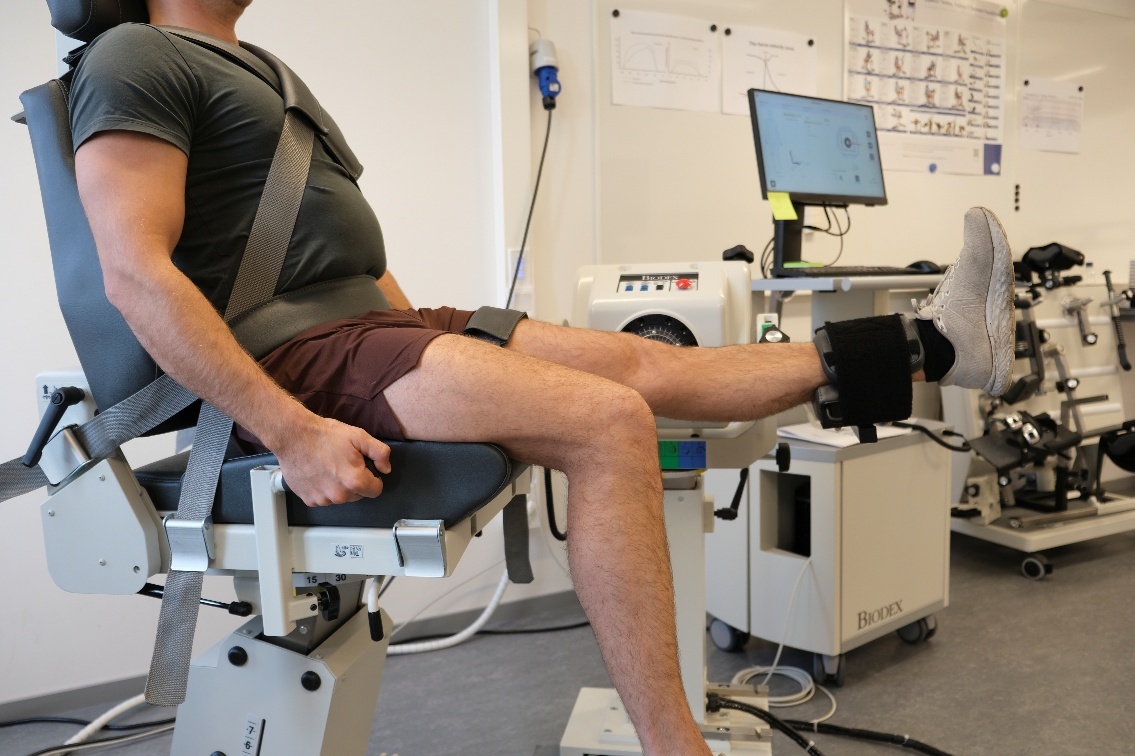
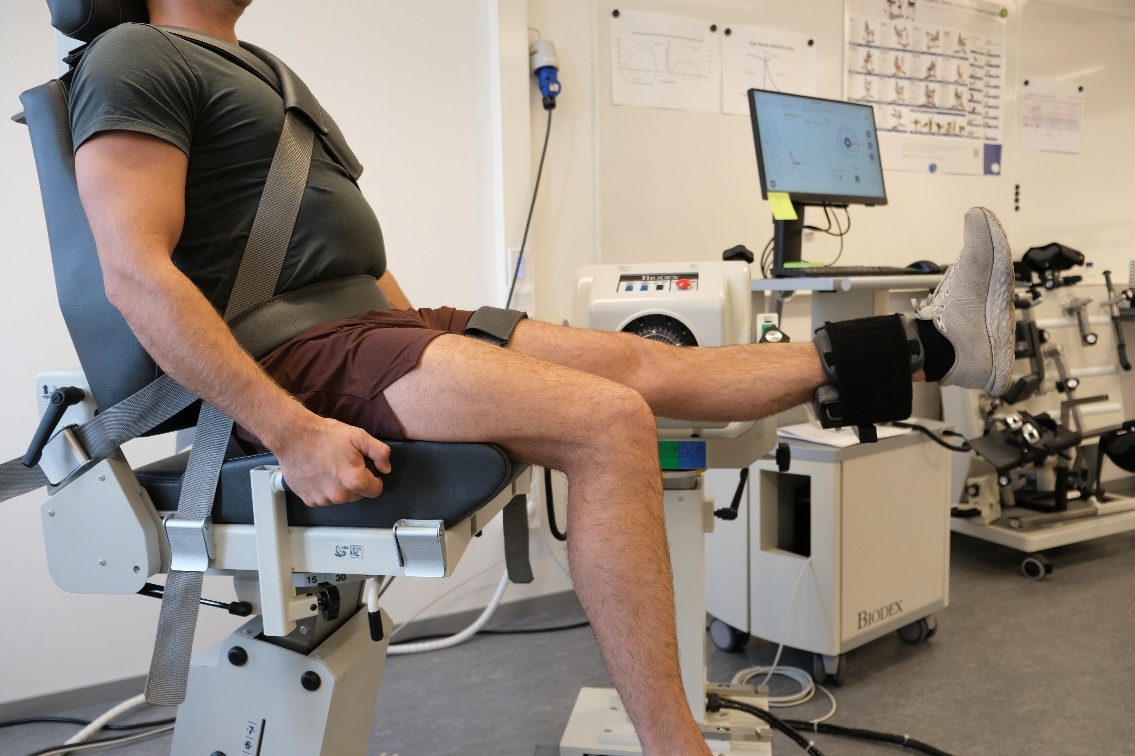
Testing was performed on the dominant lower limb using standardized positions based on the Biodex Multi-Joint System Pro setup and operation manual (test setup, Figure 1). Leg dominance was determined by asking participants which leg they would use to kick a ball. Participants were seated with the hip joint positioned at 85° of flexion. The dynamometer’s axis of rotation was aligned with the lateral femoral epicondyle, and the knee attachment cuff was secured approximately 3 cm above the lateral malleolus. Stabilization straps were applied across the torso, pelvis, and relevant thigh to minimize extraneous movement. The range of motion was set from 0° (full extension) to 100° of flexion. The dominant lower limb was weighed, and gravity correction was performed prior to testing. Each participant completed two submaximal practice repetitions followed by three maximal concentric knee extensions and flexions at 180°/s and 90°/s, performed in that order. Standardized verbal instructions and consistent strong verbal encouragement were provided by the same examiners throughout all maximal efforts during all testing sessions. The selected angular velocities were intended to provide a standardized assessment across a slow–fast velocity spectrum. Specifically, 90°/s was selected to represent a relatively slow, force-oriented contraction while reducing contraction time compared with lower testing velocities, such as 60°/s. The selection of 90°/s also reflected our intention to develop a standardized protocol applicable not only to healthy individuals but also to patients undergoing ACL rehabilitation, whereas 180°/s was selected to represent a higher, more functionally relevant angular velocity while still allowing accurate peak torque assessment. A two-minute rest interval was provided between angular velocities.
STATISTICAL ANALYSES
Continuous variables are presented as means ± standard deviations (SD). The Physical Activity Level Scale score, being ordinal, is reported as median and interquartile range. Relative reliability was assessed using the intraclass correlation coefficient (ICC[2,1]), based on a two-way random-effects model for absolute agreement (single measurement), as this model allows generalization beyond the specific measurement occasions included in the study.21 The ICC values were interpreted as follows: values above 0.90 indicated high reliability; values between 0.80 and 0.89, good reliability; values between 0.70 and 0.79, fair reliability; and values below 0.69 indicated poor reliability.22 Absolute reliability was determined using coefficient of variation (CV) and paired-sample t-tests.23 Sample size: Assuming an expected reliability of ICC = 0.90, a significance level of p = 0.05, and a statistical power of 0.80, the required sample size was estimated at n = 15.24 All analyses were performed using IBM SPSS Statistics (Version 30, IBM Corp., Armonk, NY, USA). The level of significance was set at p < 0.05.
RESULTS
PARTICIPANT DEMOGRAPHICS
All 15 participants (7 women and 8 men; all right-leg dominant) completed the familiarization session and the two test sessions. Their age, height, and body mass were 27 ± 4 years, 172 ± 9 cm, and 76 ± 13 kg, respectively (mean ± SD). The Physical Activity Level Scale25 score [1–4] was 3 [1] (median [interquartile range]). Participants had variable exercise backgrounds, and most were sport science students.
RELIABILITY
ICC values ranged from 0.92 to 0.99 for concentric knee extension and flexion at both 90°/s and 180°/s (95% CI: 0.78–1.00), while CV values ranged from 2.7% to 4.2%. Paired-sample t-tests revealed no significant differences between test and retest sessions (p > 0.05). For a full account of the test–retest reliability analyses, see Table 1.
Further, peak torque was higher for knee extension than flexion (≈90% greater across velocities) and ≈25% higher at 90°/s compared with 180°/s across muscle groups (Table 1).
DISCUSSION
The present study evaluated the test–retest reliability of concentric knee extension and flexion strength assessed at both a slow (90°/s) and a fast (180°/s) isokinetic velocity using the Biodex System 4 Pro in physically active young adults. Assessing performance across multiple velocities is conceptually important, as different angular speeds represent distinct regions of the dynamic velocity spectrum and may reflect partially independent strength qualities. The main finding was that both velocities demonstrated high relative reliability (ICC = 0.92–0.99) and low absolute variability (CV 2.7–4.2%), with no significant systematic differences between test sessions.
The current findings are consistent with previous studies reporting high reliability for isokinetic knee strength testing. Sole et al.3 showed “very high” reliability (ICC ≥ 0.90) for concentric and eccentric knee extension and flexion at 60°/s, although they focused on a single angular velocity and included both peak torque and work outcomes. Tuominen et al.5 extended this work by examining the test–retest reliability of isokinetic ankle, knee, and hip strength using the Biodex System 4 Pro, generally reporting good to excellent ICC values for knee extension and flexion in physically active adults. The present study adds to this body of evidence by demonstrating that excellent reliability is preserved not only at a single, moderate speed but also at a substantially higher angular velocity (180°/s), thereby covering a broader portion of the velocity spectrum. It should also be noted that the confidence interval for knee flexion at 180°/s was somewhat wider than that observed for knee extension. This may reflect the lower absolute torque values generated by the hamstrings, which may result in slightly greater relative variability. Nevertheless, the ICC point estimate remained high (0.92), supporting the excellent reliability of the protocol for knee flexion.
In terms of absolute reliability, the current protocol compares favorably with previous work. Sole et al.3 reported standard errors of measurement corresponding to approximately 5–10% of the mean for peak torque variables. Tuominen et al.5 found coefficients of variation for lower-limb strength that were generally higher than those observed in the present study. By contrast, our CV values ranged from 2.7% to 4.2%, indicating a very small degree of random error between test sessions. This suggests that the standardized warm-up, consistent positioning, strict stabilization, and the use of a familiarization session in the current protocol may have contributed to particularly stable measurements. From a practical perspective, such low variability implies that relatively small changes in torque may reflect true physiological change rather than measurement noise.
The absence of systematic differences between test and retest sessions in the present study, in which all participants completed a familiarization session, also deserves attention. In contrast, Sole et al.3 reported a significant increase in concentric knee extensor torque between sessions, likely reflecting a learning effect or increased confidence during maximal testing. The familiarization session may have contributed to the excellent reliability observed in the present study by reducing learning effects and increasing participant confidence during maximal efforts. Because many patients undergoing postoperative rehabilitation are tested without prior familiarization, clinicians should consider that the reliability observed under standardized research conditions in healthy individuals may not be fully transferable to an initial clinical assessment.
Similarly, Tsiros et al.4 reported an approximate 8% increase in isometric knee extensor torque in children between test sessions, despite high ICC values, and concluded that a learning effect needed to be considered when interpreting longitudinal changes. In the present study, neither knee extension nor flexion at either 90°/s or 180°/s showed significant test–retest differences, suggesting that the familiarization procedures and standardized instructions were sufficient to minimize learning effects in this cohort of physically active adults.
Given the increasing clinical interest in multi-velocity testing paradigms,16 establishing reliability across multiple speeds is a prerequisite. In the present study, both 90°/s and 180°/s demonstrated high reproducibility, supporting the feasibility of standardized dual-velocity protocols. While slower angular velocities are traditionally used to assess maximal strength, higher velocities better reflect functional and sport-specific demands. The present findings therefore provide methodological support for incorporating more than one testing speed in applied settings.
Importantly, these findings are also relevant in the context of ACLR, where isokinetic quadriceps and hamstring strength testing forms a central component of return-to-sport decision-making.12 Recent work supports the value of assessing strength across more than one angular velocity in this population. For example, Drigny et al.19 showed that isokinetic testing performed at two distinct velocities (60°/s and 240°/s) after ACL reconstruction provided additional clinically relevant information compared with single-velocity assessment. Although the present study employed different angular velocities (90°/s and 180°/s), both protocols were designed to assess knee muscle performance across distinct regions of the dynamic velocity spectrum. Nevertheless, these differences in testing velocity should be considered when comparing findings across studies. Together, these findings support the rationale for evaluating knee muscle strength across multiple velocities when monitoring recovery and functional readiness after ACLR. Given that strength deficits and asymmetries have been associated with reinjury risk after ACLR, reliable and standardized assessment across multiple angular velocities is essential to ensure that observed changes reflect true recovery rather than measurement error.16 The present results therefore provide methodological support for the use of dual-velocity isokinetic protocols in ACLR rehabilitation and follow-up.
Previous investigations of multi-velocity isokinetic reliability are limited and have primarily used dynamometer systems other than the Biodex System 4 Pro. For example, Phillips et al.26 assessed torque at 60°/s and 120°/s using a Kin-Com dynamometer in a large adult cohort, reporting reliability coefficients above 0.82. Similarly, Wilhite et al.27 examined reliability across 60°, 120°, and 180°/s using a Kin-Com device, reporting ICC values ranging from 0.76 to 0.95. However, these studies differed in device type, protocol design, and primary aims, limiting direct comparison with the present standardized dual-velocity Biodex protocol.
Taken together, these studies demonstrate that formal reliability data for dual or multi velocity protocols appear to be limited, particularly for the Biodex System 4 Pro, underscoring the novelty and relevance of the present findings. The present results also align with and complement the pediatric reliability work of Tsiros et al.,4 who showed excellent test–retest reliability (ICC ≈ 0.96) for isokinetic knee extensor and flexor torque in children using the Biodex System 4, while highlighting issues related to learning effects and limb dominance. Although the populations differ substantially (children vs. young adults), both studies support the notion that, when appropriately standardized, the Biodex System 4 provides highly reliable assessments of knee strength across different ages. Our data extend this conclusion by demonstrating that multi-velocity protocols can be used reliably in physically active adults, which is particularly relevant for sports medicine and performance testing.
Despite these strengths, several limitations should be acknowledged. First, the sample consisted exclusively of young, physically active adults, which limits generalizability to older individuals, sedentary populations, or patients recovering from injury or surgery. Prior research suggests that reliability may be influenced by neuromuscular status, task familiarity, and motivational factors, which may differ in clinical populations. Second, only peak torque during concentric actions at two angular velocities was examined; eccentric contractions, additional velocities, and alternative outcome variables (e.g., work, rate of torque development, endurance indices) were not assessed. Finally, although the protocol demonstrated excellent reliability for the dominant limb, only one limb was tested, and potential side-to-side differences in reliability remain to be explored.
CONCLUSION
A standardized isokinetic knee strength protocol at 90°/s and 180°/s demonstrated excellent test–retest reliability for concentric knee extension and flexion in physically active young adults. Because different angular velocities reflect distinct aspects of muscle performance, establishing reliability across multiple speeds is methodologically important. The present findings support the use of standardized dual-velocity isokinetic assessment with the Biodex System 4 Pro in both research and applied settings, providing a reliable basis for monitoring rehabilitation progress and evaluating training adaptations.
FUNDING
This research received no external funding.
CONFLICTS OF INTEREST
The authors declare no conflicts of interest.
ACKNOWLEDGMENTS
The authors thank all participants for their contribution to this study.